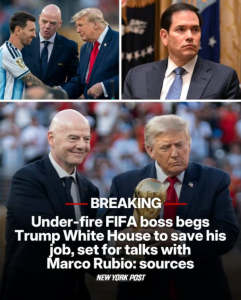
Under-Fire FIFA Boss Gianni Infantino Reportedly Seeks Trump Administration Support Amid Growing Pressure
FIFA President Gianni Infantino is facing one of the most difficult periods of his decade-long leadership after reports emerged that he has sought assistance from the Trump administration as criticism inside world football continues to mount. According to reports first published by the New York Post and later confirmed by Reuters, Infantino has been attempting to secure political backing while confronting growing opposition following the collapse of a controversial proposal involving FIFA’s commercial operations. (Reuters)
The reports claim Infantino has been unable to reach President Donald Trump directly but has instead arranged discussions with U.S. Secretary of State Marco Rubio. Although the scheduled conversation has reportedly been framed as a discussion about the role of soccer as an instrument of American soft power ahead of future international tournaments, sources cited by the reports suggest Infantino is also hoping to strengthen his own political position within FIFA. (Reuters)
The developments come after FIFA abandoned an ambitious and highly controversial proposal to create a new commercial entity that would have managed the governing body’s most valuable assets, including World Cup rights. The proposal reportedly involved selling a minority stake to private investors, a move that generated fierce opposition from football associations and officials across several continents. (New York Post)
According to Reuters and the New York Post, the proposal envisioned a new company that would oversee major FIFA competitions while outside investors would acquire a significant ownership interest in exchange for billions of dollars in funding. Supporters reportedly argued that the investment would accelerate FIFA’s commercial growth and expand football globally.
Critics, however, viewed the proposal very differently.
Many football executives reportedly feared the plan would hand unprecedented influence over the sport’s most valuable competitions to private financial interests. They also questioned the level of transparency surrounding the negotiations and expressed concern that many senior FIFA officials had not been fully informed during the planning process. (Reuters)
The backlash intensified rapidly.
Reports indicate that several major football organizations objected strongly to the proposal, while European football officials discussed coordinated action if the commercialization plan proceeded. Faced with escalating resistance, FIFA ultimately withdrew the proposal before any agreement was finalized. (New York Post)
Although the plan was abandoned, the political consequences for Infantino appear to have continued.
According to the reporting, some officials inside world football have become increasingly critical of the FIFA president’s leadership style, arguing that the episode damaged confidence in FIFA’s governance. Sources quoted in the reports describe mounting internal pressure as Infantino prepares for another presidential election cycle. (Reuters)
The reported outreach to Washington has therefore attracted significant attention.
Infantino and President Trump have maintained a visible working relationship in recent years, particularly as the United States prepares to host major FIFA competitions. The United States has played an increasingly central role in FIFA’s plans, including hosting the expanded Club World Cup and the 2026 FIFA World Cup alongside Canada and Mexico.
Because of that relationship, reports that Infantino sought help from senior U.S. officials immediately became an international story. (Reuters)
Neither FIFA nor the White House immediately confirmed the details of the reported conversations. Reuters noted that requests for comment from both organizations did not receive immediate responses following publication of the story. (Reuters)
Marco Rubio’s reported involvement has also generated interest because he serves as one of the Trump administration’s most senior foreign-policy officials. According to the reports, the planned discussion was expected to focus publicly on international cooperation surrounding football and America’s role in global sporting events, though unnamed sources suggested broader political considerations may also be involved. (Reuters)
The controversy arrives during an important period for FIFA.
Preparations continue for future international tournaments that will attract millions of visitors and billions of television viewers worldwide. Any instability within FIFA’s leadership could complicate decision-making as organizers continue planning major competitions.
Supporters of Infantino point to several accomplishments during his presidency.
Since taking office in 2016, he has overseen expansion of both the men’s and women’s World Cups, increased FIFA revenues, and promoted investment in football development programs across many nations. He has frequently argued that expanding competitions creates more opportunities for emerging football countries while generating additional revenue that can be reinvested throughout the sport.
His critics, however, contend that FIFA under his leadership has become increasingly centralized and politically driven. Some have questioned governance decisions, transparency, and the organization’s growing relationship with political leaders around the world.
These disagreements have surfaced repeatedly during recent FIFA congresses and executive meetings, illustrating broader debates over the future direction of world football.
The reported commercial proposal appears to have intensified those existing concerns rather than creating them from scratch.
Observers note that FIFA’s commercial rights represent some of the most valuable assets in international sports. Television contracts, sponsorship agreements, licensing arrangements, and digital media rights generate billions of dollars every World Cup cycle.
Any proposal involving ownership of those assets is therefore likely to attract extraordinary scrutiny from national football associations and other stakeholders.
According to published reports, opposition became so widespread that continuing with the proposal risked creating long-term divisions inside international football, contributing to FIFA’s decision to abandon the initiative. (New York Post)
Whether the controversy ultimately threatens Infantino’s presidency remains uncertain.
While reports describe growing criticism and political maneuvering, no official FIFA vote has removed him from office, and he remains the organization’s president. Leadership contests within FIFA are determined by its member associations, making any future challenge dependent on formal nominations and voting procedures rather than media speculation alone.
For now, attention remains focused on whether Infantino can rebuild confidence among FIFA’s members while continuing preparations for upcoming international competitions.
The reported outreach to the Trump administration highlights how closely international sport and global politics can become intertwined, particularly when tournaments involve multiple governments, billions of dollars in economic activity, and worldwide diplomatic attention.
Regardless of the political dimensions, FIFA’s next steps will likely be watched carefully by football federations, players, sponsors, broadcasters, and fans around the globe.
As preparations continue for future World Cups, the organization faces the dual challenge of maintaining confidence in its governance while delivering successful tournaments that unite the global football community.
Whether Gianni Infantino successfully navigates the current controversy—or whether it marks the beginning of a significant leadership challenge—will likely become clearer in the months ahead as FIFA members evaluate both the abandoned commercial proposal and the broader direction of world football. (Reuters)