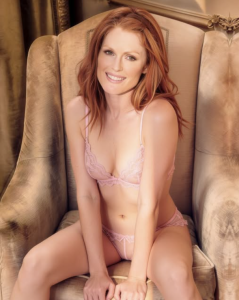
The answer is Julianne Moore.
Photographed on this day in 2002, Julianne Moore was standing at the center of one of the most extraordinary career peaks any modern actor has experienced. In the same year, she delivered two of the most acclaimed performances of her career — The Hours and Far from Heaven — films that showcased the very qualities that have made her one of the most admired actresses of her generation: quiet force, emotional precision, intelligence, and an uncanny ability to make complicated women feel utterly, unmistakably real.
The year everything seemed to converge
For many actors, a single acclaimed film can define a career. Julianne Moore had two major award-season performances in the same year, and they were strikingly different.
In The Hours, she played Laura Brown, a 1950s housewife trapped within the expectations of domestic perfection. Her performance is remarkable for what it withholds: the smallest hesitation, a glance that lingers a fraction too long, the sense of a mind quietly unraveling beneath a composed exterior. Moore understood that Laura’s crisis was not melodramatic but internal, and she conveyed that inner turbulence with extraordinary subtlety.
In Far from Heaven, directed by Todd Haynes, she became Cathy Whitaker, the seemingly ideal suburban wife whose life begins to fracture as she confronts her husband’s hidden sexuality and her own emotional awakening. The film deliberately evokes the lush melodramas of Douglas Sirk, yet Moore never plays Cathy as a nostalgic caricature. She gives her warmth, curiosity, loneliness, and a growing awareness of the rigid social boundaries surrounding her.
Those two performances earned Moore Academy Award nominations in the same year — Best Supporting Actress for The Hours and Best Actress for Far from Heaven — a rare achievement that confirmed what many critics had been arguing for years: she was operating at the highest level of screen acting.
From indie discovery to major talent
What makes Moore’s ascent especially compelling is that she did not arrive as an instant Hollywood sensation. Born Julie Anne Smith in North Carolina in 1960, she spent part of her childhood moving frequently because her father served in the military. That experience of adapting to new environments may help explain the observational quality she brings to her performances; she often seems to study a character from the inside out.
After earning a degree from Boston University, Moore began working in theater and television. Her breakthrough came on the soap opera As the World Turns, where she played dual roles and won a Daytime Emmy Award. Soap operas are sometimes dismissed, but they can be rigorous training grounds: actors must learn speed, emotional clarity, and consistency. Moore emerged from that environment with formidable technical discipline.
Her transition to film accelerated in the early 1990s through independent cinema. Movies such as Short Cuts and Safe announced a performer who was unafraid of ambiguity. In Safe, another collaboration with Todd Haynes, she played a suburban woman suffering from a mysterious environmental illness — or perhaps from something more psychological and existential. The performance is often cited as one of the finest of the decade because Moore resisted every temptation to over-explain the character.
The power of restraint
The clue describes her “quiet force,” and that phrase captures the essence of Julianne Moore’s artistry better than almost any other. She is not an actor who relies on theatrical outbursts. Instead, she creates tension through restraint.
Consider a typical Moore scene: she listens intensely, absorbs what another character says, and allows the audience to witness the thought process unfolding behind her eyes. The emotion is rarely announced; it accumulates. This approach makes her performances feel unusually lifelike because real people often conceal, redirect, or partially understand their own feelings.
That precision is particularly evident in Far from Heaven. Cathy Whitaker lives in a world that demands constant politeness and composure. Moore communicates the character’s growing emotional conflict while maintaining the social mask that the period requires. The result is heartbreaking because we sense the pressure building beneath the surface long before the character can openly acknowledge it.
A collaborator directors cherish
Great directors repeatedly return to actors who can translate complex ideas into human behavior, and Moore became exactly that kind of collaborator. Todd Haynes, Paul Thomas Anderson, Robert Altman, David Cronenberg, The Coen Brothers, and Luca Guadagnino have all recognized her ability to elevate material through nuance.
Her work with Paul Thomas Anderson in Boogie Nights is a perfect example. As porn star Amber Waves, Moore could easily have played the role as flamboyant spectacle. Instead, she found the character’s maternal longing and emotional vulnerability, transforming what might have been a supporting stereotype into one of the film’s emotional anchors.
Similarly, in Magnolia, she delivered a performance of raw desperation that contrasted sharply with the controlled elegance of Far from Heaven. The range between those roles is enormous, yet both feel completely inhabited.
The red-haired icon who changed Hollywood expectations
Julianne Moore also became an important figure simply by existing outside conventional Hollywood templates. With her distinctive red hair, porcelain complexion, and intelligent, slightly unconventional beauty, she did not fit the standard mold of the era’s blockbuster starlets. Rather than diminishing her career, that distinctiveness became one of her strengths.
Audiences came to associate Moore with complexity. When she appeared in a film, viewers expected a character with contradictions, history, and inner life. That reputation is difficult to manufacture; it emerges from years of consistently choosing challenging material.
2002: the perfect snapshot
Why does the photograph from 2002 matter so much? Because it captures a moment when critical acclaim, artistic maturity, and cultural visibility all aligned simultaneously.
She was not merely appearing in prestigious films; she was dominating conversations about acting itself. Critics debated which of her two performances was superior. Award bodies honored her repeatedly. Filmmakers sought her out. And audiences were beginning to recognize that they were witnessing a performer whose work would likely endure beyond the immediate awards season.
In retrospect, 2002 feels less like a sudden peak and more like the moment the industry fully acknowledged what had been building throughout the 1990s.
The years that followed
Moore did not fade after that breakthrough year. She continued to deliver exceptional performances in films such as Children of Men, A Single Man, The Kids Are All Right, and Still Alice.
Still Alice finally brought her the Academy Award for Best Actress, honoring a performance of devastating clarity as a linguistics professor confronting early-onset Alzheimer’s disease. Many observers viewed the Oscar not simply as recognition for one film but as acknowledgment of an extraordinary body of work.
Why she remains so admired
What ultimately separates Julianne Moore from many celebrated actors is consistency. Across independent dramas, studio productions, thrillers, science fiction films, and intimate character studies, she maintains the same commitment to psychological truth.
She rarely seems interested in appearing “important.” Instead, she focuses on understanding how a character thinks, what she fears, what she hides, and what she cannot quite say aloud. That attention to interior life is why her performances linger in memory long after plot details fade.
So when we look at that 2002 photograph, we are seeing Julianne Moore at the height of a remarkable artistic moment: the actress who, in the same year, gave unforgettable performances in The Hours and Far from Heaven, and who transformed quiet observation into one of the most powerful acting styles of modern American cinema.