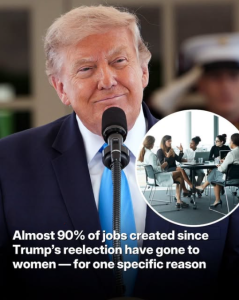
Almost 90% of Jobs Created Since Trump’s Reelection Have Gone to Women — Here’s One Reason Analysts Say That Could Happen
Employment reports often produce headlines that appear surprising at first glance. One such claim is that nearly 90% of the jobs created since President Donald Trump’s reelection have gone to women, prompting questions about whether this reflects a major shift in the labor market, a change in hiring practices, or broader economic trends.
If employment data were to show such an outcome over a given period, economists would caution against drawing quick political conclusions. Labor markets are shaped by dozens of factors—including which industries are expanding, seasonal hiring patterns, workforce participation rates, demographics, and the pace of recovery in different sectors. Rather than indicating that employers are favoring one gender over another, the numbers may simply reflect where job growth is occurring.
Understanding Employment Statistics
Monthly employment reports are among the most closely watched indicators of economic health. They measure how many jobs have been added or lost across industries such as healthcare, construction, manufacturing, education, hospitality, finance, technology, and government.
These reports also break down employment by age, race, education level, and gender.
When one demographic accounts for a disproportionate share of new jobs over a short period, economists typically look first at which industries are hiring, rather than assuming a change in hiring preferences.
Healthcare Continues to Expand
One of the strongest drivers of employment growth in recent years has been healthcare.
Hospitals, outpatient clinics, nursing facilities, home healthcare agencies, and medical practices have consistently hired workers to meet growing demand from an aging population.
Women have historically represented a large share of employment in healthcare occupations, including:
- Registered nurses
- Medical assistants
- Physical therapists
- Occupational therapists
- Healthcare administrators
- Pharmacists
- Home health aides
- Medical office staff
As these industries expand, women naturally account for a larger percentage of newly created positions simply because they already make up much of the workforce.
Education Hiring
Education has also remained an important source of employment growth.
Public schools, private schools, colleges, universities, and early childhood education programs regularly hire teachers, counselors, administrators, and support staff.
Women continue to represent the majority of employees in many educational professions.
Consequently, periods of increased hiring within education often result in a greater proportion of jobs going to women.
Hospitality and Service Industries
Restaurants, hotels, tourism businesses, entertainment venues, and personal service industries also employ millions of women.
If consumer spending strengthens, businesses in these sectors frequently increase hiring.
Even modest improvements across multiple service industries can significantly influence national employment statistics.
Labor Force Participation
Another factor economists consider is labor force participation.
Not everyone of working age is actively seeking employment.
When more women enter or re-enter the workforce—perhaps after raising children, completing education, or responding to improved job opportunities—they become available to fill newly created positions.
Higher participation alone can increase the number of women obtaining jobs without implying any change in employer preferences.
Manufacturing and Construction
Some traditionally male-dominated industries, including manufacturing, construction, mining, and transportation, may experience slower hiring during certain periods.
If those sectors expand less rapidly than healthcare and education, overall employment growth may appear disproportionately concentrated among women.
Again, this reflects industry composition rather than intentional gender imbalance.
Economic Policy and Employment
Every presidential administration highlights favorable employment reports as evidence supporting its economic agenda.
Supporters of President Trump have argued that policies emphasizing tax reductions, deregulation, domestic investment, and manufacturing incentives encourage business expansion and hiring.
Critics, meanwhile, often point out that employment trends result from a combination of factors, including Federal Reserve policies, global economic conditions, demographic changes, technological innovation, and long-term market forces that extend beyond any single administration.
Most economists agree that labor markets are influenced by multiple overlapping variables rather than one policy alone.
Why Headlines Can Be Misleading
Statistics presented without context may create misleading impressions.
For example, saying “90% of new jobs went to women” does not necessarily mean:
- Men lost jobs.
- Employers favored women over men.
- Government required gender-based hiring.
- Women received 90% of all existing jobs.
Instead, the statistic would refer only to the net increase in employment over a particular reporting period.
If 100,000 new jobs were created and 90,000 happened to be filled by women, the headline would be technically accurate—but the explanation would require much deeper analysis.
Long-Term Workforce Changes
The American workforce has undergone significant transformation over recent decades.
Women now represent nearly half of all workers nationally and constitute majorities in several professional fields.
College graduation rates among women have also increased substantially over the past generation, expanding opportunities in medicine, law, finance, education, engineering, and management.
As industries evolve toward knowledge-based and service-oriented work, employment growth increasingly occurs in occupations where women already participate at high levels.
Demographic Influences
Population aging also contributes to employment patterns.
As more Americans reach retirement age, demand increases for healthcare, assisted living, rehabilitation services, and elder care.
These industries employ millions of workers, many of whom are women.
Consequently, demographic trends can shape employment statistics regardless of political leadership.
Regional Differences
Job growth is not evenly distributed across the country.
Some states experience rapid expansion because of population growth, infrastructure investment, tourism, or energy development.
Others face slower growth due to changing industries or demographic shifts.
The types of businesses expanding in each region influence which occupations—and therefore which demographic groups—benefit most from hiring.
Economic Opportunity for Everyone
Most economists emphasize that healthy labor markets ultimately benefit everyone.
Strong employment means more households earning income, increased consumer spending, higher tax revenues, and improved business confidence.
Rather than viewing employment gains as competition between men and women, many analysts see workforce growth as a positive sign when opportunities expand across multiple industries.
Both men and women contribute essential skills throughout the economy.
Interpreting Employment Data Responsibly
Readers should be cautious when encountering dramatic employment headlines.
Important questions include:
- What time period does the statistic cover?
- Which industries added the most jobs?
- Were seasonal adjustments applied?
- How does the data compare with previous months?
- What happened to labor force participation?
- Were revisions made to earlier reports?
Looking beyond a single headline often provides a clearer understanding of broader economic trends.
The Bigger Picture
Employment statistics are snapshots rather than complete portraits of the economy.
One month may show unusually strong hiring in healthcare.
Another may feature construction booms following infrastructure projects.
Later reports may highlight manufacturing expansion or technology hiring.
Each reflects changing economic conditions rather than permanent shifts.
Conclusion
If nearly 90% of newly created jobs over a particular period were filled by women, the most likely explanation would be the mix of industries experiencing the fastest growth, along with labor force participation trends and demographic factors—not necessarily a deliberate shift in hiring practices.
Political leaders from every administration understandably emphasize favorable economic indicators. At the same time, economists generally encourage looking beyond headline numbers to understand the structural forces shaping employment.
Ultimately, the strength of an economy is measured not by whether one group outpaces another in a single report, but by whether opportunities continue expanding for workers across all backgrounds, industries, and communities. Sustainable economic growth depends on a diverse workforce, productive businesses, sound public policy, and the ability of people to find meaningful employment that supports their families and contributes to long-term prosperity.