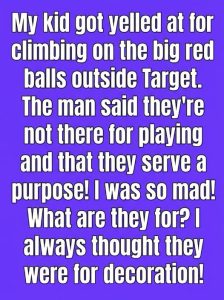
What Are the Big Red Spheres Outside of Target Really For?
If you’ve ever walked into a Target, chances are you’ve seen them: enormous bright-red spheres sitting outside the entrance, usually between the sidewalk and the store.
They look playful. They match Target’s famous red branding. Children sometimes want to climb on them, shoppers occasionally sit on them while waiting for someone, and they have even become popular photo props.
But those giant red objects aren’t primarily decoration.
They’re bollards—and their main purpose is safety.
The unusual design is part of what makes Target’s spheres so recognizable, but the basic idea behind them is serious: they create a physical barrier between vehicles and pedestrians and help prevent cars or trucks from reaching the storefront. (Allrecipes)
So why did Target choose giant red balls instead of ordinary metal posts?
And what happens when someone actually tries to climb on one?
They’re not really “balls”
The first surprise is that the objects aren’t simply oversized decorations.
They’re bollards, a general term for barriers designed to control or prevent vehicle access.
Bollards come in many forms. You may see short concrete posts, steel cylinders, heavy-duty barriers or other structures outside stores, restaurants, government buildings and pedestrian areas.
Target’s version is distinctive because it uses a spherical shape.
The spheres are made from heavy material, including concrete in documented Target locations, and they’re positioned strategically around the storefront. A federal court document describing a Target location in Florida, for example, specifically referred to four large, spherical concrete bollards painted bright red. (Middle District Court FL)
Their unusual shape is therefore not an accident.
Their most important job is stopping vehicles
Imagine a driver accidentally pressing the accelerator instead of the brake.
Or imagine a vehicle losing control in a parking lot.
Without a physical barrier, a vehicle could potentially jump the curb, cross the pedestrian area and collide with the entrance or windows.
That is where the red spheres come in.
They’re designed to make it much harder for a vehicle to reach the building.
Safety expert Cathy Pedrayes explained the basic purpose of Target’s red spheres in a widely circulated video, describing them as bollards intended to prevent cars or trucks from driving into the store. (iHeart)
That means the balls aren’t simply there to make the entrance look more attractive.
They serve a practical security function.
They can also provide protection against intentional vehicle attacks
There is another reason bollards are valuable around retail stores.
Unfortunately, vehicles can sometimes be used deliberately to break through storefronts.
In a so-called smash-and-grab burglary, criminals may drive a vehicle through a door or window, quickly enter the business, take merchandise and escape.
A sturdy barrier can make that strategy significantly more difficult.
Pedrayes has also pointed out that bollards can help protect stores against intentional vehicle incursions, not merely accidental crashes. (iHeart)
That doesn’t mean every Target ball is designed to stop every possible vehicle impact. The effectiveness of any barrier depends on its construction, anchoring, spacing and the force involved.
But the principle is straightforward:
Put something strong between moving vehicles and pedestrians or buildings.
So why are Target’s bollards round?
This is where safety meets branding.
Most people associate Target with a red bullseye.
The company’s logo is circular, so giant red spheres naturally fit the visual identity of the retailer.
A conventional gray metal post might perform the same basic protective function, but it wouldn’t look nearly as much like a Target feature.
Pedrayes explained that Target made the bollards round for branding while still giving them a genuine safety purpose. (iHeart)
It’s a clever combination.
The company gets a recognizable architectural feature while shoppers get a physical barrier between the parking area and storefront.
In other words, the spheres are both functional and visually distinctive.
Why do people think they’re decorative?
That’s easy to understand.
Look at one from a distance.
It’s bright red.
It’s perfectly round.
It resembles a giant playground ball.
It’s positioned in front of a retail store whose logo is also a circle.
Nothing about its appearance immediately screams “vehicle-security barrier.”
Traditional bollards look industrial. A metal post tells you exactly what it is.
Target’s spheres are much more playful.
That’s probably why so many people have spent years wondering what they’re actually for.
One survey of the internet’s fascination with the spheres found that shoppers routinely assumed they were decorative objects or convenient places to sit. (Y94)
The truth is much more practical.
And yes, people really do sit on them
There’s another reason the spheres can be confusing.
They’re approximately the right height and shape for someone to sit on.
People sometimes use them as temporary seats while waiting outside a store.
Others pose for photographs.
Some children try to climb onto them.
That isn’t what they’re designed for.
A bollard is a safety barrier, not playground equipment.
And the fact that the spheres look harmless doesn’t mean they are safe to climb.
Children have been injured
The playful appearance of the spheres has actually become part of the safety controversy surrounding them.
A federal court case involving a Florida Target described an incident in which a child attempted to climb onto one of the red spheres and fell, suffering fractures to her forearm that required surgery. The lawsuit alleged that the spheres’ shape and bright color could attract children to climb on them. (Middle District Court FL)
Other reporting has described similar concerns involving children interacting with the structures. (Allrecipes)
This creates an interesting contradiction.
The objects are installed to protect people from vehicles, but because they look like giant toys, some people may treat them as something to climb or play on.
That is an important reminder that appearance can influence behavior.
Target has even dressed them up
The red spheres have become such recognizable parts of Target’s identity that they’ve occasionally been incorporated into marketing campaigns.
In 2016, for example, select Target stores transformed their bollards into giant Pokémon Poké Balls during the height of the Pokémon Go craze. (GameSpot)
The idea worked precisely because shoppers already recognized the spherical objects.
Target didn’t need to build something new.
It could simply transform an existing safety feature into a temporary piece of advertising.
That is a perfect example of how the spheres have evolved beyond their basic practical function.
They’re now part of the visual language of the brand.
They’ve become internet-famous
The red spheres have also developed a strange little celebrity status.
Back in 2014, an Alabama couple became known for taking creative photographs with Target’s red balls every day for a year. Their project, associated with the hashtag #TargetBalling, turned an otherwise ordinary piece of store infrastructure into an internet novelty. (Allrecipes)
That may sound ridiculous—and that’s precisely why it worked.
People rarely take pictures with ordinary safety posts.
But a gigantic red sphere is different.
It’s unusual enough to become part of the experience of visiting Target.
For many shoppers, the balls have become a recognizable part of the trip itself.
They’re part of a much larger safety concept
The Target spheres also illustrate something important about modern retail design.
A store entrance isn’t just about doors and signs.
Designers have to think about what happens when thousands of people and hundreds of vehicles interact in the same space every day.
Cars move through parking lots.
Pedestrians cross sidewalks.
Shopping carts travel in every direction.
Delivery vehicles arrive.
Drivers may become distracted.
Someone might accidentally hit the gas pedal.
And in rare cases, someone may intentionally drive toward a building.
Physical barriers help separate those different activities.
That’s why you can see bollards in front of many kinds of businesses—not just Target.
Target’s design is simply much more memorable.
The red color serves another useful purpose
The color itself also helps the spheres stand out.
Bright red is difficult to miss, particularly against gray pavement and concrete.
That can help pedestrians and drivers recognize that the objects are there.
Of course, the spheres’ exact appearance, placement and construction can vary from one location to another. Not every Target has the same number or configuration.
Some stores may use different barriers because of local building requirements, parking-lot layouts or renovations.
But where the iconic red spheres are present, their basic role remains the same: creating a barrier between vehicles and people or the building.
They aren’t indestructible
It’s important not to misunderstand what a bollard can do.
A heavy barrier isn’t a magical shield.
A sufficiently large or fast vehicle can potentially move, damage or break almost any structure.
The goal is to reduce risk, not to guarantee that a building can never be struck.
There have even been reported incidents involving Target’s red bollards themselves. One 2017 report described a case in which a bollard reportedly became dislodged and struck a vehicle. (Allrecipes)
That illustrates why these structures need proper installation and maintenance.
A safety barrier only works properly if it remains securely anchored and maintained.
Why you shouldn’t climb on them
The most practical lesson for shoppers is simple:
Don’t treat the red spheres like playground equipment.
They may look sturdy—and they are—but their smooth, rounded surface isn’t designed for climbing.
A person can easily lose their balance.
Children in particular may see a giant red ball and instinctively want to climb onto it.
Parents should therefore discourage children from treating the spheres as toys.
The fact that something is made of concrete doesn’t make it safe to climb.
The next time you see one, look at the parking lot
The next time you visit Target, take a moment to look at the red spheres differently.
Instead of seeing oversized decorations, notice where they’re positioned.
They’re often placed along the pedestrian edge of the property, near entrances or storefront areas where vehicles might otherwise reach the building.
Suddenly, their purpose becomes obvious.
They’re creating a physical separation between two very different environments:
moving vehicles and people on foot.
The design may be playful, but the purpose is serious.
The surprising combination of safety and branding
That’s ultimately what makes Target’s red spheres so interesting.
They’re a rare example of infrastructure becoming part of a company’s identity.
A normal bollard is something most people barely notice.
Target turned its bollards into something instantly recognizable.
The company effectively took an ordinary safety concept and gave it a distinctive personality.
The result is a piece of store design that performs an important job while simultaneously reinforcing the brand.
And because the spheres look so unusual, they have become objects of curiosity in their own right.
The bottom line
So, what are the big red spheres outside Target really for?
They’re bollards—heavy protective barriers designed primarily to help keep vehicles away from pedestrians and the storefront. They can help reduce the danger posed by accidental vehicle movements and can also make intentional vehicle break-ins more difficult. (iHeart)
Their red color and spherical shape fit Target’s distinctive visual identity, which is why they look more like giant versions of the company’s bullseye than conventional security equipment.
They have since become part of the Target experience, appearing in photographs, internet memes, marketing campaigns and even Pokémon-themed promotions. (GameSpot)
But beneath all the jokes and selfies is a very practical purpose.
Those giant red “balls” are there because a parking lot can be a dangerous place when moving vehicles and pedestrians share the same space.
So the next time you walk past one, don’t just see a giant red sphere.
See the safety barrier hiding in plain sight.
And if you’re tempted to climb on it for a photograph, remember what it’s actually there to do: protect you—not entertain you.