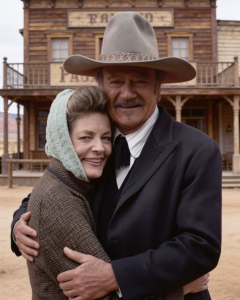
The two Hollywood legends are John Wayne and Lauren Bacall, and the 1976 film is The Shootist.
Released on July 21, 1976, The Shootist is widely regarded as one of the greatest farewell films ever made. It was not simply another Western starring John Wayne; it became the actor’s final screen performance, giving the movie an emotional resonance that audiences felt immediately and that has only deepened with time. When viewers watched Wayne portray an ageing gunfighter confronting mortality, they were also watching a legendary star confronting the end of his cinematic journey.
And beside him stood Lauren Bacall, bringing intelligence, restraint, and a lifetime of Hollywood sophistication to the role of Bond Rogers, the boarding-house owner who offers the gunfighter a rare glimpse of dignity and human connection during his final days.
A film that knew it was saying goodbye


6
What makes The Shootist extraordinary is that it understands its own mythology. Directed by Don Siegel, the film follows J.B. Books, a famous gunfighter who arrives in Carson City, Nevada, in 1901 after learning that he is dying of cancer. The Old West is disappearing, and so is the kind of man who once defined it.
That premise mirrors John Wayne’s position in American culture. For decades, he had been the towering face of frontier cinema — the embodiment of rugged individualism, courage, and the mythic American West. By 1976, both Wayne and the classical Western era were nearing their end.
The film does not romanticize that fact. Instead, it asks a painful question: What happens to a legend when the world no longer has a place for legends?
John Wayne: the frontier made flesh
To understand the emotional power of The Shootist, you have to understand what John Wayne represented.


6
From Stagecoach to Red River, The Searchers, Rio Bravo, and True Grit, Wayne did not merely star in Westerns; he helped define the genre’s visual and moral vocabulary. His walk, his voice, his physical presence, and his screen authority became instantly recognizable around the world.
By the mid-1970s, however, Wayne’s health had deteriorated significantly. He had undergone major cancer surgery years earlier, and audiences were aware that the actor they were watching was genuinely fragile. That knowledge transforms every scene in The Shootist. When J.B. Books struggles physically, it is impossible not to see the man behind the legend.
Wayne gives one of the most nuanced performances of his career here. The bravado is still present, but it is tempered by exhaustion, reflection, and an almost startling vulnerability.
Lauren Bacall: cool intelligence meets frontier grit
The clue describes her perfectly: one of classic Hollywood’s sharpest, coolest leading ladies.
Lauren Bacall became a star in To Have and Have Not, where her chemistry with Humphrey Bogart created one of cinema’s great screen pairings. Her low voice, raised eyebrow, and effortless wit made her the very definition of sophisticated cool.


7
What is remarkable about The Shootist is how naturally Bacall fits into a Western setting. Bond Rogers is not a decorative romantic interest. She is a practical woman running a boarding house, raising a son, and trying to maintain stability in a changing world. Bacall plays her with warmth, skepticism, humor, and quiet strength.
Her scenes with Wayne are the emotional center of the film. Neither actor needs grand declarations. A shared glance across a dinner table, a conversation about pain, or a moment of mutual understanding carries the weight of two entire careers.
Old-movie royalty sharing the screen
One reason the film feels so special is that it unites performers who symbolize different golden-age traditions.
- John Wayne represents the epic American frontier.
- Lauren Bacall represents the sophisticated studio-era star system and film noir elegance.
Together, they create a chemistry based not on youthful passion but on recognition. Their characters see each other clearly: a dying man trying to preserve his dignity and a woman intelligent enough to understand what that dignity costs.
That maturity is rare in Hollywood cinema, especially in Westerns, which often focus on action rather than emotional intimacy.
The supporting cast of legends
The Shootist is filled with remarkable actors.


4
The cast includes:
- James Stewart as the doctor who delivers the fatal diagnosis,
- Ron Howard as Gillom Rogers, the young man who idolizes J.B. Books,
- Richard Boone,
- Harry Morgan,
- and Hugh O’Brian.
The film almost feels like a gathering of Hollywood history itself, with veteran stars passing the torch to a new generation.
The famous opening montage
One of the movie’s most brilliant choices is its opening sequence. Don Siegel uses actual footage from John Wayne’s earlier Westerns to establish J.B. Books’s legendary reputation. We see the younger Wayne in black-and-white classics, then transition to the older, frailer man arriving in Carson City.
It is a cinematic acknowledgment that the character and the actor have become inseparable. The audience is invited to bring decades of memories into the film.
A Western about mortality, not gunfights
Although The Shootist contains action, its true subject is mortality.
J.B. Books spends much of the film trying to avoid becoming a spectacle. He does not want to die slowly in bed, consumed by pain and watched by strangers. He wants control over the ending of his story.
That desire gives the final act its tragic inevitability. The famous saloon confrontation is thrilling, but it is also heartbreaking because we understand that Books is not fighting for victory; he is fighting for the right to leave the world on his own terms.
The final performance
John Wayne died in 1979, only three years after the film’s release. Knowing that makes the closing moments almost unbearable for many viewers.

When the camera lingers on Wayne in those final scenes, cinema is not just recording a fictional gunfighter. It is recording the last chapter of one of the medium’s most iconic careers.
Critics who had sometimes dismissed Wayne as merely a movie star were forced to reckon with the depth of feeling he brought to the role. The Shootist became a powerful reminder that screen presence itself can be a form of artistry.
Why the film endures
Nearly fifty years later, The Shootist remains beloved because it functions on multiple levels:
- a compelling Western,
- a meditation on aging,
- a study of masculine myth,
- a portrait of dignity in decline,
- and a genuine cinematic farewell.
The warmth between Wayne and Bacall prevents the film from becoming merely elegiac. Their scenes provide humor, tenderness, and the sense that even legends need companionship.
So, can you name them?
Yes — the two Hollywood legends are John Wayne and Lauren Bacall, and the 1976 film is *The Shootist*.
Released on July 21, 1976, this late-career Western brought together the towering face of American frontier cinema and one of classic Hollywood’s coolest, sharpest leading ladies. As J.B. Books and Bond Rogers, they infused the film with warmth, grit, and unmistakable old-movie royalty, turning The Shootist into far more than a Western: it became one of the most moving farewells in film history.