Trump Embraces Teary-Eyed Mom of 12-Year-Old Boy Shot Dead on NYC Street
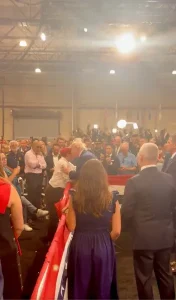
A deeply emotional moment unfolded during President Donald Trump’s appearance on Long Island when he stepped away from his remarks to embrace the grieving mother of 12-year-old Jacob Freytes, a Bronx boy killed by a stray bullet while riding his bicycle.
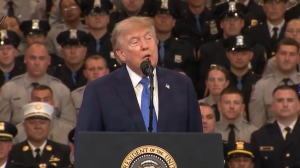
Migdalia Martinez, Jacob’s mother, was visibly emotional as Trump approached her and offered a hug. The encounter came during a law-enforcement-focused event at the Nassau County Police Academy in Garden City, where Trump was speaking about crime and public safety. The president also greeted Jacob’s father, Jesus Freytes, before returning to the stage.
For the family, however, the moment was not primarily about politics. It was about a child whose life had been cut short and a mother left to cope with an unimaginable loss.
Jacob was killed in July in the Bronx after gunfire erupted outside a bodega. According to police, he was an innocent bystander who happened to be riding his bicycle when he was struck by a bullet. His death shocked the neighborhood and generated renewed debate about gun violence and public safety in New York City.
A child caught in the wrong place
Jacob’s death was particularly devastating because authorities say he was not the intended target of the shooting.
Police said the boy was riding his bike near 104 Elliot Place in the Mount Eden section of the Bronx on the afternoon of July 25 when gunfire broke out. Officers responding to a 911 call found three male victims suffering from gunshot wounds. Jacob, only 12 years old, was transported to a hospital but died from his injuries.
The two other shooting victims, both adults, survived.
Authorities later arrested 45-year-old William Ferrer in connection with the shooting. Police said he faces charges including second-degree murder, first-degree manslaughter, attempted murder, assault and criminal possession of a weapon. Investigators were continuing to examine the circumstances and motive surrounding the shooting.
For Jacob’s family, the legal terminology cannot capture the enormity of what happened.
A child who had left home on his bicycle would never return.
A mother left with grief and questions
In the days following Jacob’s death, Martinez spoke publicly about her son and the impact his killing had on the family.
She described a child who had dreams and a future that should have stretched decades ahead of him. His death left his parents facing the painful reality that they would never see him grow older.
Jacob’s father was a retired NYPD sergeant, and his mother has said that her son looked up to his father and wanted to become a police officer himself. That detail has made the tragedy even more poignant: the boy who dreamed of protecting others became the victim of the very violence that police officers work to prevent.
Hundreds of people gathered for Jacob’s funeral in early August. The ceremony reflected how deeply the shooting had affected the surrounding community. Loved ones gathered around his mother, while police officers stood nearby and mourners lined the streets outside the funeral home.
For a family accustomed to seeing a child running, laughing and riding his bicycle, the sudden silence left behind by his death was devastating.
Trump’s emotional gesture
During Trump’s Long Island appearance, Jacob’s parents were brought into the public spotlight.
Trump had been discussing crime reduction and law enforcement when he walked away from the lectern to meet them. He embraced Martinez as she cried and then greeted Jacob’s father.
The brief interaction was striking because it interrupted the political rhythm of the event. For those moments, campaign themes and statistics gave way to a grieving family.
Trump called Jacob’s death a horrible tragedy and used the case to argue for tougher approaches to crime. He has also criticized New York’s criminal-justice policies and specifically targeted bail-reform rules championed by Gov. Kathy Hochul.
The event therefore carried both a personal and political dimension.
The personal dimension was unmistakable: a mother grieving her son.
The political dimension centered on the question of how New York can prevent another child from becoming an innocent victim of street violence.
“Jacob’s Law”
Martinez has not limited her response to mourning.
She has also begun advocating for changes to New York’s criminal-justice system, calling for severe punishment for people convicted of killing children. Her campaign has been associated with a proposed measure known as “Jacob’s Law,” which she hopes would honor her son while strengthening penalties for violent criminals who kill minors.
The proposal reflects how grieving families sometimes transform personal tragedy into public advocacy.
For Martinez, legislation cannot bring Jacob back. But she appears determined to ensure that his death leads to something that could protect other children.
Her position is rooted in a simple fear: no parent should have to receive the news that their child was killed because someone else chose to use a gun in the middle of a neighborhood.
A neighborhood shaken by violence
The shooting also affected people who did not know Jacob personally.
A child being killed in broad daylight while riding a bicycle is the kind of event that can alter how an entire community views its streets. Parents may become more cautious about allowing children to play outside. Residents may wonder whether a familiar corner is still safe. Witnesses may struggle with what they saw.
Jacob’s killing occurred in a place where ordinary life was unfolding: people were outside, businesses were operating and children were moving through the neighborhood.
Then gunfire changed everything.
That is one of the most disturbing aspects of random or stray-bullet violence. Victims do not have to be involved in an argument or connected to the people responsible. They can simply be present.
The broader debate over crime
Trump used the appearance to emphasize his argument that aggressive policing and tougher criminal-justice policies are necessary to reduce violent crime.
He praised Nassau County law enforcement and cited crime statistics while criticizing Hochul and New York’s approach to bail and public safety. ABC7 New York reported that Trump said Nassau County had experienced a major reduction in crime and described it as the safest county in the nation.
The political debate over crime is complicated, with disagreements over policing, sentencing, bail reform, gun laws and rehabilitation.
But Jacob’s family occupies a different emotional space within that debate.
For them, the question is not theoretical.
They are living with the consequences of a shooting that took their child.
Remembering Jacob as more than a headline
One danger in covering violent crime is that victims can become reduced to numbers.
Jacob was not simply “a 12-year-old shooting victim.”
He was a son.
He was a child with parents who loved him.
He was a boy who rode a bicycle through his neighborhood.
He reportedly admired his father and dreamed of becoming a police officer.
Friends and relatives remember him as a young person with a personality, relationships and ambitions. Those details matter because they restore humanity to someone whose life can otherwise become compressed into a few sentences in a news report.
His death was not merely another statistic.
It was the destruction of an entire future.
The role of law enforcement
The case has also drawn attention to the work of New York police investigators.
Authorities arrested Ferrer less than a day after the shooting, according to police information reported by Fox 5. Detectives continued working to establish the circumstances surrounding the gunfire and determine the appropriate charges.
For Jacob’s father, a former NYPD officer, the investigation likely carried a particularly painful significance.
Having spent a career associated with protecting New Yorkers, he was forced into the role of a father seeking answers after his own son was killed.
That contrast underscores the randomness and cruelty of the incident.
A moment that resonated beyond politics
Trump’s embrace of Martinez was brief, but the image carried enormous emotional weight.
A mother stood grieving the child she had lost.
A president stood before her, offering physical comfort while speaking publicly about the violence that had taken her son.
Some observers will interpret the moment through a political lens, especially because it occurred during an event supporting Bruce Blakeman, Nassau County’s Republican executive who is challenging Hochul in the governor’s race.
Others will see it primarily as a human interaction.
Both realities can exist at once.
Politics surrounded the event, but grief was at its center.
The painful reality of innocent victims
Jacob’s death also demonstrates why gun violence can be so frightening for ordinary families.
A person does not have to seek trouble to encounter it.
A child can simply ride a bicycle down a familiar street.
A parent can send a son out to buy something or visit a friend.
And an eruption of violence involving other people can suddenly change an entire family’s life.
That is the fear behind many calls for stronger public-safety measures.
At the same time, debates over how best to prevent violence remain politically contentious. Different officials and communities disagree about which combination of policing, sentencing, gun restrictions, social programs and criminal-justice reforms is most effective.
Jacob’s family, however, is unlikely to find comfort in political arguments.
They want their son remembered.
They want accountability.
And they want other parents to be spared the experience they are now enduring.
A mother’s determination
Martinez’s decision to speak publicly about Jacob suggests that grief has not silenced her.
Instead, she has used her son’s name to call for action.
Her support for “Jacob’s Law” is an attempt to turn personal heartbreak into a lasting legacy. Whether lawmakers ultimately adopt the measure or not, the campaign ensures that Jacob’s story remains connected to a larger conversation about violence against children.
That may become one of the ways his family carries his memory forward.
The pain will not disappear simply because a law changes. No legislation can restore a lost child.
But for a grieving parent, the possibility that another family might be spared the same suffering can provide a reason to keep speaking.
A tragedy that should not be forgotten
The emotional meeting between Trump and Jacob’s mother lasted only moments, but it represented something larger than a photograph or political appearance.
It brought attention back to a 12-year-old boy whose life ended far too soon.
Jacob Freytes should be remembered not only for the circumstances of his death, but for the life he was beginning to build.
He was a child with dreams, a family and a future.
His mother now carries the burden of remembering that future while fighting for changes she believes could prevent another tragedy.
Trump’s embrace offered a brief moment of compassion amid an otherwise intensely political event. But the deeper story belongs to Jacob’s family and to the Bronx community that mourned him.
Their grief cannot be measured in crime statistics or political talking points.
It is measured in an empty place at home, a bicycle that will no longer be ridden and a mother’s tears for a child who should have had many more years ahead of him.
For Martinez, the hope is that Jacob’s name will ultimately stand for more than the violence that took him.
It will stand for a demand that children be able to ride their bikes, walk through their neighborhoods and live ordinary lives without becoming innocent victims of someone else’s gunfire.
And that is perhaps the most powerful message to emerge from the emotional encounter: behind every debate about crime is a human life, and behind every statistic is a family that has to live with what happened long after the cameras leave.