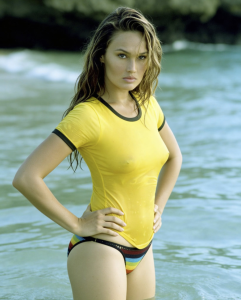
The Hawaiian-born actress and singer is Tia Carrere.
Photographed on this day in 1998, Carrere was already far more than a beautiful movie face. By then she had built a career that blended comedy, action, television adventure, and genuine musical talent — a rare combination that made her one of the most distinctive performers of the 1990s.
Most audiences first fell in love with her as Cassandra Wong in Wayne’s World (1992), the glamorous rock frontwoman who instantly caught Wayne Campbell’s eye. With her leather-clad stage presence, powerhouse singing voice, and razor-sharp comic timing, Carrere became one of the film’s breakout stars and helped turn a quirky Saturday Night Live sketch adaptation into a cultural phenomenon.
Born Althea Rae Janairo on January 2, 1967, in Honolulu, Hawaii, Tia Carrere grew up surrounded by the islands’ rich mix of cultures and music. Her Filipino, Chinese, and Spanish heritage contributed to the striking look that would later make her stand out in Hollywood, but long before the cameras arrived, music was already a central part of her life.
As a teenager, she entered talent competitions and pursued singing seriously. In fact, her path to Hollywood began through music rather than acting. Legend has it that she was discovered while shopping in a grocery store in Waikiki by a local producer, a story that sounds almost too perfectly Hollywood to be true — but it launched her into television work and eventually brought her to Los Angeles.
Her first major break came with the daytime soap General Hospital, where she played Jade Soong. Soap operas were notoriously demanding training grounds: actors had to memorize large amounts of dialogue, shoot quickly, and maintain emotional intensity under relentless schedules. Carrere later credited that experience with giving her the professional discipline needed for a long career.
Then came Wayne’s World, and everything changed.
Directed by Penelope Spheeris and starring Mike Myers and Dana Carvey, the film captured the anarchic spirit of early-1990s youth culture. Carrere’s Cassandra could easily have been written as a simple love interest, but she refused to play the role passively. Cassandra was ambitious, talented, and fully aware of her own musical potential. She didn’t exist merely to validate Wayne; she had dreams of stardom independent of him.
That distinction mattered enormously.
Carrere performed her own vocals in the film, something many viewers didn’t realize at the time. Her rendition of songs like “Ballroom Blitz” showcased real rock credentials, and the chemistry between her and Mike Myers gave the movie much of its heart. The famous scene in which Wayne first becomes mesmerized by Cassandra on stage remains one of the defining images of 1990s comedy cinema.
The success of Wayne’s World led to Wayne’s World 2 in 1993, where Carrere returned as Cassandra and continued to balance comedy with genuine musical performance. Unlike many actors who lip-sync through movie-musician roles, she brought authentic stage energy, which made the character believable as a rising rock star.
Hollywood quickly recognized that Carrere could do more than comedy.
In 1994 she appeared opposite Arnold Schwarzenegger and Jamie Lee Curtis in True Lies, James Cameron’s blockbuster action-comedy. Playing Juno Skinner, a seductive art dealer entangled in espionage and terrorism, Carrere demonstrated a completely different screen persona. The role required glamour, physical confidence, and the ability to hold her own in a film dominated by some of the biggest stars in the world.
True Lies became a massive international hit, and Carrere’s performance helped establish her as a credible action-film presence rather than simply “the woman from Wayne’s World.”
What made her especially valuable to filmmakers was her versatility. She could deliver a punchline, sing live, perform action sequences, and project sophisticated glamour — a combination that was surprisingly uncommon.
By the late 1990s, television was undergoing a shift toward more adventurous, internationally styled action series, and Carrere found perhaps her most enduring starring vehicle: Relic Hunter.
Premiering in 1999, the show cast her as Sydney Fox, a globe-trotting professor and adventurer who tracked down lost artifacts while battling thieves, cults, and conspiracies. The series blended elements of Indiana Jones, Tomb Raider, and classic adventure serials, and Carrere was its undeniable centerpiece.
Sydney Fox was intelligent, witty, athletic, and unapologetically competent. Carrere brought charm and self-awareness to the role, preventing the series from taking itself too seriously. For many viewers around the world, Relic Hunter became a weekly escape into exotic locations, ancient mysteries, and fast-paced adventure.
The show also arrived at a moment when female-led action television was gaining momentum, alongside series such as Xena: Warrior Princess and Buffy the Vampire Slayer. Carrere’s Sydney Fox fit perfectly into that landscape while maintaining her own distinctive mix of sophistication and humor.
Then came another career milestone that introduced her to an entirely new generation.
In 2002, Disney released Lilo & Stitch, and Carrere voiced Nani Pelekai, the older sister struggling to raise Lilo after the loss of their parents. Nani could have been overshadowed by the film’s alien chaos and comedic mayhem, but Carrere infused her with warmth, frustration, exhaustion, and fierce love.
Her Hawaiian background added authenticity to the film’s portrayal of island culture, and Nani became one of Disney’s most relatable adult characters. She wasn’t a fairy-tale princess; she was a young woman trying desperately to keep her family together while navigating work, responsibility, and grief.
That emotional grounding is one reason Lilo & Stitch has remained beloved for more than two decades.
Away from acting, Carrere never abandoned music. She released several albums rooted in Hawaiian music and earned significant recognition within that world, including Grammy Awards for Best Hawaiian Music Album. This is perhaps the most underappreciated aspect of her career: she is not an actress who occasionally sings, but a genuinely accomplished vocalist with deep connections to Hawaiian musical traditions.
Looking back at a 1998 photograph of Tia Carrere captures a fascinating moment in entertainment history. The studio-system glamour of earlier Hollywood had largely faded, while the global, multimedia celebrity era was taking shape. Carrere embodied that transition perfectly: film star, television lead, recording artist, voice actor, and international pop-culture figure all at once.
What has allowed her career to endure is not simply beauty — though she undeniably possessed the striking screen presence that made audiences stop and look. It is the combination of talent and adaptability. She moved fluidly between genres that rarely overlap: broad comedy, blockbuster action, syndicated adventure television, animation, and traditional Hawaiian music.
For many fans, however, the image that still defines her is Cassandra Wong stepping onto the stage in Wayne’s World, guitar in hand, commanding the room before speaking a word. In that moment, Tia Carrere wasn’t just playing a rock star — she looked and sounded like one.
So the answer is Tia Carrere: the Hawaiian-born actress and singer who went from Cassandra in *Wayne’s World* to Juno in *True Lies, *Sydney Fox in Relic Hunter**, and Nani in *Lilo & Stitch*, building a career that combined sharp humor, action-star charisma, authentic musical talent, and lasting 1990s screen glamour.