AI Is Now Being Used to Unmask History’s Monsters
Artificial intelligence is often associated with the darker side of modern technology.
Deepfakes can make people appear to say things they never said. Scammers can use AI-generated voices to impersonate relatives, executives, or public officials. Fake photographs can spread across social media in seconds, making it increasingly difficult to distinguish authentic evidence from manufactured material.
Yet the same technology that can be abused can also be used for something profoundly different: helping researchers uncover the truth about the past.
Across archives, museums, universities, and historical projects, researchers are experimenting with artificial intelligence to organize enormous collections of documents, identify people in photographs, translate old texts, restore damaged materials, and connect fragments of evidence that might otherwise remain hidden.
In that sense, AI is becoming a new tool for confronting history’s monsters—the dictators, war criminals, propagandists, perpetrators, and institutions whose actions left behind mountains of evidence scattered across millions of pages.
The technology cannot replace historians.
But it may help historians find what was previously almost impossible to find.
The Problem With Historical Archives
Modern historians have an extraordinary amount of material available to them.
The problem is that there can simply be too much of it.
A single historical event can generate government correspondence, military records, newspapers, photographs, diaries, court documents, letters, intelligence reports, transcripts, maps, audio recordings, and personal testimonies.
Archives may contain millions of pages.
Even the most dedicated researcher can only read a tiny fraction of them.
This creates a frustrating problem.
A crucial piece of evidence might exist in an archive but remain effectively invisible because nobody has had the time to locate it.
Artificial intelligence can help by searching through enormous collections at speeds impossible for humans.
Instead of asking a historian to manually examine thousands of documents, an AI system can scan and classify them, identify recurring names, recognize locations, detect relevant phrases, and highlight connections.
The historian can then examine the most promising material.
That changes the role of AI.
Rather than being the historian, it becomes a kind of research assistant.
Finding Names Hidden in Old Documents
One of the most useful applications involves identifying people.
Historical documents often contain inconsistent spellings, abbreviations, handwriting, damaged pages, or references to individuals by titles rather than full names.
A person might appear under several variations of their name across different documents.
Traditional keyword searches can easily miss those connections.
AI-assisted systems can sometimes recognize patterns across documents and suggest that different references may relate to the same person.
This is particularly valuable when investigating large criminal organizations.
For example, Nazi Germany produced enormous quantities of administrative paperwork.
Names of officials, soldiers, bureaucrats, prisoners, businesses, and institutions appear throughout these records.
Connecting those references can help researchers reconstruct chains of responsibility.
That matters because historical accountability is not simply about identifying the most famous perpetrators.
It is also about understanding the systems that allowed crimes to happen.
Technology and Holocaust Research
Some of the most important applications of AI-assisted historical research involve Holocaust documentation.
The Holocaust generated a vast documentary record, including photographs, deportation lists, government records, correspondence, testimony, camp records, and postwar investigations.
Organizations preserving Holocaust history have increasingly explored digital technologies to make these collections more accessible.
AI and machine-learning techniques can potentially help researchers search photographs, transcribe handwritten material, translate documents, and connect names across different databases.
That can be enormously important.
A victim’s name might appear in one database.
A photograph might exist in another archive.
A transport document might be held somewhere else.
A testimony might contain another spelling of the same surname.
When these fragments are connected, historians can sometimes reconstruct a much clearer picture of an individual’s life.
That is more than an academic exercise.
It restores identity to people who were deliberately reduced to statistics by their persecutors.
Giving Victims Their Names Back
One of the most powerful uses of technology in historical research is therefore not identifying perpetrators.
It is identifying victims.
Genocide and mass political violence often involve deliberate attempts to erase identities.
People become numbers.
Families disappear.
Documents are destroyed.
Photographs are separated from names.
Buildings are demolished.
Communities are scattered.
Digital tools can sometimes reverse part of that process.
A photograph without a caption may be compared with other photographs.
A handwritten name can potentially be transcribed.
A damaged document can sometimes be digitally enhanced.
Multiple databases can be searched simultaneously.
Each individual discovery may appear small.
Together, however, they can help reconstruct entire communities.
AI Can Help Expose Propaganda
Another important area is the study of propaganda.
History’s most dangerous regimes rarely relied only on physical violence.
They also depended on information.
Governments manipulated newspapers, photographs, radio broadcasts, posters, speeches, films, and official records to influence how people understood reality.
AI can help researchers analyze these enormous bodies of propaganda.
Systems can identify recurring language, compare speeches, detect changes in messaging, and map how particular narratives spread.
This can reveal patterns that might be difficult to recognize by reading individual documents.
For example, researchers could examine thousands of newspaper articles to determine how a particular minority group was gradually portrayed.
Was the language becoming more hostile?
Were certain stereotypes appearing repeatedly?
Did government terminology eventually enter supposedly independent publications?
These questions matter because propaganda often prepares societies for persecution by changing how victims are perceived.
Understanding that progression can help historians explain how mass violence became possible.
Facial Recognition: Powerful but Dangerous
One of the most controversial applications is facial recognition.
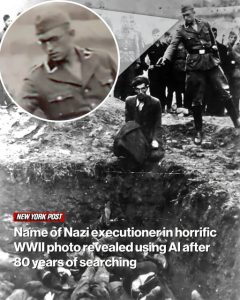
In theory, AI can compare faces appearing in historical photographs and identify individuals who have never been named.
This could be enormously valuable.
A photograph from a concentration camp, military operation, protest, or political gathering might contain dozens of people.
If one person can be identified, that discovery might lead to other records.
But facial recognition is not infallible.
Historical photographs can be blurry.
Faces can be partially obscured.
People change appearance with age.
AI systems can also produce false matches.
For that reason, responsible researchers should treat AI-generated identifications as leads rather than unquestionable facts.
A computer saying “this may be the same person” is not the same as proving that it is.
Human verification remains essential.
The Problem of AI Hallucinations
AI has another serious weakness: it can confidently produce incorrect information.
Modern generative AI systems can sometimes invent names, dates, quotations, sources, or historical connections.
This phenomenon is commonly described as hallucination.
For historical research, that is particularly dangerous.
A fabricated detail can become misinformation if someone assumes the AI is authoritative.
Imagine a researcher asking an AI system to identify an unknown person in an old photograph.
If the system confidently invents an identity, a false claim could eventually enter articles, databases, social media posts, or even educational materials.
That is why AI should never become the final authority on historical truth.
The strongest approach is collaborative.
AI identifies possibilities.
Historians examine the evidence.
Archives provide original documents.
Independent sources confirm or challenge conclusions.
The final judgment remains grounded in evidence.
Restoring Damaged Evidence
AI can also assist with damaged historical materials.
Old photographs fade.
Film deteriorates.
Audio recordings become noisy.
Documents can be torn, stained, or partially illegible.
Modern computational techniques can sometimes improve readability or reconstruct missing visual information.
But restoration comes with a major ethical warning.
There is a difference between enhancing evidence and inventing evidence.
If an AI system cleans up scratches on a photograph, that may help researchers see the original image more clearly.
If it generates facial details that were never actually recorded, however, the result is no longer a faithful representation of the historical evidence.
This distinction must remain clear.
A restored image should never quietly become a synthetic image.
AI and the Search for War Criminals
Historical investigations sometimes continue for decades.
Researchers may still be trying to identify individuals involved in atrocities long after the events occurred.
AI could potentially assist these investigations by searching old records for connections between names, locations, military units, organizations, and dates.
Instead of searching one archive at a time, researchers can use computational tools to identify relationships across massive datasets.
A name appearing insignificant in one document might become highly important when connected with ten others.
The technology can therefore reveal networks.
And networks can reveal responsibility.
That is especially significant when crimes were committed through bureaucratic systems rather than by a handful of individuals acting alone.
The Human Element Still Matters Most
Despite the excitement surrounding AI, the most important part of historical investigation remains human judgment.
Historians understand context.
They know that documents can be biased.
They recognize propaganda.
They understand the difference between a primary source and a later interpretation.
They can ask why a document was created, who created it, what information may have been omitted, and what interests the author had.
An algorithm may identify a pattern.
A historian must determine what that pattern means.
That distinction is crucial.
AI can process information.
It does not possess historical wisdom.
Turning Technology Toward Accountability
The idea of using AI to investigate historical atrocities carries an important philosophical message.
Technology itself is not inherently good or evil.
The same tools that can generate convincing fake photographs can also help authenticate old ones.
The same technology capable of producing deceptive voices can help transcribe historical recordings.
The same computational power that can manipulate information can also uncover connections hidden inside enormous archives.
The difference lies in how people use it.
That makes responsible development particularly important.
Researchers need transparent methods, verifiable sources, careful documentation, and clear distinctions between confirmed evidence and AI-generated suggestions.
Why This Matters Today
Studying history’s worst crimes is not simply about looking backward.
It can help societies recognize warning signs.
Propaganda, dehumanization, political violence, institutional corruption, persecution, and systematic misinformation have appeared repeatedly throughout history.
Understanding how these processes developed can help modern societies identify them earlier.
AI may make it possible to study historical evidence on a scale that was previously unimaginable.
But the ultimate purpose should not be sensationalism.
It should be understanding.
It should be remembrance.
And, where possible, accountability.
Final Thoughts
Artificial intelligence has earned a reputation for deepfakes, scams, misinformation, and manipulation.
Those concerns are real.
But technology can also be directed toward a very different purpose.
Used responsibly, AI can help historians search enormous archives, connect fragmented records, identify people in photographs, translate documents, restore damaged materials, analyze propaganda, and uncover relationships hidden for generations.
It cannot tell us the truth by itself.
And it should never be trusted blindly.
The most valuable partnership is between technology and human expertise: machines capable of processing vast quantities of information, working alongside researchers capable of understanding context and evaluating evidence.
For victims of historical atrocities, the potential is especially meaningful.
A forgotten photograph can sometimes receive a name.
A fragmented record can become part of a larger story.
A hidden connection can help establish responsibility.
A person reduced to a number can once again be recognized as an individual.
History’s monsters cannot be erased by technology.
But neither should their crimes be allowed to disappear into forgotten archives.
If AI can help bring hidden evidence into the light—carefully, transparently, and truthfully—it may become one of the most powerful tools available for preserving memory and confronting the darkest chapters of the human past.