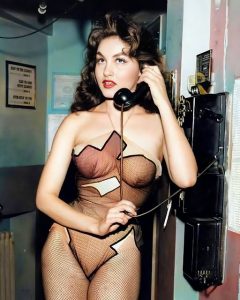
NAME THE 93-YEAR-OLD STAR IN THIS 1956 PHOTO: JULIE NEWMAR AS STUPEFYIN’ JONES
The answer is Julie Newmar, the extraordinary actress, dancer, singer, designer, and businesswoman whose career stretched from Broadway and Hollywood to one of television’s most unforgettable comic-book roles.
Born August 16, 1933, in Los Angeles, Newmar turns 93 today. She became internationally famous as Catwoman on the classic television series Batman, but long before she slipped into the iconic catsuit, she was already turning heads on Broadway.
And that is exactly what makes the 1956 photograph in this quiz so fascinating.
In the image, Newmar is shown on the telephone during a Broadway production of Li’l Abner, dressed as Stupefyin’ Jones, the unforgettable character whose name essentially described what happened to the men who saw her. Getty Images identifies the photograph as a 1956 Broadway image of Newmar playing Stupefyin’ Jones. (Getty Images)
So the two-part answer is:
The actress: Julie Newmar.
The character: Stupefyin’ Jones.
But the photograph represents much more than an amusing moment from an old Broadway show. It captures Newmar at an important turning point, when her extraordinary physical presence and theatrical talent were beginning to make her one of the most distinctive performers of her generation.
From Ballet to Broadway
Julie Newmar’s journey into entertainment began long before she became a television icon.
Born Julia Chalene Newmeyer, she studied music and dance from an early age. She eventually became a ballerina with the Los Angeles Opera, developing the physical control and stage presence that would later become trademarks of her acting career. (IMDb)
That background is important because Newmar was never simply an actress who happened to look glamorous.
She was a trained performer.
Dance taught her how to communicate through movement, posture, timing, and expression. Those abilities would prove enormously valuable when she began appearing in roles in which physical comedy and visual presence were central to the character.
Her Broadway career began with Silk Stockings in 1955. Her official biography notes that this was her first Broadway role, followed by the part that would make her a sensation: Stupefyin’ Jones in Li’l Abner. (Julie Newmar)
The transition from dancer to actress was underway.
And Newmar was about to discover that one unusual role could completely transform the way audiences saw her.
Enter Stupefyin’ Jones
Li’l Abner was based on Al Capp’s popular comic strip and brought the eccentric inhabitants of Dogpatch to the Broadway stage.
Among its colorful characters was Stupefyin’ Jones.
The character’s name was the joke.
She was so extraordinarily beautiful that men who encountered her supposedly became completely frozen or “stupefied.”
It was a comic exaggeration, but Newmar understood how to make the idea work visually.
LIFE later described Newmar’s performance as one of several roles she played during the period in which she portrayed women whose appearance left male characters bewildered. (LIFE)
That makes the 1956 photograph particularly appropriate.
There she is, apparently simply talking on a telephone, but the character surrounding the image is larger than life.
The photograph captures Newmar’s extraordinary stage presence before the world knew her as Catwoman.
The Mystery of the Phone Photograph
The image described in the question is not simply a publicity portrait.
Getty’s archival description identifies Newmar as making a phone call during the Broadway stage production of Li’l Abner in New York City in 1956. It specifically identifies her character as Stupefyin’ Jones. (Getty Images)
That makes the picture a fascinating piece of theatrical history.
Photographs like this were often used to capture performers between or during scenes, giving audiences a glimpse of productions they might otherwise only have experienced from the theater seats.
Newmar’s appearance also demonstrates how strongly visual her character was.
Stupefyin’ Jones did not require pages of complicated dialogue to become memorable.
The entire joke was built around her effect on everyone around her.
In other words, Newmar’s physical performance was part of the storytelling.
Her years as a dancer had prepared her perfectly for that kind of role.
A Role Without the Need for Long Speeches
One of the fascinating aspects of Stupefyin’ Jones is that the character’s impact came largely from her presence.
According to historical accounts, Newmar’s performance in the original Broadway production became legendary even though the character was not built around conventional dialogue.
That was unusual.
Actors are often expected to establish characters through words.
Newmar could do it through posture, movement, expression, timing, and sheer theatrical confidence.
The role became a signature early performance.
And she would eventually reprise it in the 1959 film adaptation of Li’l Abner. IMDb lists Newmar as Stupefyin’ Jones in the film. (IMDb)
The part therefore became an important bridge between her Broadway career and her growing screen career.
Hollywood Came Calling
Newmar was already appearing on screen before Li’l Abner became a movie.
Her film credits included Seven Brides for Seven Brothers in 1954, where she appeared as Dorcas Gaylen. (IMDb)
But Broadway gave her something different.
It allowed audiences to experience her personality and comic timing at full scale.
Her success as Stupefyin’ Jones helped establish her as more than a dancer.
She was becoming a recognizable theatrical personality.
And Hollywood increasingly saw opportunities for her.
Yet there was a potential danger.
Because Newmar was exceptionally beautiful and statuesque—she stood around 5 feet 11 inches—casting directors could easily reduce her to the role of the glamorous woman in the room.
Newmar herself reportedly wanted audiences to appreciate her comedy as much as her appearance.
That ambition would become an important part of her career.
The Broadway Triumph That Followed
Two years after Li’l Abner, Newmar took another major step forward.
In 1958, she appeared in The Marriage-Go-Round as Katrin Sveg.
This was a very different kind of role.
Newmar played a young Swedish woman who arrives in the lives of an older married couple and dramatically disrupts their world.
The performance was a major success.
Newmar won the Tony Award for Best Featured Actress in a Play for her Broadway performance. Her official biography notes that she won the Tony for her first speaking role on Broadway. (Julie Newmar)
That achievement was significant.
It demonstrated that she could do more than make an audience stare.
She could act.
She could deliver comedy.
She could carry a sophisticated theatrical performance.
And she could win one of Broadway’s most prestigious awards.
Then Came Catwoman
Of course, today the name Julie Newmar is inseparable from one character.
Catwoman.
When Batman premiered on television in 1966, Newmar was cast as the feline-themed villain who became one of the show’s most memorable recurring characters.
The role transformed her into an international pop-culture icon.
Newmar’s Catwoman was elegant, playful, dangerous, flirtatious, and funny.
She did not simply play the character as a conventional villain.
She understood the exaggerated tone of the series and used her physicality, timing, voice, and comedic confidence to create a performance that remains recognizable decades later.
Her official biography describes her creation of the Catwoman role as occurring in 1966 and notes that her humor and physicality made the character the show’s most popular villain. (Julie Newmar)
Suddenly, the actress who had once been known on Broadway as Stupefyin’ Jones had become the definitive Catwoman for an entire generation.
The Connection Between Stupefyin’ Jones and Catwoman
At first, Stupefyin’ Jones and Catwoman may seem like completely different characters.
One comes from a rural comic-strip musical.
The other is a comic-book supervillain.
But there is an important connection.
Both roles depended heavily on physical performance.
Newmar understood how to use her body, posture, facial expressions, walk, and timing to create characters who could dominate a scene without needing constant dialogue.
The confidence she developed as a dancer was still visible.
The theatrical skills she developed on Broadway were still there.
And the comedic instincts she demonstrated in Li’l Abner became invaluable on Batman.
In a sense, Stupefyin’ Jones was one of the early building blocks of Catwoman.
More Than a Pin-Up
Newmar became a major beauty icon during the 1950s and 1960s.
Magazine photographers loved her.
Audiences were fascinated by her unusual height and distinctive appearance.
But reducing her career to glamour would miss much of what made her remarkable.
She was a trained dancer.
A Broadway performer.
A Tony Award winner.
An actress.
A singer.
A designer.
An inventor.
And a businesswoman.
Her career eventually extended into areas far beyond entertainment.
Her official biography notes her work as a lingerie designer and her invention of a pantyhose design called “Nudemar.” (Julie Newmar)
That entrepreneurial side of Newmar’s personality is often overlooked because Catwoman became such an enormous part of her public identity.
A Career That Refused to Stay in One Lane
After Batman, Newmar continued working in television and film.
She starred as Rhoda the robot in the cult television comedy My Living Doll, another role that depended heavily on her physical presence and comic timing. (IMDb)
She also appeared in programs including The Twilight Zone, and her career continued across different genres.
Her performances repeatedly demonstrated that she could play glamorous, comic, mysterious, supernatural, and exaggerated characters.
The common denominator was her ability to command attention.
Returning to Stupefyin’ Jones
One of the most charming details in Newmar’s career is that she eventually returned to Li’l Abner.
In 1991, she appeared in a Broadway revival of the musical, decades after her original performance.
Her official biography notes that she returned to the production 42 years after performing in the original version, once again playing Stupefyin’ Jones in the same costume. (Julie Newmar)
That creates a remarkable circle in her career.
The young dancer who had appeared in the original Broadway production in 1956 eventually returned to the same character more than four decades later.
Few performers get such an opportunity.
Why the 1956 Photograph Matters
The photograph of Newmar on the telephone is therefore more than an attractive vintage image.
It captures a moment before she became Catwoman.
Before the Tony Award.
Before My Living Doll.
Before decades of television appearances and pop-culture recognition.
In 1956, she was still establishing herself.
She was already a Broadway performer, but the role of Stupefyin’ Jones was helping audiences remember her.
The photograph shows a young Newmar at the beginning of an extraordinary career.
And knowing what came afterward makes the image even more fascinating.
Looking at her there, it is almost impossible not to think of the character she would create a decade later.
Celebrating Julie Newmar at 93
Today, Julie Newmar’s legacy extends far beyond one television character.
Yes, she will always be remembered as Catwoman.
That role is permanently embedded in television history.
But the full story is much richer.
She was a dancer before she became an actress.
She was a Broadway performer before becoming a television icon.
She won a Tony Award.
She worked in film.
She designed clothing.
She pursued business ventures.
And she repeatedly reinvented herself.
The 1956 photograph captures one of the earliest chapters in that journey.
It shows Julie Newmar as Stupefyin’ Jones, the extraordinary woman whose very presence was supposed to leave the men of Dogpatch frozen in their tracks.
And it provides a fascinating reminder that Catwoman did not appear out of nowhere.
The character was the culmination of years of theatrical experience, dance training, comedy, physical performance, and confidence.
Final Answer
So, if you were trying to solve the mystery from the clues, the answer is Julie Newmar.
Born on August 16, 1933, Newmar is celebrating her 93rd birthday today. She is the actress, dancer, singer, designer, and entrepreneur who moved from ballet and Broadway into film and television before becoming one of the most recognizable faces of the 1960s. (Wikipedia)
And in the famous 1956 telephone photograph, she is portraying Stupefyin’ Jones in the Broadway musical Li’l Abner. Getty Images specifically identifies both Newmar and the role in its archival description. (Getty Images)
A decade later, she would become Catwoman on Batman—the clawed character that ultimately defined her place in television history.
But that photograph reminds us that before the catsuit, there was Broadway.
Before Catwoman, there was Stupefyin’ Jones.
And before Julie Newmar became a television legend, there was a remarkably talented young dancer standing on a New York stage, already proving that she could make an audience stop and stare.