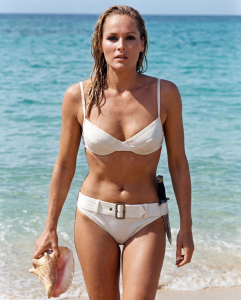
The film is Dr. No.
And the bonus answer is Ursula Andress, who played Honey Ryder, the woman pictured emerging from the sea in what became one of the most famous entrances in movie history.
Released in the United States on May 8, 1963 (after its 1962 UK premiere), Dr. No was the cinematic milestone that introduced James Bond to global audiences for the very first time. It was not merely the beginning of a successful film series; it was the birth of a modern screen mythology. More than sixty years later, nearly every Bond film still carries DNA that was established in this remarkably confident first adventure.


5
The literary secret agent becomes a movie star
Before Dr. No, James Bond existed primarily in the pages of Ian Fleming’s bestselling novels. Fleming had created Bond in 1953 with Casino Royale, and the books quickly gained a devoted following. Bond was sophisticated, dangerous, and distinctly British — a government assassin who navigated a world of espionage, luxury, gambling, and exotic locations.
Bringing that character to the screen was a gamble. Producers Albert R. “Cubby” Broccoli and Harry Saltzman formed Eon Productions and acquired the rights to several Fleming novels. They chose Dr. No as the launch film partly because it could be made on a relatively modest budget.
What they needed most was the right Bond.
Sean Connery: the unexpected choice

The role ultimately went to Sean Connery, a former bodybuilder and actor from Edinburgh. Fleming initially had doubts about the casting, imagining Bond as more refined and aristocratic. But Connery possessed something irresistible: a combination of physical menace, sexual confidence, and effortless cool.
His first proper introduction in Dr. No is now legendary. Sitting at a baccarat table in a tuxedo, he lights a cigarette and delivers the line:
“Bond. James Bond.”
That moment established one of the most recognizable character introductions in cinema history.
Jamaica: the perfect Bond playground
The film sends Bond to Jamaica to investigate the disappearance of a fellow British agent, John Strangways. From the beginning, the setting feels crucial. Unlike the gray bureaucratic world of London, Jamaica offers sun-drenched beaches, colonial intrigue, hidden dangers, and a sense that paradise may conceal something sinister.

Bond’s investigation gradually leads him toward Crab Key, a private island controlled by the mysterious scientist Dr. Julius No.
This structure — a British intelligence mission that expands into a confrontation with a larger criminal or geopolitical threat in an exotic location — became the template for countless Bond films that followed.
The villain who set the standard
Joseph Wiseman plays Dr. No, a brilliant but deranged scientist with metallic hands and ambitions that extend far beyond ordinary crime. He is isolated on his island fortress, surrounded by technology, guards, and elaborate defenses.

Many of the classic Bond-villain ingredients appear here for the first time:
- the secret island base
- the eccentric physical trait
- the intellectual superiority complex
- the monologue explaining the grand plan
- the deadly obstacle course designed to eliminate the hero
Later villains would become more extravagant, but Dr. No established the blueprint.
The entrance that changed movie history
Then comes the scene that transformed Ursula Andress into an international icon.
Bond is searching the shoreline of Crab Key when a figure rises from the Caribbean Sea wearing a white bikini, carrying a knife and collecting seashells. The image is simple, almost mythic, and Hitchcockian in its understanding of visual impact.

Why did it become so famous?
It combined several powerful elements
- Surprise: the audience encounters Honey before Bond fully understands who she is.
- Visual clarity: the white bikini against the blue sea creates an instantly memorable composition.
- Character introduction: Honey is not simply posing; she is working, armed, and self-sufficient.
- Mythic quality: she appears almost like a classical figure emerging from the ocean.
The bikini itself became one of the most famous costumes in film history and has been referenced, parodied, and recreated for decades.
Honey Ryder: more than a Bond girl stereotype
It is easy to reduce Honey Ryder to that entrance, but the character has more substance than many early Bond companions. She survives alone on Crab Key, understands the island better than anyone else, and has her own traumatic backstory and motivations.
Andress’s performance gives Honey a mixture of vulnerability and toughness that helped define the “Bond girl” archetype: glamorous, capable, and central to the adventure rather than merely decorative.
A franchise finds its identity
What is remarkable about Dr. No is how many elements of the Bond formula arrived fully formed.
| Element | First iconic use in Dr. No |
|---|---|
| Gun-barrel style opening | Yes |
| “Bond, James Bond” introduction | Yes |
| Exotic international setting | Jamaica |
| Eccentric mastermind villain | Dr. No |
| Memorable female lead | Honey Ryder |
| Stylized action and suspense | Yes |
| Signature musical identity | Yes |
The James Bond Theme, arranged by John Barry from Monty Norman’s composition, was especially important. Those twanging guitar notes became inseparable from the character’s identity.
The Jamaican atmosphere
Much of the film’s enduring charm comes from its atmosphere. Director Terence Young understood that Bond should feel both dangerous and aspirational. The audience is invited into a world of casinos, tropical resorts, speedboats, fine tailoring, and hidden threats.

This balance between escapist glamour and genuine suspense became the franchise’s defining tone.
Critical reaction and growing success
Initial reviews were mixed; some critics considered the film pulpy entertainment rather than serious cinema. But audiences responded enthusiastically. The movie’s box-office success proved that Bond had enormous commercial potential.
Eon Productions quickly moved forward with From Russia with Love, which expanded the scale of the series, and then Goldfinger, which cemented Bondmania around the world.
Without Dr. No succeeding first, none of the later phenomenon would have existed.
Why it still matters after sixty years
Modern viewers accustomed to gigantic blockbuster budgets are often surprised by how lean and efficient Dr. No is. The action is relatively restrained, the gadgets are minimal, and the suspense relies heavily on pacing, composition, and performance.
That restraint is actually part of its power.
The film feels less like a cartoon spectacle and more like a stylish espionage thriller with occasional bursts of adventure. Connery’s Bond is dangerous in a tangible way, and the Caribbean setting feels like a real place rather than a digital fantasy.
The legacy of one sea emergence
Perhaps the most extraordinary legacy belongs to that single image of Ursula Andress emerging from the sea.
It has influenced:
- fashion photography
- music videos
- advertising campaigns
- later Bond films
- countless cinematic homages
When Halle Berry recreated the moment in Die Another Day, the reference worked instantly because the original had become embedded in global popular culture.
The answer
So the answer is Dr. No.
The actress emerging from the sea is Ursula Andress as Honey Ryder.
Released in the United States on this day in 1963, Dr. No introduced James Bond to cinema audiences for the first time, sent him to Jamaica to investigate a missing British agent, confronted him with the mysterious scientist Dr. No on a private island, and delivered one of the most iconic bikini-clad entrances in movie history. More importantly, it established the style, glamour, suspense, music, villains, and exotic adventure that would define the James Bond franchise for more than six decades — a cinematic template so successful that it remains one of the longest-running and most influential series in film history.