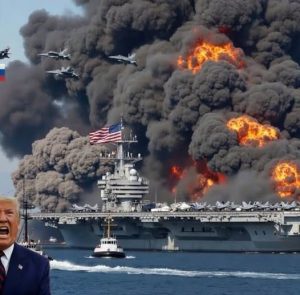
BREAKING: Claims of a Russian Su-57 Strike on a U.S. Aircraft Carrier Are Circulating Online — But What Do We Actually Know?
A dramatic military claim is spreading across social media alleging that a Russian Su-57 stealth fighter has carried out a devastating strike against a U.S. aircraft carrier supposedly transporting more than 700 tanks.
The headline is designed to sound like an extraordinary breaking-news event. Posts circulating online use phrases such as “13 minutes ago,” “Russian Su-57 pilot destroys U.S. aircraft carrier,” and references to a carrier carrying hundreds of tanks. (Facebook)
But there is a crucial problem: there is currently no credible evidence confirming that a Russian Su-57 has attacked or destroyed a U.S. aircraft carrier.
Several versions of the claim appear to originate from social-media posts and online videos rather than verified military reporting. One YouTube result explicitly describes footage associated with the story as a virtual game simulation, not authentic combat footage. (YouTube)
That distinction is essential.
A real Russian attack on a U.S. aircraft carrier would represent an extraordinary military escalation between two nuclear-armed powers. It would not be an ordinary battlefield development that could remain confined to a few social-media accounts.
The Viral Claim
The circulating story describes a Russian Su-57 pilot supposedly launching a devastating attack against an American aircraft carrier.
Some versions say the ship was carrying 700 tanks, while other versions circulating online use different numbers or descriptions. The inconsistencies themselves are an important warning sign.
One Facebook post currently repeating the claim says that a Russian Su-57 destroyed a U.S. aircraft carrier carrying 700 tanks. Another post uses almost identical wording while changing details of the supposed event. (Facebook)
When supposedly breaking military news appears in multiple versions with different details, readers should not automatically assume that each variation represents a separate report.
Often, such posts are copied from one another.
There Is No Confirmation of a Carrier Attack
The most important fact is that searches for the alleged incident do not produce credible confirmation from major international news organizations or official military sources.
Instead, the results are dominated by social-media posts and videos.
One video result explicitly identifies its presentation as a virtual game simulation involving a Russian Sukhoi Su-57 and a U.S. aircraft carrier. (YouTube)
Another video makes a similar claim involving the destruction of a U.S. carrier but likewise presents the material as a simulation. (YouTube)
That means dramatic footage associated with these headlines should not be presented as genuine combat video.
What Is the Su-57?
The Su-57 is a Russian fifth-generation stealth multirole fighter developed by Sukhoi.
It is designed for missions including air-to-air combat and strikes against ground and maritime targets. The aircraft incorporates stealth features, advanced avionics, maneuverability and internal weapons bays. (Wikipedia)
The aircraft entered Russian military service in 2020.
It has also been used in Russia’s war against Ukraine, although publicly available information about its combat operations has often been limited because of the sensitivity surrounding Russia’s most advanced fighter aircraft. (Wikipedia)
The existence of a capable aircraft, however, does not mean that every dramatic story involving it is authentic.
A military platform can be real while the supposed combat footage or incident is completely fictional.
Why the Carrier Story Doesn’t Make Sense as Presented
There is another major issue with the viral headline: the description of an American aircraft carrier transporting 700 tanks is unusual.
U.S. aircraft carriers are primarily designed as floating airbases.
Their central function is to carry and operate aircraft, along with the personnel, weapons, fuel, equipment and support systems necessary to maintain those aviation operations.
They are not ordinarily described as ships transporting hundreds of main battle tanks.
That does not mean U.S. naval vessels cannot transport military equipment.
The U.S. military operates numerous types of ships specifically intended for transporting vehicles, personnel and cargo.
But describing an aircraft carrier as a vessel carrying 700 tanks should immediately prompt readers to question the accuracy of the story.
The number appears to be part of the sensational presentation rather than a detail supported by credible reporting.
Why Simulation Videos Can Be Confusing
Modern military video games and computer-generated simulations can look remarkably realistic.
They can show aircraft launching missiles, ships exploding, fighter jets maneuvering and large-scale naval battles.
When a clip is removed from its original context and reposted with a sensational caption, viewers may believe they are watching real combat footage.
That appears to be happening with some versions of the Su-57 carrier story.
A search result connected with the claim specifically labels the video as a virtual game simulation. (YouTube)
That does not necessarily mean the creator intended to deceive viewers.
Simulation videos are common online and can be created for entertainment, military analysis or gaming channels.
The problem occurs when a fictional or simulated scene is presented as actual breaking news.
What Would a Real Attack Mean?
If a Russian fighter actually attacked a U.S. aircraft carrier, the consequences would be enormous.
The United States and Russia possess the world’s two largest nuclear arsenals.
An attack by Russian military forces against an American carrier would therefore represent an extraordinarily serious confrontation between two major nuclear powers.
It would almost certainly trigger immediate international attention.
The U.S. Department of Defense would be expected to address the incident. The White House would likely respond. NATO governments would be closely involved. Major news agencies around the world would publish reports.
The event would not simply appear as a handful of Facebook posts.
That is another reason the current viral claim deserves skepticism.
Russia’s Su-57 Is Real — But That Doesn’t Validate the Story
It is important not to go too far in the opposite direction.
The Su-57 is not fictional.
It is a real Russian fifth-generation aircraft and has entered operational service. Its development has been followed closely by defense analysts for years. (Wikipedia)
The aircraft is capable of carrying air-to-air and air-to-surface weapons and was designed to conduct a variety of missions.
But social-media posts sometimes exploit the reputation of advanced weapons systems to make fictional scenarios appear plausible.
The reasoning becomes:
“The Su-57 is a powerful stealth fighter, therefore this video of a Su-57 destroying a carrier must be real.”
That conclusion does not follow.
Military capability and evidence of a specific event are two completely different things.
Russia’s Naval Aviation Situation
The broader Russian naval aviation picture also deserves context.
Russia’s aircraft-carrier capability is relatively limited compared with that of the United States. Russia’s sole aircraft carrier, Admiral Kuznetsov, has been inactive for years, with its future repeatedly questioned. (Wikipedia)
Russian naval aviation therefore relies heavily on shore-based aircraft and other platforms rather than a large fleet of operational aircraft carriers.
The Su-57 itself is primarily a Russian Aerospace Forces aircraft rather than a conventional carrier-based fighter.
That makes sensational stories about a Su-57 suddenly operating from a Russian carrier and attacking an American carrier especially worth examining carefully.
Why “Breaking News” Language Works
The headline structure is familiar.
“BREAKING.”
“Shocking reports.”
“Destroyed.”
“700 tanks.”
“13 minutes ago.”
Each phrase is designed to increase urgency.
The reader is encouraged to react emotionally before investigating the claim.
Military stories are particularly effective at generating this reaction because people understand that the consequences of a major attack could be enormous.
The more dramatic the alleged event, the more important it becomes to slow down.
A headline is not evidence.
A video is not necessarily evidence.
And a photograph can easily be taken from an older event or a simulation.
How to Verify a Military Claim
When confronted with a story like this, several checks are useful.
First, search for the incident through multiple independent news organizations.
Second, check official statements from the U.S. Department of Defense and other relevant military authorities.
Third, examine the original video rather than a reposted clip.
Fourth, look for signs that the footage comes from a video game, simulation or computer-generated animation.
Fifth, check whether the story contains consistent details.
If one version says 700 tanks, another says 350, and another describes a completely different cargo, that is a strong indication that the material is unreliable.
The Difference Between Possibility and Fact
A Su-57 attacking a naval target is technically within the broad category of missions for which the aircraft was designed.
But that does not establish that such an attack happened.
This is a common problem with military misinformation.
A story may combine several real facts:
A real aircraft.
A real missile.
A real aircraft carrier.
A real geopolitical rivalry.
A realistic simulation.
Then the creator presents them together as if they document an actual event.
The result can sound convincing even though the underlying incident never occurred.
The Bigger Danger of False Military News
False reports about military attacks are not harmless entertainment.
A fabricated story claiming that Russia has attacked an American aircraft carrier could create unnecessary fear and confusion.
It could also be exploited for political propaganda.
People may begin discussing retaliation before realizing that the supposed attack never happened.
In an environment already filled with international tensions, misinformation can make an unstable situation appear even more dangerous.
That is why responsible reporting is especially important when nuclear powers are involved.
What We Can Say With Confidence
The Russian Su-57 is a genuine fifth-generation fighter.
It has entered Russian service and has been associated with combat operations connected to the war in Ukraine. (Wikipedia)
However, the current viral claim that a Russian Su-57 pilot has destroyed or devastatingly struck a U.S. aircraft carrier carrying more than 700 tanks is not supported by credible evidence.
The social-media posts repeating the claim are not sufficient verification. (Facebook)
And at least one prominent video associated with the story is explicitly identified as a virtual game simulation. (YouTube)
Final Thoughts
The alleged Russian Su-57 attack on a U.S. aircraft carrier is an extraordinary story—but extraordinary stories require extraordinary evidence.
At present, the evidence points toward an online misinformation or simulation-based narrative rather than a confirmed military event.
That does not make the Su-57 irrelevant.
It remains one of Russia’s most advanced combat aircraft and an important component of discussions about modern air warfare.
Nor does it make the U.S.-Russia military relationship unimportant.
Quite the opposite.
Because an actual attack on a U.S. aircraft carrier by Russian forces would be an event of enormous international significance, readers should demand reliable confirmation before believing such a claim.
For now, the responsible conclusion is simple:
There is no credible confirmation that a Russian Su-57 has destroyed or carried out a devastating strike on a U.S. aircraft carrier carrying 700 tanks.
The viral posts should therefore be treated as unverified, and the dramatic videos circulating alongside them should not be presented as authentic combat footage.
In an age when simulations can look real and sensational headlines can spread worldwide within minutes, the most powerful response to shocking military news is not immediate sharing.
It is verification.