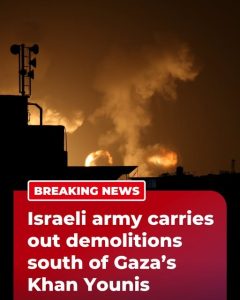
Israeli Military Demolitions South of Khan Younis Raise Fresh Concerns Over Gaza’s Fragile Ceasefire
Reports that the Israeli military is carrying out demolitions in areas under its control south of Khan Younis have drawn renewed attention to the fragile security and humanitarian situation in the southern Gaza Strip. The reported operations come at a particularly sensitive moment, as diplomatic efforts aimed at advancing a broader Gaza peace plan continue while violence and military activity have not completely stopped.
According to reports from correspondents and Palestinian sources, Israeli forces have been conducting demolition operations in parts of southern Gaza. Similar demolition activity south of Khan Younis was reported earlier this month, when Palestinian media reported that Israeli forces were destroying structures while maintaining military activity in the area. (Anadolu Ajansı)
The developments are significant because Khan Younis and the surrounding southern areas have repeatedly been at the center of Gaza’s humanitarian crisis. Large numbers of Palestinians have been displaced into the region during the conflict, while military operations, restrictions on movement, damaged infrastructure and shortages of basic supplies have made life increasingly difficult.
A Fragile Moment for Gaza
The latest reports come as diplomatic efforts are taking place behind the scenes. U.S. President Donald Trump’s representatives have been meeting with regional mediators in an attempt to advance a plan intended to bring the conflict toward an end.
On August 16, U.S. envoys met Egyptian, Qatari and Turkish mediators in Cairo as part of efforts to advance the American peace initiative. The diplomatic activity has continued even as Israeli military operations have persisted in parts of Gaza. (The Straits Times)
Other reporting on August 17 indicated that talks involving Trump’s envoy Jared Kushner and Israeli and Hamas representatives ended without a major breakthrough, with the sides continuing to disagree over important elements of a proposed settlement. (Daily Sabah)
That combination of diplomacy and continued military activity illustrates just how uncertain the situation remains.
While negotiations may create the possibility of a longer-term political settlement, events on the ground can quickly complicate those efforts.
Why Demolitions Matter
Demolition operations are particularly consequential in Gaza because so much of the territory’s housing and infrastructure has already been damaged or destroyed.
A building demolition is not simply the removal of a structure. For families who have repeatedly been displaced, the destruction of another home or neighborhood can eliminate one of the few remaining possibilities of returning.
The humanitarian consequences can also extend beyond individual buildings. Residential areas often contain roads, water connections, electrical infrastructure, businesses and community facilities. When structures disappear, the surrounding area can become significantly more difficult for civilians to inhabit.
United Nations humanitarian reporting has repeatedly highlighted the effects of military operations and movement restrictions in Gaza, including new displacement and reduced access to food, water, shelter and medical services. (UNOCHA OPT)
That makes every new episode of destruction especially significant for civilians who have already experienced repeated displacement.
Khan Younis and the Humanitarian Burden
Khan Younis is one of Gaza’s major urban centers and has been heavily affected throughout the conflict.
The surrounding region has also become an important refuge for displaced Palestinians. Families who fled fighting elsewhere have repeatedly moved southward, only to face new military developments or restrictions.
Recent reporting has described continued violence around Khan Younis even during the current period of reduced hostilities. Reuters reported that an Israeli strike on August 13 in Khan Younis killed one Palestinian and wounded another, with Israel saying the target was a Hamas commander preparing an attack. (Reuters)
The incident demonstrated the fragility of the situation. Even when overall military activity is reduced, individual strikes or ground operations can still produce casualties and renewed fear among civilians.
For residents of Khan Younis, the difference between a formal ceasefire and genuine security is therefore enormous.
A ceasefire can reduce the intensity of fighting, but civilians need more than a reduction in bombardment. They also need safe movement, reliable humanitarian access, shelter, medical care and the ability to rebuild their lives.
The Question of Military Control
Another important issue surrounding the reported demolitions is the question of military control.
Israeli officials have previously described military zones and security areas inside Gaza as necessary to prevent attacks and maintain security. Palestinian officials and humanitarian organizations, however, have repeatedly warned that expanding military-controlled areas can reduce the space available for civilian life and contribute to displacement.
Earlier this year, Israeli Prime Minister Benjamin Netanyahu said Israeli forces were moving toward control of a much larger portion of Gaza. Reporting at the time described an expansion of military-controlled areas and buffer zones, including areas south of Khan Younis. (WAFA Agency)
Other reporting has described the Israeli military’s “yellow line” as a significant element of the evolving geography of control inside Gaza. (Asharq Al-Awsat)
These developments matter because territorial control affects where civilians can live, travel and receive assistance.
The more fragmented the territory becomes, the harder it can be for humanitarian agencies to operate and for families to maintain normal lives.
The Human Cost of Repeated Displacement
Perhaps the most immediate concern is the psychological and practical burden placed on civilians.
Many Palestinians in Gaza have been displaced multiple times. A family may have fled one neighborhood, established temporary shelter somewhere else, and then been forced to move again.
Repeated displacement creates enormous uncertainty.
Parents may not know whether they will be able to remain in a particular location. Children can spend months or years living without stable housing or schooling. Older people and people with disabilities may struggle to move at all.
Medical patients face additional dangers when military activity changes access routes.
The humanitarian crisis is therefore not limited to people directly affected by a demolition. The broader consequences can spread through entire communities.
International Concerns
The destruction of civilian property during armed conflict is governed by international humanitarian law, which establishes rules concerning military necessity, distinction and the protection of civilians.
Whether a particular demolition is lawful depends on the circumstances, including the purpose of the operation, the status of the structure, the military objective involved and the measures taken to protect civilians.
This is why individual reports need to be investigated carefully rather than automatically interpreted in one direction.
At the same time, international organizations have repeatedly expressed concern about the scale of destruction and displacement in Gaza.
A United Nations human-rights document has described extensive destruction associated with military corridors and buffer zones and raised concerns about the consequences for Palestinian housing and access to land. (SP Communication Reports)
Humanitarian organizations have similarly documented the enormous impact of continued military operations on housing, infrastructure and essential services.
A Diplomatic Race Against Events on the Ground
The timing of the demolitions is particularly important because negotiators are attempting to create a political framework capable of ending the conflict.
Diplomacy requires trust, or at least enough confidence between opposing sides to implement agreements.
Military activity can make that process considerably harder.
If Palestinians see continuing demolitions and attacks, confidence in a peace process may decline. Conversely, Israeli officials may argue that maintaining military pressure is necessary to prevent Hamas from rebuilding its military capabilities.
That fundamental disagreement lies at the heart of the current crisis.
One side emphasizes security and the prevention of future attacks.
The other emphasizes civilian safety, territorial access, reconstruction and an end to military control.
Any durable agreement will have to address both.
The Broader Reconstruction Challenge
Even if fighting were to stop completely, Gaza would face an enormous reconstruction challenge.
Homes need to be rebuilt. Hospitals and schools require restoration. Roads, water networks, electricity systems and sanitation infrastructure need to be repaired.
But reconstruction cannot proceed effectively without security and predictable access.
If areas continue to be demolished or remain subject to military restrictions, rebuilding becomes extremely difficult.
That is why the events south of Khan Younis matter beyond the immediate destruction. They raise broader questions about what Gaza will look like after the conflict and whether displaced residents will be able to return to their communities.
What Happens Next?
The coming days could be crucial.
Diplomatic efforts involving the United States and regional mediators are continuing. At the same time, developments on the ground will influence whether negotiations gain momentum or stall.
The reported demolitions south of Khan Younis are therefore being watched closely because they could become another source of tension during an already delicate period.
For civilians, however, the issue is more immediate.
People living in or near affected areas need clarity about where they can safely remain, whether humanitarian assistance can reach them and whether their homes and communities will still exist when the conflict finally ends.
Those questions cannot be answered through military operations alone.
A Moment That Highlights Gaza’s Uncertain Future
The reports from south of Khan Younis underline the enormous gap between diplomatic announcements and daily life in Gaza.
While negotiators discuss ceasefires, disarmament, withdrawals and international stabilization arrangements, residents continue to experience the consequences of events taking place around them.
The destruction of buildings can change a neighborhood in a matter of hours. The consequences for families can last generations.
The current situation remains fluid, and reports from the ground should continue to be independently verified as more information becomes available. What is clear is that southern Gaza remains a critical humanitarian and political flashpoint.
The challenge now is not simply stopping individual attacks or demolitions. It is creating conditions in which civilians can finally live without repeated displacement, where humanitarian assistance can move safely, and where reconstruction can begin.
The diplomatic efforts underway may offer a path toward that future, but the continuing military activity demonstrates how fragile that possibility remains.
For the people of Khan Younis and communities across Gaza, the ultimate measure of any agreement will not be the statements made in negotiating rooms. It will be whether families can return home, rebuild their communities and live without fear of the next demolition, evacuation order or military strike.