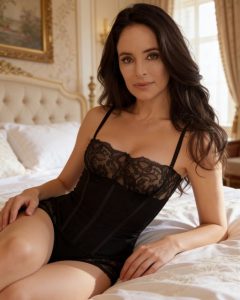
NAME THE 90s SCREEN STAR WHO WAS ABOUT TO BECOME THE QUEEN OF THE HAMPTONS!
The actress in the clue is Madeleine Stowe, the elegant and formidable star who found an entirely new generation of fans when she became Victoria Grayson on ABC’s hit drama Revenge. Born August 18, 1958, Stowe turned 68 in 2026, making today’s birthday a perfect opportunity to revisit the remarkable career of a performer who moved effortlessly from prestige films and romantic dramas to one of television’s most deliciously ruthless characters. (Wikipedia)
The 2011 portrait mentioned in the clue captures Stowe at a fascinating point in her career. She was returning to television in a major way as Victoria, the glamorous matriarch of the wealthy Grayson family. With her immaculate wardrobe, controlled expressions and seemingly endless collection of secrets, Victoria quickly became one of the defining characters of Revenge.
But long before she was ruling the Hamptons from Grayson Manor, Stowe had already established herself as one of the most distinctive actresses of the late 1980s and 1990s.
From Piano to Acting
Madeleine Stowe’s path to Hollywood was not entirely conventional.
Born in Los Angeles and raised in the Eagle Rock neighborhood, she initially had ambitions that had little to do with becoming a movie star. As a child, she trained seriously as a concert pianist, practicing for hours each day. After the death of her piano teacher in 1976, however, her plans changed. She eventually studied cinema and journalism at the University of Southern California before turning toward acting. (TV Insider)
Her early career included television appearances before she made her feature-film breakthrough in Stakeout in 1987.
The movie established Stowe as an actress capable of combining intelligence, elegance and emotional vulnerability. Hollywood quickly began offering her increasingly prominent roles.
By the early 1990s, she was becoming one of the industry’s most recognizable leading ladies.
The Last of the Mohicans
For many moviegoers, the role that truly announced Stowe as a major star was Cora Munro in Michael Mann’s 1992 epic The Last of the Mohicans.
Starring opposite Daniel Day-Lewis, Stowe played Cora, a woman caught in the violence and uncertainty of the French and Indian War.
The film was visually spectacular, but Stowe’s performance gave the story its emotional center.
Cora was not simply a conventional damsel in distress. She was intelligent, determined and willing to confront danger. Her romance with Hawkeye became one of the movie’s most memorable elements, while Stowe’s performance helped make the character considerably more complicated than a typical period-film heroine.
The movie became a major success and remains one of the most celebrated films of Stowe’s career. (Wikipedia)
For audiences in the early 1990s, it was difficult to miss her.
She had arrived as a genuine film star.
A Remarkable Run Through the 1990s
Stowe followed The Last of the Mohicans with a series of roles that demonstrated her range.
She appeared in the thriller Unlawful Entry, then took on the challenging ensemble drama Short Cuts. Robert Altman’s 1993 film gave Stowe the opportunity to work with a large cast of respected performers, and her performance earned her the National Society of Film Critics Award for Best Supporting Actress. (Wikipedia)
Then came Blink, a suspense thriller that placed Stowe at the center of the story.
She also appeared in Bad Girls, a Western featuring a group of women at the heart of the action.
Rather than becoming locked into one particular genre, Stowe moved between thrillers, dramas, westerns, romantic stories and historical films.
That versatility became one of her trademarks.
12 Monkeys
In 1995, Stowe entered the strange, disturbing world of Terry Gilliam’s 12 Monkeys.
The science-fiction thriller starred Bruce Willis as a prisoner sent back through time in an attempt to investigate the virus that devastated humanity. Brad Pitt delivered one of his most memorable early performances, while Stowe played Dr. Kathryn Railly, a psychiatrist whose understanding of the mysterious events gradually changes. (Wikipedia)
The film was ambitious and unconventional.
It was also a perfect showcase for Stowe because she had to balance skepticism with growing fear and fascination.
Her character begins grounded in the rational world, only to find herself confronted with events that seem impossible.
The movie became a cult favorite and remains one of the standout science-fiction films of the decade.
The General’s Daughter
By the end of the 1990s, Stowe was still appearing alongside major Hollywood stars.
In 1999, she appeared in The General’s Daughter, starring John Travolta.
The military thriller gave her another opportunity to work within a tense mystery while sharing the screen with a major commercial leading man.
By this point, her résumé included several genres and some of the biggest films of the era.
Yet something interesting was about to happen.
Stowe would step away from the movie-star spotlight for a period.
A Different Kind of Hollywood Life
One of the intriguing aspects of Stowe’s career is that she never seemed entirely consumed by celebrity.
She became increasingly selective about her work and spent time away from major film productions.
She also devoted attention to family life and humanitarian interests.
ABC News reported during the early Revenge period that Stowe had traveled to Haiti before the devastating 2010 earthquake and remained deeply involved with humanitarian concerns there. (ABC News)
That side of her life was dramatically different from the world inhabited by Victoria Grayson.
Victoria lived among extraordinary wealth.
She was calculating, status-conscious and intensely protective of her family and social position.
Stowe, meanwhile, had developed a reputation for being private and selective about her public life.
That contrast helped make her casting in Revenge particularly effective.
Enter Victoria Grayson
Then came 2011.
ABC premiered Revenge, a glossy mystery drama inspired in part by Alexandre Dumas’ The Count of Monte Cristo. The series followed Emily Thorne, played by Emily VanCamp, as she returned to the Hamptons under an assumed identity with a plan to punish the people she believed had destroyed her family. (Wikipedia)
At the center of that world stood Victoria Grayson.
She was wealthy.
She was powerful.
She was socially connected.
And she was hiding secrets.
Stowe immediately understood what made the character compelling.
Victoria wasn’t simply a villain.
She loved deeply, feared losing control and possessed a fierce determination to protect the life she had built.
That combination made her dangerous.
ABC described Victoria as the matriarch of the Grayson family and the woman who ruled the Hamptons social scene. (ABC7 Los Angeles)
The character’s icy confidence became one of the show’s biggest attractions.
The Queen of the Hamptons
Victoria Grayson was almost tailor-made for the era of prestige nighttime soap operas.
She had money, power, complicated relationships, enemies everywhere and enough secrets to fuel multiple seasons.
Her immaculate appearance was part of the character’s armor.
Her clothes communicated status.
Her smile could conceal a threat.
Her seemingly polite conversations could become battles of psychological warfare.
And Stowe played her with extraordinary restraint.
Rather than turning Victoria into a cartoon villain, she gave her layers.
There was anger underneath the elegance.
Fear underneath the confidence.
And vulnerability underneath the manipulation.
Stowe later described Victoria as deeply hateful and venal while acknowledging that she also loved intensely. (ABC News)
That contradiction was crucial.
Viewers could despise Victoria’s actions while remaining fascinated by her.
A Second Round of Stardom
Revenge became more than a comeback.
It introduced Stowe to television viewers who might not have been familiar with her earlier film work.
For younger audiences, she was no longer simply the actress from The Last of the Mohicans or 12 Monkeys.
She was Victoria Grayson.
And Victoria was unforgettable.
The Los Angeles Times described the series as a modern, glossy descendant of classic primetime soaps such as Knots Landing, Dynasty and Dallas. (Los Angeles Times)
That comparison was fitting.
Revenge combined wealth, betrayal, romance, murder, family secrets and social competition.
At the center of all of it was Stowe’s performance.
Golden Globe Recognition
The acclaim wasn’t limited to enthusiastic viewers.
Stowe received a Golden Globe nomination for Best Actress in a Television Series – Drama for her performance as Victoria. The nomination came at the 2012 Golden Globe Awards after the show’s successful debut. (Golden Globes)
The recognition confirmed that her television comeback was more than a nostalgic return.
She had created a character powerful enough to become one of the defining dramatic performances on network television at the time.
Why Victoria Worked So Well
The secret of Stowe’s performance was control.
Victoria rarely needed to shout.
She could communicate anger with a glance.
She could make a seemingly harmless sentence sound like a threat.
She could enter a room and instantly change its atmosphere.
That ability came naturally from an actress who had spent decades working in films where subtle expressions could communicate enormous amounts of information.
Stowe brought that cinematic discipline to television.
Every pause mattered.
Every smile could have another meaning.
Every conversation potentially contained a secret.
That was exactly what Revenge required.
A Career Defined by Reinvention
Looking back, Stowe’s career is unusual because it contains several distinct chapters.
There was the young actress establishing herself in the 1980s.
There was the major film star of the 1990s.
There was the actress taking on challenging ensemble projects and genre films.
There was the period of relative retreat from the spotlight.
And then there was Victoria Grayson.
Each chapter revealed something different about her abilities.
Her performance in The Last of the Mohicans showcased romance and determination.
12 Monkeys highlighted her ability to handle science fiction and psychological complexity.
The General’s Daughter demonstrated her continued presence in mainstream thrillers.
And Revenge proved she could command a television series as effectively as a feature film.
Beyond the Hamptons
Although Victoria Grayson became one of Stowe’s signature roles, she never became trapped by it.
Her later work continued to demonstrate her willingness to explore different genres and formats.
She returned to television and appeared in projects including Soundtrack, while also taking on later roles that introduced her to new audiences.
Her career has therefore continued well beyond the world of Grayson Manor.
But for many viewers, the image of Stowe standing in an elegant room, delivering a perfectly measured threat, remains impossible to forget.
The Legacy of Madeleine Stowe
At 68, Madeleine Stowe can look back on a career that has lasted for decades and crossed several major eras of entertainment.
She became a recognizable movie star without allowing herself to be defined by celebrity.
She earned critical recognition for serious dramatic performances.
She appeared opposite some of the industry’s most respected actors.
She worked in historical drama, science fiction, thriller, comedy and television mystery.
Then, after stepping away from the center of Hollywood for a time, she returned with a role that gave her a completely new audience.
That is what makes the 2011 portrait especially interesting.
It captures Stowe just as she was entering another major chapter.
The woman who had once raced through colonial America in The Last of the Mohicans was now ruling a fictional corner of the Hamptons.
The actress who had faced the surreal apocalypse of 12 Monkeys was now navigating a world of billionaires, secrets and revenge.
And the star who had built her reputation in film had discovered a new kingdom on television.
Victoria Grayson may have been ruthless, manipulative and occasionally terrifying.
But she was also unforgettable.
And that may be the perfect description of Madeleine Stowe’s career itself.
She has never needed to play the loudest character in the room.
She simply needed to be the most interesting.
From her early days in Los Angeles to the defining roles of the 1990s, and finally to her celebrated return as the Queen of the Hamptons, Stowe has repeatedly shown why longevity in Hollywood is about more than fame.
It is about reinvention.
It is about choosing characters that reveal another side of your talent.
And, sometimes, it is about finding the perfect role at exactly the right moment.
For Madeleine Stowe, that role was Victoria Grayson.
The Hamptons may have belonged to Victoria.
But the performance belonged entirely to Stowe.