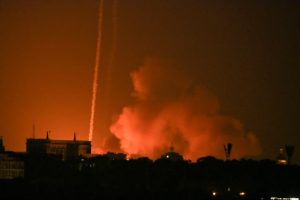
Russian Missile Barrage Kills at Least 16 People in Kyiv as Massive Overnight Attack Shakes Ukraine
Kyiv woke Thursday to scenes of destruction after Russia launched a massive overnight barrage of missiles and drones against the Ukrainian capital and surrounding areas, killing at least 16 people and injuring roughly 40, according to Ukrainian officials and international news agencies. (AP News)
The assault lasted for hours, sending residents rushing into underground shelters as explosions echoed across Kyiv. Apartment buildings were damaged, fires broke out, and emergency crews searched damaged structures for survivors.
The attack was among the latest and most serious in a series of large-scale Russian aerial assaults against Ukraine during a summer in which missile and drone strikes on Kyiv have become increasingly frequent. (AP News)
For residents of the capital, the night was another reminder that even after more than four years of full-scale war, the threat of Russian long-range attacks remains immediate.
A Night of Explosions Across Kyiv
The attack began overnight and continued into the early morning hours.
Ukrainian officials said Russia launched a combination of ballistic missiles, cruise missiles and drones. The Ukrainian Air Force reported that Russia fired dozens of missiles and approximately 168 drones during the assault. Ukrainian forces said they intercepted large numbers of the incoming weapons, including most of the drones and many cruise missiles. (Reuters)
Despite those interceptions, numerous weapons reached targets or caused damage.
Explosions were reported across several districts of Kyiv. Residential buildings were among the structures affected, while a school and children’s medical facilities were also damaged.
Emergency responders worked through the aftermath as fires burned and residents attempted to determine whether friends, relatives and neighbors were safe.
The death toll initially changed as emergency workers reached damaged areas and searched through debris. Early reports gave lower casualty figures, but Ukrainian authorities later said at least 16 people had been killed in Kyiv and the surrounding region. (euronews)
Officials warned that the figures could change as rescue and recovery operations continued.
Thousands Sought Shelter Underground
For many people in Kyiv, the city’s subway system once again became a refuge.
More than 38,000 people reportedly took shelter in metro stations during the attack, including more than 2,000 children. (BostonGlobe.com)
The use of underground stations as emergency shelters has become a familiar part of life in Kyiv.
When air-raid sirens sound, residents frequently descend beneath the city carrying children, pets, blankets, water and whatever belongings they can grab quickly.
For families with young children, the experience can be particularly frightening.
The sounds of explosions above ground can continue for hours, leaving people underground uncertain about what has happened to their homes and neighborhoods.
When the warnings finally end, residents emerge into a city that can look dramatically different from the one they entered.
That was the reality confronting thousands of Kyiv residents Thursday morning.
Residential Areas Were Hit
The latest attack caused extensive damage to civilian infrastructure.
Photographs and video from Kyiv showed damaged apartment buildings, shattered windows, burned vehicles and debris scattered through streets.
Emergency personnel moved through affected areas while residents gathered outside damaged homes.
A children’s hospital and other civilian facilities were among the structures affected, according to reports. (Reuters)
The presence of civilian buildings in the affected areas has intensified criticism from Ukrainian officials.
President Volodymyr Zelenskyy said Russia had been preparing the attack for a long time and accused Moscow of deliberately combining different types of weapons to maximize the damage caused to Ukraine. (BostonGlobe.com)
Russia, meanwhile, has said its strikes target military, industrial and logistical facilities.
The competing claims are part of the broader information battle surrounding the war, but the physical consequences in Kyiv were unmistakable: people were killed, buildings were damaged and emergency services were forced into another large-scale rescue operation.
Ukraine’s Air Defense Under Pressure
One of the most important issues raised by the attack is Ukraine’s shortage of air-defense ammunition.
Ukraine has repeatedly appealed to its Western allies for additional air-defense systems and interceptor missiles, particularly U.S.-made Patriot systems capable of engaging ballistic missiles.
Patriot batteries have become especially important because many other air-defense systems cannot reliably intercept high-speed ballistic weapons.
Zelenskyy again called on international partners to provide additional interceptors, arguing that shortages in air-defense capabilities are directly contributing to civilian deaths. (Reuters)
The problem is not simply the number of launchers available.
Modern air-defense systems require large quantities of expensive interceptor missiles, and those supplies are difficult to replace quickly.
Ukraine is fighting a war in which Russia can launch large numbers of relatively inexpensive drones alongside more sophisticated and expensive missiles.
That creates a difficult economic and military equation.
Ukraine must decide how to allocate limited interceptors against incoming weapons while protecting major cities, military facilities and critical infrastructure.
Russia Has Increased the Scale of Its Air Campaign
The Kyiv attack did not occur in isolation.
Russian missile and drone attacks have become increasingly large and frequent in recent months. Another Russian attack on Kyiv and the surrounding region earlier this month killed 17 people, while nine people were killed in the capital in an attack two days earlier. (BostonGlobe.com)
The United Nations said Kyiv was among the Ukrainian cities hardest hit by violence in July, with at least 54 civilians killed and 202 injured during the month. (WRAL News)
That pattern has created a new rhythm of fear for residents.
A relatively quiet day can quickly turn into another night spent underground.
The attacks also place enormous pressure on emergency workers, hospitals, municipal services and utility providers.
Every major bombardment can damage power infrastructure, transportation networks, homes and public facilities.
The Human Cost Goes Beyond the Death Toll
Sixteen deaths are a devastating figure, but casualty statistics tell only part of the story.
Every person killed leaves behind relatives, friends and communities.
Those wounded may face months of medical treatment and rehabilitation.
Families whose homes were damaged may have nowhere to live.
Children who repeatedly experience air-raid sirens and explosions can face lasting psychological consequences.
And emergency workers themselves must repeatedly confront scenes of destruction while knowing another attack could come at any moment.
For residents, the cumulative effect is enormous.
The war is not experienced only on battlefields hundreds of miles from the capital.
It is experienced in apartment buildings, schools, hospitals, subway stations and residential streets.
That is what makes attacks on Kyiv particularly significant.
The capital is the political center of Ukraine and home to millions of people, but it is also a civilian city where ordinary people are attempting to maintain ordinary lives despite the war.
Zelenskyy Calls for More International Support
Following the attack, Zelenskyy again pressed Ukraine’s international partners to provide stronger air-defense capabilities.
His argument is that diplomatic pressure alone cannot protect Ukrainian civilians from missiles already in the air.
He has repeatedly said Ukraine needs additional Patriot systems and interceptors to reduce the effectiveness of Russian ballistic attacks. (Reuters)
The appeal comes as Western countries face competing demands for air-defense equipment.
Global stockpiles are under pressure, while other international conflicts have increased demand for missile-defense systems and ammunition.
For Ukraine, however, the issue is immediate.
Every interceptor shortage potentially creates a gap through which another missile can pass.
The War Is Also Moving in the Opposite Direction
While Russia continues attacking Ukrainian cities, Ukraine has increasingly used long-range drones to strike targets inside Russia.
Ukrainian attacks have targeted oil facilities and other infrastructure, with the aim of disrupting Russia’s ability to sustain its war effort. (AP News)
That has created an increasingly reciprocal long-range conflict.
Russia attacks Ukrainian cities and infrastructure.
Ukraine responds with strikes against Russian military, industrial and energy-related targets.
The result is a war in which the front line is no longer the only place where civilians feel the conflict.
The danger can reach hundreds of miles behind traditional battle lines.
Growing Concerns Beyond Ukraine
The escalation has also generated concern in neighboring European countries.
Russian and Ukrainian drones have crossed or approached the airspace of neighboring states during the broader conflict, increasing pressure on NATO members to monitor their borders closely.
Poland, Romania and Moldova have all faced security concerns related to the war’s spillover effects. (AP News)
The possibility of an incident involving a NATO member is particularly sensitive because it could create a much wider international crisis.
European governments therefore face the difficult task of supporting Ukraine while attempting to prevent the conflict from expanding beyond Ukrainian territory.
Another Grim Morning in Kyiv
By Thursday morning, the immediate task was rescue.
Emergency crews continued searching damaged buildings.
Residents inspected their homes and vehicles.
Officials counted the dead and injured.
Families waited for information.
And workers began clearing streets filled with broken glass and debris.
For people who live in Kyiv, this process has become painfully familiar.
Yet familiarity does not make it less traumatic.
Every major attack creates another collection of families whose lives have changed in a matter of minutes.
The latest barrage is particularly significant because of its scale and because it exposed continuing vulnerabilities in Ukraine’s air-defense network.
What Happens Next?
The immediate focus will be on rescue operations, treating the wounded and repairing damaged infrastructure.
But the political consequences will likely extend much further.
Ukraine will continue pressing allies for Patriot interceptors and other air-defense systems.
Russia is expected to continue using drones and missiles as part of its long-range campaign.
And Ukraine is likely to maintain its own strikes against Russian military and energy-related targets.
The latest attack therefore offers little indication that the war is approaching an easy resolution.
Instead, it demonstrates how the conflict continues to evolve.
A Capital Under Constant Threat
Kyiv has survived some of the darkest periods of Russia’s full-scale invasion.
Its residents have learned to live with sirens, blackouts, damaged buildings and the possibility of another nighttime attack.
But resilience does not mean immunity.
The deaths of at least 16 people in the latest barrage show the continuing human cost of the war. (euronews)
The attack also underscores the importance of air defense for Ukraine’s civilian population.
Every missile intercepted can mean a destroyed building avoided, a family spared and lives saved.
Every interceptor that is unavailable creates another vulnerability.
As Kyiv begins recovering from this latest assault, the central question remains whether Ukraine’s allies can provide enough defensive capacity to protect its cities from the next barrage.
For the people of Kyiv, that question is not theoretical.
It is a matter of survival.
And after another night of explosions, fires and loss, thousands of residents are once again left to rebuild their lives while wondering when the next warning siren will sound.