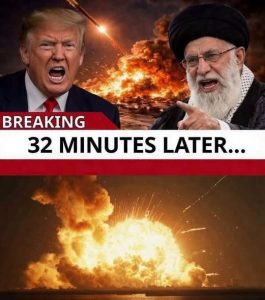
BREAKING NEWS: Iran Tried to Sink a U.S. Aircraft Carrier? What Happened 32 Minutes Later
The headline sounds like something from a Hollywood war movie:
Iran tried to sink a U.S. aircraft carrier—and just 32 minutes later, everything changed.
But when dramatic claims like this begin spreading online, there is an important question that should come before the excitement:
What can actually be confirmed?
The United States and Iran are currently locked in a serious military confrontation, with fighting and tensions surrounding the Strait of Hormuz and other parts of the region. Iran has issued warnings about military escalation and has threatened action against the U.S. naval blockade. (Reuters)
At the same time, a new American aircraft carrier, the USS George Washington, has arrived in the Middle East as the USS Abraham Lincoln prepares to leave after an extraordinarily long deployment. (AP News)
Those facts alone are significant.
But the dramatic claim that Iran attempted to sink an American carrier at a specific moment—and that a major event happened exactly 32 minutes later—requires evidence that has not been established by the reliable sources currently available.
That doesn’t make the broader situation unimportant.
Far from it.
A Dangerous Moment at Sea
Aircraft carriers are among the most heavily protected military platforms in the world.
A carrier does not operate alone. It normally forms the centerpiece of a carrier strike group surrounded by other warships, aircraft and defensive systems.
The purpose is straightforward: protect the carrier from threats arriving by air, sea or underwater.
That makes any alleged attack on a carrier an extraordinarily serious claim.
An attempt to strike one would potentially represent a major escalation, particularly during an already dangerous conflict.
For that reason, claims about such an event should be supported by official statements, multiple reputable news organizations or other independently verifiable evidence.
At the time of writing, those sources have not confirmed the specific “32 minutes later” scenario described in the viral headline.
Iran’s Warnings Have Become More Serious
Even without that particular claim, the military situation is tense.
Iran has warned that it could escalate if the United States does not honor an interim agreement, with an Iranian official telling Reuters that Tehran could take military measures intended to challenge the U.S. naval blockade. (Reuters)
The Strait of Hormuz is especially important.
The waterway is one of the world’s most strategically significant shipping routes, and disruptions there can affect energy markets far beyond the Middle East.
Recent reporting says shipping traffic through the strait remains limited, while tensions between Washington and Tehran continue. (AnewZ)
That means even relatively small military incidents can have consequences far beyond the ships directly involved.
The Arrival of the USS George Washington
One of the most important confirmed developments this week is the arrival of the USS George Washington in the Middle East.
U.S. Central Command said the carrier strike group entered the CENTCOM theater after arriving in the region on Wednesday. (Arab News)
The arrival is significant because it is intended to relieve the USS Abraham Lincoln.
The Lincoln has been deployed for more than 250 days, supporting U.S. military operations during the conflict with Iran. Reports about the length of the deployment have raised concerns about crew exhaustion, morale and supply conditions. (AP News)
The replacement therefore represents more than a routine movement of ships.
It demonstrates that the United States continues to maintain substantial naval forces in the region.
Why the “32 Minutes Later” Claim Matters
Specific time claims are powerful.
A headline saying something happened “32 minutes later” creates the impression that there was a documented chain of events.
It suggests that someone has carefully established the exact timeline.
But a precise number does not automatically make a story reliable.
In the age of social media, exact times can sometimes be inserted into headlines because they make a story sound more dramatic and authoritative.
That is why readers should ask:
Where did the 32-minute figure come from?
Was it provided by the U.S. military?
Was it reported by Iranian officials?
Was it independently verified?
Was there video?
Were multiple sources reporting the same sequence?
Without answers to those questions, the claim should be treated cautiously.
What We Do Know About the Naval Threat
The threat to American naval forces is not imaginary.
The current conflict has already demonstrated that Iran can pose serious risks to American interests throughout the region.
Iranian attacks have affected regional military infrastructure, while the conflict has also created significant logistical consequences for U.S. forces.
Reporting has linked earlier Iranian attacks on a key U.S. facility in Bahrain to supply difficulties affecting the USS Abraham Lincoln’s prolonged deployment. (Palestine Chronicle)
The broader situation is therefore extremely serious even without confirming every sensational story circulating online.
That distinction matters.
Accurate information does not make a crisis less dramatic.
It makes our understanding of the crisis more reliable.
Why Aircraft Carriers Are So Important
An aircraft carrier is essentially a mobile airfield.
Instead of relying on a fixed base, the United States can position a carrier strike group at sea and operate aircraft from its flight deck.
That gives American commanders enormous flexibility.
But it also makes carriers high-value targets.
A successful attack against one would have both military and psychological consequences.
That is why carrier strike groups are surrounded by layers of protection.
Destroyers and cruisers can provide air-defense capabilities.
Aircraft can patrol the surrounding area.
Other systems are designed to detect potential threats before they reach the carrier.
The carrier itself also has defensive systems.
The objective is not simply to survive an attack.
It is to prevent an attacker from getting close enough to launch a successful strike.
The Psychological Battle
Modern conflicts are fought on another battlefield too: information.
Images, videos, headlines and rumors can spread around the world in minutes.
A dramatic claim involving an American aircraft carrier can generate enormous attention because carriers symbolize American military power.
If someone claims that Iran attacked one, readers immediately understand the potential significance.
But that also makes carrier stories especially vulnerable to exaggeration.
A real military incident can become mixed with unverified details.
An old video can be presented as new.
A missile launch from a different event can be mislabeled.
A military exercise can be described as an attack.
And a speculative claim can eventually be repeated so many times that people begin assuming it must be true.
What Happened “32 Minutes Later”?
At present, the safest answer is:
The specific 32-minute sequence has not been independently established by the reliable sources reviewed for this report.
That doesn’t mean nothing happened.
It means the exact claim should not be presented as confirmed.
What is confirmed is that the U.S. continues to operate major naval forces in the region and that the USS George Washington has arrived to take over from the USS Abraham Lincoln. (AP News)
It is also confirmed that tensions involving Iran, the United States and the Strait of Hormuz remain high. (AnewZ)
Those developments are already consequential.
Why Verification Matters During a War
During a military conflict, inaccurate information can have consequences beyond embarrassing headlines.
False reports can increase public fear.
They can influence financial markets.
They can affect perceptions of military strength.
They can even contribute to escalation if people believe an attack has occurred when it has not.
That is why responsible reporting requires separating confirmed events from allegations and speculation.
A sensational headline may attract millions of clicks.
A carefully verified timeline may attract fewer.
But the second is far more valuable.
The Bigger Picture
Whether or not the specific viral claim about an attempted sinking proves true, the strategic situation remains dangerous.
The United States continues to maintain powerful naval forces in the Middle East.
Iran continues to threaten escalation.
The Strait of Hormuz remains a major pressure point.
And diplomatic efforts remain uncertain. (AnewZ)
The arrival of the George Washington shows that Washington is maintaining its ability to project air power in the region even as the Lincoln’s extraordinary deployment comes to an end.
That transition itself is a major military development.
The Bottom Line
The phrase “Iran tried to sink a U.S. aircraft carrier” makes for an explosive headline.
But extraordinary military claims require extraordinary evidence.
As of the latest reporting available, there is no reliable confirmation for the precise claim that Iran attempted to sink a U.S. carrier followed by a specific event exactly 32 minutes later.
What is confirmed is serious enough: the United States and Iran remain engaged in a dangerous confrontation, the Strait of Hormuz remains a major flashpoint, and American carrier forces continue operating in the region.
The USS George Washington has now arrived to relieve the USS Abraham Lincoln after one of the longest carrier deployments in recent U.S. military history. (AP News)
So before sharing the dramatic “32 minutes later” story, it is worth asking one simple question:
Do we know what happened—or do we only know what the headline claims happened?
In a rapidly developing war, that difference can matter enormously.