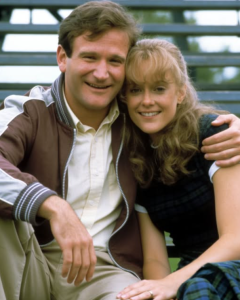
NAME THE MUCH-MISSED STAR IN THIS OFFBEAT 80s DRAMA!
📚 Bonus points if you can name the actress beside him! 📚
Released on this day in 1982, The World According to Garp introduced cinema audiences to a remarkable dramatic performance from a man who would go on to become one of the most beloved entertainers of his generation. While the world would later know him for his explosive improvisation, boundless energy and unforgettable comic performances, this film revealed a very different side of his extraordinary talent.
The actor is Robin Williams, and the actress beside him is the wonderful Mary Beth Hurt, who played his devoted wife, Helen Holm.
Looking back today, The World According to Garp stands as one of the most unusual and ambitious films of the early 1980s. Adapted from John Irving’s hugely successful 1978 novel, it blended comedy, tragedy, satire and family drama into something that defied easy categorisation. It was funny one moment, heartbreaking the next, and often deeply philosophical—all qualities that demanded a lead actor capable of balancing wildly different emotional tones.
Robin Williams proved he was exactly the right choice.
At the time, audiences primarily associated Williams with comedy. His breakthrough had come through the television sitcom Mork & Mindy, where his portrayal of the lovable alien Mork made him an overnight sensation. His lightning-fast improvisation, limitless imagination and manic energy seemed almost impossible to contain, and Hollywood quickly recognised that he possessed a comic gift unlike anyone else.
Many expected him to spend his career making audiences laugh.
Instead, Williams surprised everyone.
In The World According to Garp, he played T. S. Garp, a thoughtful writer whose life unfolds through a series of bizarre, humorous and often painful experiences. Rather than relying on rapid-fire jokes, Williams embraced subtlety. His Garp is curious, insecure, loving, occasionally jealous and deeply protective of those closest to him.
It was one of the earliest signs that Robin Williams could do far more than comedy.
His performance remains remarkably restrained.
Instead of dominating every scene with exuberance, he listens, reacts and allows the emotions to develop naturally. The humour comes not from exaggerated performance but from the wonderfully eccentric situations that surround Garp and the unforgettable characters who populate his life.
Opposite Williams is Mary Beth Hurt, delivering one of the finest performances of her career as Helen Holm, Garp’s intelligent and independent wife.
Helen is far more than simply the supportive spouse often found in literary adaptations. She is a teacher, a mother and a woman with ambitions and frustrations of her own. Hurt portrays her with remarkable honesty, allowing audiences to understand both her strengths and her flaws.
The chemistry between Hurt and Williams is one of the film’s greatest achievements.
Their relationship feels genuine, affectionate and occasionally strained in ways that reflect real married life. They share moments of tenderness, humour, anger and heartbreak, creating a believable partnership that anchors even the film’s strangest events.
The story itself is anything but conventional.
John Irving’s novel had earned widespread acclaim for its imaginative storytelling and fearless willingness to tackle complex subjects including family, identity, sexuality, feminism, loss and the unpredictability of life.
Director George Roy Hill, already celebrated for classics such as Butch Cassidy and the Sundance Kid and The Sting, understood that adapting such an unconventional novel required careful balance. Rather than attempting to simplify the story, he embraced its eccentricity while ensuring its emotional core remained intact.
The result is a film unlike almost anything else released during that period.
One of its greatest strengths is its remarkable supporting cast.
Glenn Close, in her film debut, received an Academy Award nomination for her unforgettable portrayal of Jenny Fields, Garp’s fiercely independent mother. Intelligent, unconventional and uncompromising, Jenny becomes an accidental feminist icon through her bestselling autobiography.
Her relationship with Garp forms the emotional foundation of the entire story.
The film also features memorable performances from John Lithgow, who earned an Academy Award nomination for playing Roberta Muldoon, a transgender former football player. At a time when such characters were rarely portrayed with dignity or compassion in mainstream cinema, Lithgow’s sensitive performance was widely praised and remains an important milestone in Hollywood representation.
Robin Williams found himself surrounded by actors working at the very highest level.
Yet he never disappeared into the ensemble.
Instead, he quietly guided audiences through Garp’s extraordinary life, making every joy and every tragedy feel authentic.
Watching the film today, it is fascinating to see how many qualities that later defined Williams’ greatest dramatic performances are already present. The empathy he would bring to films such as Dead Poets Society, Good Will Hunting, Awakenings and The Fisher King can all be glimpsed here.
Even in his earliest dramatic work, Williams possessed an extraordinary ability to communicate vulnerability.
He made audiences care.
Throughout his remarkable career, Robin Williams continually surprised viewers by moving effortlessly between broad comedy and profound drama. Whether portraying an inspirational teacher, a compassionate therapist, a lonely widower or a devoted father, he always approached his characters with humanity and kindness.
Those qualities made him one of the world’s most cherished performers.
Sadly, Williams passed away in 2014, leaving millions of fans devastated. Tributes poured in from fellow actors, directors, comedians and audiences across the globe, all reflecting on the joy, comfort and inspiration he had provided over four decades of extraordinary work.
His legacy remains immense.
He won an Academy Award for Good Will Hunting, received multiple Golden Globe Awards, Emmy Awards and Grammy Awards, and starred in countless films that continue to delight new generations of viewers.
Yet long before those achievements, The World According to Garp quietly demonstrated just how gifted he truly was.
It showed that behind the whirlwind of comic invention was an actor capable of remarkable emotional depth.
Today, the film enjoys an enduring reputation as one of the most distinctive literary adaptations of the 1980s. Its blend of satire, romance, family drama and bittersweet humour has aged remarkably well, while its exploration of life’s unpredictability feels just as relevant now as it did upon release.
Robin Williams’ performance sits at the heart of that achievement.
He doesn’t simply play Garp.
He allows audiences to experience Garp’s hopes, fears, disappointments and triumphs as though they were their own.
Alongside him, Mary Beth Hurt provides the perfect emotional counterbalance, creating one of the most believable marriages seen in cinema during that era.
Together they anchor a story filled with extraordinary events through performances grounded in emotional truth.
More than forty years after its release, The World According to Garp remains an essential chapter in Robin Williams’ extraordinary career—not because it contains his biggest laughs, but because it revealed the remarkable dramatic actor hiding behind the comic genius.
So if you recognised the gentle smile and unmistakable warmth of Robin Williams, you were absolutely right.
And if you also identified Mary Beth Hurt as the actress beside him, you’ve earned those bonus points.
Their performances helped transform The World According to Garp into one of the most distinctive, moving and quietly brilliant films of the early 1980s—a reminder that Robin Williams’ greatest gift wasn’t simply making people laugh, but making them feel every emotion in between.