BREAKING NEWS: “13 Countries Join Forces to Attack” — What We Actually Know
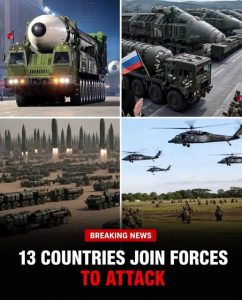
A dramatic image circulating online is sending social media into a frenzy with a huge warning: “13 COUNTRIES JOIN FORCES TO ATTACK.” The picture appears to show missiles, military vehicles, helicopters and troops, creating the impression that a massive international military operation is already underway.
But before sharing a headline this alarming, there is an important distinction to make.
There is no reliable confirmation that 13 countries have formed a coalition specifically to launch a coordinated attack in the way the viral headline suggests.
The claim appears to be connected to real developments involving multinational military cooperation, but the wording “13 countries join forces to attack” dramatically oversimplifies—and in some versions appears to distort—what has actually been reported.
Recent reporting does confirm that international military alliances and coalitions are expanding as conflicts and security tensions continue to affect the Middle East and other regions. But a defensive coalition, a security partnership and a coordinated offensive attack are not necessarily the same thing.
That distinction matters.
Where Did the “13 Countries” Claim Come From?
One real development involving exactly 13 countries was reported in July 2026, when Saudi Arabia announced efforts to establish an international coalition to protect shipping in the Red Sea from attacks by Iran-backed Houthi forces in Yemen.
According to Al Jazeera, dozens of countries were invited to participate, and Saudi Arabia said 13 countries had agreed to join the proposed mission. (Al Jazeera)
That is likely one reason the number 13 has appeared in viral posts.
But the reported purpose was maritime security and protection of shipping, not a declaration that 13 nations had suddenly united to launch an unspecified attack on another country.
The difference is enormous.
A multinational force can be created to defend shipping lanes, protect military installations, deter attacks or provide surveillance without automatically meaning that its members have agreed to launch a new war.
The Viral Image Tells a Different Story
The image accompanying the headline is designed to create a sense of urgency.
It combines several military-looking scenes into a single graphic: a large missile transporter, military vehicles, helicopters and what appears to be a large deployment of equipment.
For someone scrolling quickly through social media, the image can make the headline appear immediately credible.
But photographs do not automatically prove the claim written over them.
Military equipment can be photographed years before a particular event. Images can be taken in completely different countries, during exercises, parades, training operations or previous conflicts.
A photograph of a missile transporter does not prove that the vehicle has been deployed for a newly announced attack.
Likewise, helicopters flying over troops do not establish who those troops are, where the photograph was taken or what operation they are participating in.
That is why journalists and fact-checkers normally require additional evidence before treating a dramatic image as proof of a breaking military development.
Why the Headline Is So Powerful
The wording “13 countries join forces to attack” is extremely effective at grabbing attention.
It creates several immediate questions:
Who are the 13 countries?
Who are they attacking?
When will the attack begin?
Has war already started?
Are other nations going to become involved?
Those questions encourage people to click, comment and share.
And that is exactly why sensational headlines spread so quickly online.
A post does not necessarily need to provide complete information to become viral. In fact, uncertainty can make a headline even more powerful because readers begin searching for answers themselves.
The problem is that by the time reliable information reaches the public, the original claim may already have been shared thousands of times.
There Really Is Increased Military Cooperation
That does not mean nothing is happening internationally.
Far from it.
The security environment in 2026 is extremely tense, with military forces operating across multiple regions and governments increasing cooperation.
The United States has also been developing new multinational military capabilities.
In August, U.S. Central Command announced the creation of Task Force Falcon Strike, described as a first-ever multinational attack-drone task force. CENTCOM said regional partners were being consulted and formally invited to participate. At the time of the announcement, however, officials did not say that other countries had already joined the unit. (DefenseScoop)
That is another important example of why careful wording matters.
There is a real multinational military initiative.
But that is not the same thing as saying 13 countries have suddenly united to launch an attack.
Defensive and Offensive Operations Are Different
Military alliances often use language such as “deterrence,” “defense,” “security,” “freedom of navigation” and “protection.”
These terms can sound similar to someone unfamiliar with military planning, but they can represent very different missions.
For example, an international force protecting commercial ships in a dangerous sea lane might escort vessels, conduct surveillance, intercept attacks or protect shipping infrastructure.
That is fundamentally different from a coalition whose stated objective is to invade another country.
The July Red Sea coalition is a useful example.
Saudi Arabia’s effort was announced amid attacks and threats against shipping, particularly around the Red Sea and Bab al-Mandeb. Al Jazeera reported that the mission was intended to guard the shipping route. (Al Jazeera)
Therefore, describing the development simply as “13 countries join forces to attack” leaves out the most important part of the story.
Why the Public Should Be Careful
False or misleading military claims can have consequences.
When people believe that a huge international attack is imminent, fear can spread rapidly.
People may begin sharing unverified videos.
Old photographs may suddenly be presented as new.
Unrelated military exercises can be described as emergency deployments.
And ordinary citizens may mistake speculation for confirmed information.
This is particularly dangerous during periods of genuine conflict because the public is already receiving large amounts of confusing information.
A real missile launch may appear alongside a fake military map.
A genuine photograph may be placed under a false caption.
A legitimate government statement may be combined with an invented conclusion.
The result can look convincing even when the overall story is inaccurate.
What About the Countries Involved?
The viral headline does not reliably establish a list of 13 nations participating in a coordinated offensive.
That alone should be a warning sign.
If 13 countries had formally agreed to launch a major international attack, such a development would be extraordinarily significant. Governments would be expected to issue statements, defense ministries would likely provide details, and major international news organizations would report the development from multiple angles.
Instead, the versions of the viral claim circulating online tend to provide dramatic imagery and vague language while offering little verifiable information about the supposed attack.
That is not enough to establish that a new 13-nation offensive coalition exists.
The Real Danger Is Misinterpretation
Perhaps the most important lesson from this viral story is that a real event can be transformed into a misleading story.
The existence of multinational military cooperation is real.
The number 13 has appeared in connection with a real international coalition.
Military forces are genuinely operating in tense regions.
But those facts do not automatically prove the dramatic conclusion presented by the headline.
This is a common pattern online.
A real event provides the foundation.
A dramatic headline is added.
An unrelated or recycled photograph is placed underneath it.
Then the entire package is presented as breaking news.
Readers who recognize the real elements may assume the entire story must be true.
But each individual claim still needs to be checked.
What Happens Next?
The international security situation remains fluid, and military developments can change rapidly.
New alliances may be created.
Countries may increase deployments.
Defense forces may conduct exercises.
Ships may be moved.
Aircraft may be repositioned.
And governments may announce new security missions.
But those developments should be distinguished from claims that a major offensive has already been launched.
At present, the evidence available does not support treating the viral phrase “13 countries join forces to attack” as confirmation of a new 13-nation attack.
Instead, the headline appears to be taking real developments involving multinational defense cooperation and turning them into a much more dramatic narrative.
Don’t Let a Red “BREAKING NEWS” Banner Decide What Is True
One of the most recognizable features of viral misinformation is the use of urgent visual design.
Red banners.
Capital letters.
Multiple exclamation marks.
Military photographs.
Words such as BREAKING, URGENT, ATTACK, WAR and ALERT.
These design elements are intended to trigger an emotional response before the reader has time to investigate.
The image attached to this claim does exactly that.
It looks serious.
It looks frightening.
It looks official.
But appearance is not verification.
The best response to a dramatic military headline is not panic.
It is patience.
Check the date.
Check the source.
Look for official statements.
Compare multiple reputable news organizations.
Determine whether the photograph actually comes from the event being described.
And most importantly, ask whether the headline is describing what authorities actually said—or what the person posting it wants readers to believe.
The Bottom Line
The headline “13 Countries Join Forces to Attack” should not currently be treated as verified confirmation of a new 13-nation offensive.
There has been a genuine development involving 13 countries and a Saudi-led effort related to protecting Red Sea shipping. (Al Jazeera)
There are also genuine multinational military initiatives developing elsewhere, including the U.S. Central Command’s Task Force Falcon Strike, which was announced in August as a multinational attack-drone effort but had not, at announcement, been confirmed as joined by a specific group of 13 countries. (DefenseScoop)
Those facts are serious enough on their own.
There is no need to exaggerate them.
The viral image may be striking, but an image cannot establish the existence of a new international war.
So if this post appears in your social-media feed, take a moment before sharing it.
Thirteen countries cooperating on defense or maritime security is not the same as thirteen countries joining an offensive attack.
In a world already filled with real conflicts and genuine military threats, accurate information matters more than ever.
Stay alert. Stay informed. And verify before you share.