White House Physician Releases Trump Health Update — What the Medical Record Actually Says
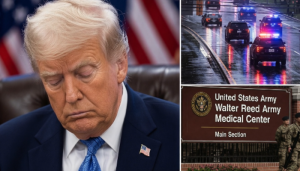
A dramatic image circulating online claims that President Donald Trump has been “admitted to hospital” and pairs the message with photographs of Trump and Walter Reed National Military Medical Center. The graphic is presented as breaking news and appears designed to suggest that the president is currently facing a serious medical emergency.
But the available evidence tells a very different story.
As of the latest credible reporting, there is no evidence that Trump has been admitted to Walter Reed for an emergency hospitalization. A similar claim circulated widely in August 2026, including posts accompanied by an apparently AI-generated video. Fact-checking reports found no evidence that Trump had been hospitalized at Walter Reed. (Hindustan Times)
The confusion appears to stem partly from the fact that Trump really has visited Walter Reed in 2026—but those visits were for medical examinations rather than an emergency admission.
Trump Did Visit Walter Reed
On May 26, 2026, Trump underwent a scheduled medical examination at Walter Reed National Military Medical Center.
Trump himself announced afterward that he had completed what he called his “6 month physical” and said that everything had checked out “PERFECTLY.” (CBS News)
The White House subsequently released a detailed memorandum from Navy Capt. Sean Barbabella, the physician to the president.
The memo said that Trump underwent his annual medical examination at Walter Reed on May 26. The evaluation included laboratory testing, diagnostic studies and consultations with 22 specialty providers from multiple academic institutions. (The American Presidency Project)
That is an important distinction.
A visit to Walter Reed does not automatically mean that a president has been hospitalized. Walter Reed is a major military medical facility capable of conducting routine examinations, advanced imaging, specialist consultations and other forms of preventive care.
In Trump’s case, the publicly released information characterized the May visit as a comprehensive medical examination.
What Did the White House Physician Say?
The most important information comes from the physician’s report rather than the sensational social-media graphic.
Barbabella said Trump remained in “excellent health” and demonstrated strong cardiac, pulmonary, neurological and overall physical function. The report also stated that he was considered fully fit to perform the duties of president and commander in chief. (The Washington Post)
The examination reportedly included cardiovascular imaging, a CT scan, cancer screenings and other preventive assessments.
The physician also said Trump scored 30 out of 30 on the Montreal Cognitive Assessment, a standardized screening tool for cognitive impairment. His neurological examination was described as showing no abnormalities. (Anadolu Ajansı)
These findings are the basis for the White House’s public assessment that Trump was medically fit to continue serving.
Why Are People Talking About His Health?
Although the official medical report was reassuring, questions about Trump’s health have continued.
Some of the discussion has focused on visible bruising on his hands and swelling in his lower legs. These observations have prompted outside doctors and journalists to ask additional questions about his health, particularly because Trump is the oldest person ever to serve as U.S. president.
The White House physician addressed some of these concerns.
According to the medical report, Trump had slight lower-leg swelling that had improved compared with the previous year. He had previously been diagnosed with chronic venous insufficiency, a condition that can cause blood to pool in the lower legs and produce swelling. (Hindustan Times)
The physician also described the bruising on Trump’s hands as minor soft-tissue irritation associated with frequent handshaking and noted that aspirin therapy can contribute to bruising.
These statements do not mean that every question surrounding Trump’s health has disappeared. Independent physicians have continued to debate whether the information released by the White House provides a complete picture.
But questioning the completeness of a medical disclosure is very different from having evidence that the president has been admitted to a hospital.
The Viral “Hospital Admission” Claim
The image circulating online makes a much stronger claim.
Its large text reads “ADMITTED TO HOSPITAL,” while the accompanying photographs include Walter Reed and Trump looking serious.
The visual presentation is typical of social-media posts designed to create an immediate sense of urgency.
However, there is a major problem with the claim: the image itself is not evidence of hospitalization.
A photograph of Walter Reed proves only that the medical center exists. A photograph of Trump proves only that the person pictured is Trump. Neither photograph establishes that he was admitted to the hospital at the time the post was published.
Recent fact-checking has specifically addressed claims that Trump was taken to Walter Reed and found no evidence supporting the idea that he had been admitted. One viral post even used an AI-generated video that appeared to show bodyguards carrying Trump near a hospital. (Hindustan Times)
That is why readers should be particularly cautious with dramatic “breaking news” graphics.
A Real Medical Visit Can Become a False Story
One reason these rumors can appear convincing is that they often begin with a genuine fact.
Trump really did visit Walter Reed.
He really did undergo medical testing.
His physician really did release a medical report.
Those facts can then be rearranged into a completely different narrative.
A post might take a photograph from a legitimate hospital visit and combine it with a headline suggesting an emergency admission. Someone encountering the image without knowing the original context may reasonably assume that the headline is reporting a new development.
But the difference between “visited Walter Reed for a scheduled physical” and “was admitted to Walter Reed” is enormous.
The first is documented.
The second requires separate evidence.
Trump’s July Medical Statement
The situation became even more confusing because Trump later said in July that he had completed another physical examination at Walter Reed.
On July 11, Trump said he had just completed a “perfect” physical at the military medical center and said he had requested another cognitive test. He stated that he had received perfect scores on the tests he had taken. (Anadolu Ajansı)
Again, however, this was described as a medical examination rather than an emergency hospitalization.
The existence of repeated medical evaluations is not itself evidence of a serious medical crisis.
Presidents receive extensive medical care because of the responsibilities of the office. A president’s health is a matter of national interest, and presidential medical teams routinely conduct preventive examinations and specialist consultations.
Why Walter Reed Matters
Walter Reed National Military Medical Center has become particularly associated with presidential health because it is one of the country’s leading military medical facilities.
When a president is photographed arriving or leaving Walter Reed, the image can immediately generate public interest.
That does not mean every visit represents a crisis.
Walter Reed provides a wide range of medical services, including routine examinations and advanced diagnostic testing. The May 2026 visit, for example, involved numerous specialists and extensive preventive testing. (The Washington Post)
The scale of the examination may sound dramatic to the general public, but comprehensive medical evaluations for a president are inherently extensive.
Why Verification Matters
Health rumors involving public figures can cause unnecessary alarm.
When the person involved is the president of the United States, the consequences can be even greater. A false claim about a presidential hospitalization can spread rapidly across social media, influence public discussion and potentially create confusion about the president’s ability to perform his duties.
This is why credible reporting matters.
Before accepting a headline like “Admitted to Hospital,” readers should ask several questions:
- Who reported the hospitalization?
- Has the White House confirmed it?
- Has the president’s physician issued a statement?
- Is there a credible news organization independently reporting the same information?
- Is the photograph actually from the event being described?
- Could the image be old or digitally manipulated?
If those questions cannot be answered, the claim should not automatically be treated as fact.
What We Can Say With Confidence
Based on the available evidence, Trump has undergone medical evaluations at Walter Reed in 2026, including a major examination on May 26.
His physician subsequently described him as being in excellent health and fully fit to perform his presidential duties. (The Washington Post)
There have also been legitimate discussions about his visible hand bruising, lower-leg swelling and the transparency of presidential medical disclosures.
But those issues should not be confused with proof of an emergency hospitalization.
The viral graphic claiming that Trump was “admitted to hospital” therefore goes beyond what the available evidence establishes.
Final Thoughts
The dramatic image circulating online is a powerful example of how quickly a genuine event can be transformed into a misleading story.
Donald Trump did visit Walter Reed for medical examinations in 2026, and his physician released an extensive report about his health. The report described him as being in excellent health and fit to serve. (The American Presidency Project)
At the same time, recent reports have documented false social-media claims that Trump was urgently taken to Walter Reed, including material involving apparent AI-generated imagery. There is no credible evidence supporting the claim that he was admitted to the hospital in the circumstances suggested by the viral graphic. (Hindustan Times)
That does not mean questions about presidential health should be ignored. Quite the opposite: the health of a sitting president deserves careful scrutiny and accurate reporting.
But scrutiny requires evidence.
A photograph of a hospital, a serious-looking expression and a large “BREAKING NEWS” banner may create an emotional impression, but they do not establish a medical diagnosis or hospitalization.
For now, the documented medical update is considerably less dramatic than the viral graphic suggests: Trump has undergone extensive medical examinations, his physician has publicly described his overall health as excellent, and the claim that he has been admitted to Walter Reed is not supported by credible evidence.
I can also create a fact-check-style image that clearly separates the verified health update from the viral hospitalization claim.