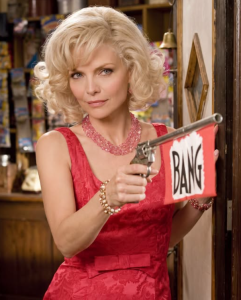
The Hollywood star is Michelle Pfeiffer.
Released on this day in 2007, Hairspray brought one of Broadway’s most beloved musicals to the big screen in a dazzling explosion of colour, music and optimism. Packed with an all-star cast that included John Travolta, Nikki Blonsky, Queen Latifah, Zac Efron, Amanda Bynes, Christopher Walken and James Marsden, the film delighted audiences with its infectious songs and heartfelt message about acceptance and equality. Yet among all the singing and dancing, one performer stood out by embracing a role unlike almost anything she’d done before. Michelle Pfeiffer, long regarded as one of Hollywood’s most glamorous leading ladies, gleefully stepped into the role of Velma Von Tussle, the calculating television producer and former beauty queen determined to keep her daughter at the top of Baltimore’s teenage dance scene.
By 2007, Michelle Pfeiffer had already enjoyed a remarkable career spanning more than three decades. She had earned a reputation for combining extraordinary beauty with serious acting talent, refusing to be pigeonholed as merely another Hollywood blonde. While audiences often admired her elegance and sophistication, Pfeiffer consistently chose challenging, unpredictable roles that showcased her remarkable versatility. Playing Velma allowed her to have enormous fun as a deliciously over-the-top villain while still grounding the character in genuine ambition and insecurity.
Born on April 29, 1958, in Santa Ana, California, Pfeiffer had no immediate plans to become an actress. Like many future stars, she worked ordinary jobs while figuring out her future. After entering beauty pageants—including Miss Orange County—she caught the attention of talent scouts, leading to acting lessons and television appearances. Although her earliest performances were modest, Hollywood quickly recognised that she possessed a rare combination of screen presence, intelligence and charisma.
Her breakthrough came in 1983 with Brian De Palma’s Scarface. Playing Elvira Hancock opposite Al Pacino’s Tony Montana, Pfeiffer delivered a cool, understated performance that perfectly contrasted the explosive violence surrounding her. Dressed in glamorous fashions and exuding effortless sophistication, she became one of the defining screen icons of the decade. Although the film divided critics upon release, it has since become a classic, and Pfeiffer’s performance remains one of its most memorable elements.
The 1980s proved to be a golden era for her career. She impressed critics in Ladyhawke, showcased her romantic charm in The Witches of Eastwick, and earned widespread acclaim for Dangerous Liaisons, where she held her own alongside Glenn Close and John Malkovich. That performance earned her an Academy Award nomination and demonstrated that she was far more than a glamorous movie star.
She followed this with another Oscar-nominated role in The Fabulous Baker Boys (1989), playing Susie Diamond, a singer whose sultry rendition of “Makin’ Whoopee” atop a piano became one of the most unforgettable scenes in modern cinema. Pfeiffer brought vulnerability, confidence and emotional depth to the character, creating one of the finest performances of her career.
Throughout the 1990s, Pfeiffer continued to surprise audiences. She tackled drama in Love Field and The Age of Innocence, romantic comedy in One Fine Day, fantasy in Stardust later on, and family adventure in The Story of Us. She refused to settle into one particular genre, constantly reinventing herself.
For many fans, however, one role towers above the rest: Selina Kyle, better known as Catwoman, in Tim Burton’s Batman Returns (1992). Pfeiffer transformed the comic-book character into something unforgettable—seductive, dangerous, tragic and strangely sympathetic. Her stitched vinyl costume became instantly iconic, while her whip skills, feline movements and unforgettable one-liners elevated Catwoman into one of cinema’s greatest villains. Even decades later, many superhero fans still consider Pfeiffer’s Catwoman the definitive live-action version.
After focusing more on family life during the early 2000s, Pfeiffer became increasingly selective about her projects. When Hairspray came along, it offered the perfect opportunity to showcase a lighter side of her talent. Instead of playing the elegant heroine, she embraced the deliciously wicked Velma Von Tussle.
Velma is a former beauty queen who now manages The Corny Collins Show, Baltimore’s most popular television dance programme. Obsessed with maintaining her family’s social status and determined that her daughter Amber remains the show’s biggest star, Velma uses manipulation, prejudice and sabotage to crush anyone who threatens their position.
Pfeiffer approached the role with theatrical flair, balancing camp comedy with genuine menace. She sang, danced and delivered razor-sharp dialogue while never letting the character become a simple cartoon villain. Beneath Velma’s confidence lies desperation—a woman terrified of losing relevance in a rapidly changing world.
One of the film’s great strengths is that it uses humour to explore serious issues. Set in 1962 Baltimore, Hairspray centres on the fight to integrate local television programming. Velma represents resistance to social progress, while heroine Tracy Turnblad champions inclusion and equality. Pfeiffer’s performance gives the story a formidable antagonist, making Tracy’s triumph all the more satisfying.
Her musical numbers showcased talents that audiences hadn’t often seen. Songs like “Miss Baltimore Crabs” allowed Pfeiffer to lean fully into Broadway-style performance, delivering exaggerated expressions, comic timing and theatrical energy that fit perfectly within the film’s joyful tone.
The cast itself became one of the biggest talking points of the movie. John Travolta’s transformation into Edna Turnblad drew headlines, while newcomer Nikki Blonsky won audiences’ hearts as Tracy. Christopher Walken brought warmth as Wilbur Turnblad, Queen Latifah radiated authority as Motormouth Maybelle, Zac Efron charmed as Link Larkin, and James Marsden sparkled as Corny Collins. Surrounded by such colourful performances, Pfeiffer never disappeared into the ensemble. Instead, she embraced the role of glamorous antagonist with obvious delight.
Released on July 20, 2007, Hairspray became both a critical and commercial success. Reviewers praised its exuberant energy, memorable musical numbers and uplifting themes. The film introduced a new generation to the beloved stage musical while celebrating diversity, body positivity and racial integration through irresistible entertainment.
In the years that followed, Michelle Pfeiffer continued to enjoy an impressive career resurgence. She appeared in Mother!, Murder on the Orient Express, Maleficent: Mistress of Evil, and entered the Marvel Cinematic Universe as Janet van Dyne in the Ant-Man films. Each performance reinforced her reputation as one of Hollywood’s most dependable and captivating actresses.
Part of Pfeiffer’s enduring appeal lies in her refusal to rely solely on glamour. Although she has consistently been regarded as one of cinema’s great beauties, she has always prioritised character over image. Whether portraying a tragic singer, a ruthless aristocrat, a lonely wife, a comic-book antihero or an outrageous musical villain, she brings intelligence, emotional honesty and effortless charisma.
Looking back, Hairspray stands as one of the most entertaining chapters in Michelle Pfeiffer’s remarkable career. It allowed audiences to see a playful side of an actress often associated with dramatic elegance. As Velma Von Tussle, she relished every wicked grin, every cutting remark and every outrageous scheme, creating a villain audiences loved to hate.
From the icy sophistication of Scarface, to the unforgettable claws of Catwoman, and finally to the hairspray-fuelled scheming of Velma Von Tussle, Michelle Pfeiffer has repeatedly proven that true movie stars are never confined by a single image. Whether playing heroine, antihero or villain, she possesses that rare ability to command the screen the moment she appears—a gift that has kept her among Hollywood’s brightest and most respected stars for more than four decades.