“2 Hours Ago! Fierce Naval Battle: U.S. …” — What the Dramatic Image Really Shows
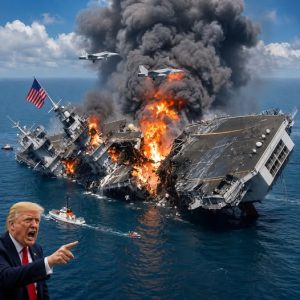
A dramatic image circulating online appears to show an American aircraft carrier engulfed in flames after a devastating naval battle. The accompanying headline begins with “2 hours ago! Fierce naval battle: US st…”, creating the impression that a major maritime confrontation has just taken place.
The image is striking: a massive warship appears broken apart in the ocean, flames pour from its deck, thick black smoke rises into the sky, fighter jets fly overhead, and small boats race toward the scene. A photograph of Donald Trump has also been placed in the foreground.
But there is a major reason to be cautious before treating this as breaking news.
The image itself is not evidence that such an event happened. Its highly cinematic appearance strongly suggests that it is a digitally created or manipulated illustration rather than an authentic photograph of a current naval battle.
That distinction is especially important because there is genuine military activity involving U.S. forces in 2026, meaning a fabricated image can easily be mistaken for documentation of a real event.
A Dramatic Picture With a Dramatic Message
The photograph has all the visual ingredients of a breaking-war-news graphic.
A huge warship is apparently sinking.
Aircraft are flying through smoke.
The sea is filled with flames and wreckage.
A U.S. flag is visible on the damaged vessel.
And Trump appears in the lower corner, pointing toward the destruction.
The composition is designed to communicate one simple message: something catastrophic has just happened to the United States Navy.
But real breaking-news photographs usually contain identifiable details that allow journalists and military analysts to establish where and when the photograph was taken. This image instead has the polished, almost movie-poster quality commonly associated with AI-generated social-media graphics.
That doesn’t establish the exact origin of the image by itself, but it is a strong reason not to present the picture as photographic evidence.
There Is a Real U.S.-Iran Conflict Behind the Rumor
The background is important.
The United States has genuinely been involved in a military conflict with Iran in 2026. Recent reporting has described extended U.S. Navy operations in the Middle East, including the deployment of the aircraft carrier USS Abraham Lincoln.
The Lincoln has been at sea for an exceptionally long period, and lawmakers have raised concerns about conditions aboard the ship. Reports have included concerns about morale, supplies, maintenance and the psychological strain of an unusually prolonged deployment. (Al Jazeera)
That real military situation creates an environment in which dramatic false images can spread very quickly.
Someone seeing an image of a burning aircraft carrier may already know that American forces are operating in the region. The picture can therefore appear believable even when it does not represent a real event.
The USS Abraham Lincoln Is Not Shown as Sunk
The current reporting does not establish that the USS Abraham Lincoln has been destroyed in a naval battle matching the image.
In fact, recent reporting has continued to discuss the Lincoln as an operational carrier deployed in the Middle East.
The carrier’s extraordinarily long deployment has become a major story in its own right. According to reports, it has been at sea since November 2025 and has been operating in the Middle East since January 2026. Its mission was originally expected to end much earlier but has repeatedly been extended because of the war with Iran. (Al Jazeera)
The situation has generated legitimate concerns.
But concern about an exhausted crew is not the same thing as evidence that the ship has been sunk.
Why the Image Looks Suspicious
There are several visual characteristics that make the picture unsuitable as evidence of a real naval disaster.
The destruction appears extraordinarily cinematic. The carrier is shown breaking apart in a way that resembles a Hollywood action sequence, while multiple aircraft are positioned dramatically above the smoke.
The composition also appears unusually clean for a genuine battlefield photograph.
Real combat photographs generally contain visual imperfections: obscured objects, uncertain perspectives, distant subjects, motion blur, smoke blocking details and other characteristics caused by the difficulty of photographing an active military engagement.
AI-generated images often produce the opposite effect.
They can create spectacular scenes in which every element is positioned for maximum drama.
This image fits that pattern.
The Trump Photograph Is Another Clue
The picture also includes Donald Trump in the foreground.
That is unusual for a genuine battlefield photograph.
A president would not normally appear physically composited into a photograph showing a distant naval battle. The inclusion of Trump’s image is therefore an editorial device designed to connect the alleged event directly to the president.
It makes the graphic more emotionally powerful.
The viewer is encouraged to associate Trump personally with the military catastrophe being depicted.
That technique is common in social-media thumbnails and viral political content.
It does not establish that Trump was present at the event—or that the event itself happened.
What Is Actually Happening With the U.S. Navy?
While the dramatic image is questionable, the U.S. Navy is undergoing significant changes.
The Trump administration has been pursuing an ambitious shipbuilding agenda known as the “Golden Fleet.” A Navy shipbuilding plan released in May described a goal of expanding the fleet and rebuilding America’s maritime industrial capacity. (U.S. Department of War)
More recently, Trump has pushed for changes to future aircraft-carrier designs.
Reports on August 24 said Trump wants changes to the superstructure of future Gerald R. Ford-class carriers, potentially moving the island structure closer to the center of the ship. Analysts have warned that such a modification could increase costs and cause delays because the superstructure is deeply integrated into the carrier’s systems. (Українські Національні Новини (УНН))
These are major naval developments—but they have nothing to do with an aircraft carrier being destroyed in the dramatic scene shown in the viral image.
Trump and the Future of American Aircraft Carriers
Another significant development is the administration’s interest in changing how future aircraft carriers operate.
Recent reports say Trump has directed the Navy to reconsider electromagnetic aircraft-launch systems and return to steam-powered catapults for future carriers. (The Defense Post)
The debate illustrates how much attention the administration is placing on naval power.
The Navy is considering questions involving ship design, aircraft-launch systems, fleet size and industrial capacity.
These issues are important because aircraft carriers remain central to America’s ability to project military power far from its shores.
But none of them provides evidence that the burning carrier in the viral graphic is real.
A Real War Can Produce Fake Images
This is perhaps the most important lesson.
False images do not necessarily appear during peaceful periods.
In fact, they can become more convincing during genuine conflicts.
When a real war is taking place, people know that ships can be attacked, aircraft can be destroyed and military personnel can be placed in danger. A fabricated image therefore fits into an existing narrative.
That makes verification more difficult.
The viewer thinks:
There is a war.
American ships are there.
Therefore, this photograph could be real.
But those three facts do not prove that the specific event shown in the picture occurred.
Each major claim requires independent evidence.
What Would Confirm a Naval Disaster?
If an American aircraft carrier had actually been sunk in a major naval battle only two hours earlier, the event would be extraordinarily significant.
A carrier is one of the largest and most strategically important military assets in the world.
Such an event would likely generate immediate reporting from multiple major news organizations, the Pentagon, the U.S. Navy and officials from the country involved.
There would also likely be extensive discussion among military analysts.
A single social-media graphic would not be sufficient evidence.
This is why readers should look for corroboration before sharing a dramatic image.
The Human Cost Behind the Clickbait
There is also a serious human dimension to naval warfare.
An aircraft carrier can carry thousands of sailors and Marines. A genuine sinking would therefore represent a potentially enormous loss of life, not merely the destruction of an expensive machine.
That is one reason sensational claims about military disasters should be handled responsibly.
Using an artificial image to suggest that hundreds or thousands of service members may have died can cause unnecessary fear among families and military communities.
It can also spread misinformation at a moment when accurate information is particularly important.
Why “2 Hours Ago” Is So Effective
The phrase “2 hours ago” is a classic urgency tactic.
It tells the viewer that the event is extremely recent and that they need to click immediately before the story develops further.
This technique is common on social-media pages seeking engagement.
It encourages people to share the post before they have time to verify it.
The result can be a chain reaction in which an unsupported claim appears increasingly credible simply because thousands of people have repeated it.
But the number of shares does not determine whether a military event occurred.
Evidence does.
What the Image Can—and Cannot—Tell Us
The image can tell us that someone created or circulated a dramatic representation of a burning aircraft carrier.
It cannot independently establish:
- where the alleged battle occurred;
- when it occurred;
- which ship is supposedly involved;
- who attacked the ship;
- whether anyone was killed;
- whether the U.S. Navy lost a carrier;
- or whether Trump made any statement about such an incident.
Those are separate factual claims requiring reliable sources.
At present, the available reporting supports the existence of an ongoing U.S.-Iran military conflict and significant pressure on U.S. naval forces, but it does not support treating this particular image as proof of a newly sunk American aircraft carrier.
The Real Naval Story May Be Less Dramatic—but More Important
Ironically, the real story surrounding the U.S. Navy is already significant without fabricated imagery.
The USS Abraham Lincoln has experienced an exceptionally long deployment. Lawmakers have raised questions about conditions aboard the ship, while the Navy has disputed some of the more alarming characterizations. (Al Jazeera)
The United States is also reconsidering how quickly it can expand its fleet.
The administration’s proposed shipbuilding strategy calls for a larger and more capable Navy, while Trump has personally become involved in questions about aircraft-carrier design. (U.S. Department of War)
Those developments could have consequences for American military strategy for decades.
They deserve serious reporting rather than sensational images.
Final Thoughts
The headline “2 hours ago! Fierce naval battle: US st…” is designed to make viewers believe they are witnessing an extraordinary breaking-news event.
But the dramatic photograph accompanying the claim should not be treated as proof that an American aircraft carrier has just been destroyed.
The image appears highly stylized and is consistent with digitally generated or manipulated military artwork. More importantly, current credible reporting does not corroborate the depicted catastrophe.
There is, however, a real and serious military story behind the misinformation. American forces remain involved in the 2026 conflict with Iran, the USS Abraham Lincoln has endured an unusually long deployment, and the Trump administration is pursuing major changes to America’s future naval fleet. (Al Jazeera)
Those developments are consequential enough on their own.
For readers encountering this kind of post, the safest approach is simple: pause before sharing, check the date, identify the source, look for independent confirmation, and treat spectacular military imagery with particular caution.
A picture may look like breaking news.
That does not make it evidence of breaking news.