Elizabeth Montgomery and the Viral “G-String” Video: What the Story Gets Wrong
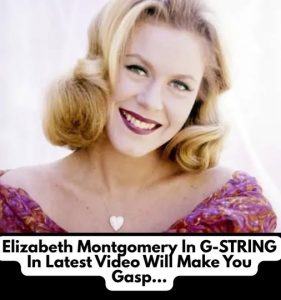
A provocative headline claiming that “Elizabeth Montgomery in a G-string” appears in a “latest video” is designed to make readers stop scrolling. The wording promises a shocking discovery, encourages curiosity, and suggests that previously unseen footage has somehow surfaced. But there is one major problem with the claim: Elizabeth Montgomery died in 1995. There cannot be a genuine “latest video” of the actress participating in a newly filmed scene.
Montgomery remains one of the most recognizable actresses of classic American television. For millions of viewers, she will forever be associated with Samantha Stephens, the charming witch at the center of Bewitched. The series became one of television’s defining sitcoms of the 1960s and early 1970s, and Montgomery’s performance turned Samantha into a character remembered generations later. (Biography)
That enduring popularity is one reason misleading celebrity headlines continue to circulate online. Old photographs, television clips, magazine images, edited videos, and unrelated footage can be repackaged with sensational captions that make them appear current. In Montgomery’s case, the word “latest” is particularly misleading because her professional career ended with her death in 1995.
The woman behind the headline
Elizabeth Victoria Montgomery was born in Los Angeles on April 15, 1933. Acting was already part of her family background. Her father, Robert Montgomery, was a well-known actor, while her mother, Elizabeth Allen, was a Broadway actress. Rather than simply relying on her family’s name, however, Montgomery pursued formal acting training and developed a substantial career of her own. (Biography)
Her television career began during the 1950s. She appeared on her father’s anthology program, Robert Montgomery Presents, and subsequently worked across television, film, and the stage. Her early career included appearances in dramatic programs at a time when live television was an important part of American entertainment. (IMDb)
Her breakthrough came in 1964.
That year, Bewitched premiered, introducing audiences to Samantha Stephens, a seemingly ordinary suburban wife who happened to possess magical powers. Montgomery brought an unusual combination of elegance, humor, warmth, and comic timing to the character. Samantha’s famous nose twitch became one of the most recognizable gestures in television history.
The show ran for eight seasons, from 1964 through 1972. Montgomery received multiple Emmy nominations for her work on the series, and the program became a major part of American television culture. (Biography)
Why the image can be misleading
The photograph accompanying sensational social-media headlines does not automatically prove the claim made by the headline.
Images of Montgomery have circulated widely for decades. Some come from publicity sessions, television appearances, magazine features, film projects, or personal archives. Others may have been cropped, digitally altered, incorrectly captioned, or combined with text intended to generate clicks.
A photograph can be authentic while the caption attached to it is completely false.
That distinction is especially important when dealing with famous people from earlier generations. A photograph from the 1960s or 1970s can suddenly appear on social media decades later and be presented as if it were recent. Someone encountering the image without knowing Montgomery’s history may assume that the accompanying description is accurate.
It is not.
The available biographical records consistently establish that Montgomery died on May 18, 1995, in Beverly Hills. (Los Angeles Times)
Consequently, any headline describing a newly filmed “latest video” featuring Montgomery should immediately raise questions about its authenticity and context.
Her career was much bigger than Samantha
Reducing Montgomery to provocative photographs also overlooks how versatile she was as an actress.
After Bewitched ended, Montgomery deliberately moved into more serious dramatic work. Her performances in television movies demonstrated that she was interested in challenging audiences rather than simply repeating the persona that had made her famous.
One of her most notable projects was A Case of Rape, released in 1974. She followed that with The Legend of Lizzie Borden in 1975, portraying the controversial historical figure Lizzie Borden. Both performances earned her Emmy recognition. (Biography)
This transition was significant. Samantha Stephens had made Montgomery internationally recognizable, but she did not want her career to end with one sitcom character. Instead, she accepted darker and more demanding roles.
She continued working in television movies throughout the 1970s, 1980s, and early 1990s. Her credits included productions such as The Awakening Land, Second Sight: A Love Story, Sins of the Mother, and Black Widow Murders: The Blanche Taylor Moore Story. (Encyclopedia.com)
Montgomery also lent her voice to documentary projects. The Panama Deception, which she narrated, won the Academy Award for Best Documentary Feature in 1993. (Biography)
Her final years
Montgomery’s final period of work was tragically short.
She completed filming Deadline for Murder: From the Files of Edna Buchanan in 1995. Soon afterward, she was diagnosed with colon cancer. The illness progressed rapidly, and she died only weeks later. (Wikipedia)
Her death marked the end of a career that had lasted more than four decades.
The news was widely reported at the time, with tributes emphasizing the remarkable contrast between the lighthearted Samantha Stephens and the serious dramatic characters Montgomery played later in her career. She had successfully avoided being trapped by the image of the magical housewife who made her famous.
Why these headlines keep appearing
So why would someone publish a headline claiming that Montgomery’s “latest video” will make viewers gasp?
The answer is largely the economics of online attention.
Sensational celebrity headlines are constructed around curiosity. Words such as “latest,” “shocking,” “you won’t believe,” and “make you gasp” are designed to create an information gap. The reader sees a dramatic claim and feels compelled to click to discover what supposedly happened.
The strategy becomes particularly effective when the celebrity is already familiar.
Elizabeth Montgomery is a perfect example. Even people who have never watched an entire episode of Bewitched may recognize her face or remember Samantha’s magical nose twitch. That recognition makes a dramatic headline more likely to attract attention.
But curiosity should not replace verification.
Before accepting such a claim, readers should ask several basic questions: When was the footage actually recorded? Is the original source identified? Does a reputable publication report the same event? Does the celebrity’s documented timeline make the claim possible?
In Montgomery’s case, the timeline provides the clearest answer.
She died in 1995.
A legacy that survives
More than three decades after her death, Montgomery’s work continues to attract audiences. Bewitched remains one of television’s most recognizable classic sitcoms, and Samantha Stephens remains one of the character’s defining roles. Recent retrospectives continue to discuss Montgomery and the cast because the series remains culturally significant. (People.com)
Her legacy, however, is not dependent on sensational photographs or questionable “latest videos.”
It rests on her performances.
She successfully moved from live television drama to Broadway, from sitcom comedy to serious television films, and eventually to documentary narration. She demonstrated that an actress could become famous for one iconic role while still developing a broad and challenging career afterward.
That is the story worth remembering.
The viral headline may promise a shocking discovery, but the historical record tells us something much more interesting. Elizabeth Montgomery was not simply the glamorous face of a classic sitcom. She was a trained performer whose career stretched across several decades and genres.
The next time an old celebrity photograph appears beneath a sensational caption, it is worth pausing before sharing it. The photograph may be real, but the story surrounding it may not be.
In Elizabeth Montgomery’s case, there is no genuine “latest video” of her appearing in a newly filmed scene. She died in 1995. What does remain is an extensive archive of her performances, interviews, publicity photographs, television appearances, and films—material that allows modern audiences to rediscover the actress on her own terms.
And perhaps that is the most fascinating part of all: decades after her death, Elizabeth Montgomery still has the power to capture people’s attention. But her lasting appeal comes not from a fabricated viral headline. It comes from the talent, charisma, intelligence, and range that made her Samantha Stephens unforgettable in the first place. (Biography)