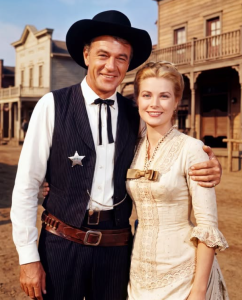
The two stars are Gary Cooper and Grace Kelly, and the unforgettable 1952 classic is High Noon.
Released on this day in 1952, High Noon is widely regarded as one of the greatest Westerns ever made, a tense, intelligent and emotionally gripping film that redefined the genre. While many Westerns of the era focused on sprawling landscapes, large-scale gunfights and heroic adventures, High Noon took a very different approach. It unfolded almost in real time, building unbearable suspense as one lonely lawman waited for a deadly showdown that everyone else in town was too frightened to face.
At the centre of the story stood Gary Cooper as Marshal Will Kane, one of cinema’s most iconic heroes. Alongside him was a young Grace Kelly, making only her second feature film, playing Kane’s newly married Quaker bride, Amy Fowler Kane. Neither actor could have known that the film would become a landmark in Hollywood history, nor that Kelly herself would soon leave the silver screen behind to become a real-life princess.
When High Noon premiered in July 1952, audiences expected another traditional Western. Instead, they found a psychological drama wrapped in cowboy boots, a film that explored fear, courage, loyalty and moral responsibility in ways rarely seen before.
Gary Cooper’s Will Kane has just married Amy and is preparing to retire from his position as town marshal. Having spent years keeping order in the small New Mexico town of Hadleyville, he is ready to leave behind violence and begin a peaceful new life with his bride.
Then comes devastating news.
Frank Miller, a ruthless outlaw Kane had previously sent to prison, has been released and is arriving on the noon train. Worse still, Miller’s gang is already waiting at the station. Everyone knows exactly what will happen when the train arrives.
They expect revenge.
Initially, Kane and Amy begin leaving town. But during the journey, Kane wrestles with his conscience. Realising that running away would leave innocent people vulnerable—and betray everything he believes in—he turns back to face Miller.
From that moment onward, the film becomes an extraordinary study of isolation.
Kane walks through the streets seeking deputies willing to stand beside him. Again and again, the townspeople refuse.
Some are simply terrified.
Others argue that fighting would only bring unnecessary bloodshed.
Several believe it is no longer Kane’s responsibility since he has resigned.
Even people who owe him their safety abandon him when he needs them most.
This growing sense of betrayal gives High Noon its extraordinary emotional power. The film is not simply about one man facing four outlaws. It is about what happens when ordinary people choose self-preservation over doing what they know is right.
Gary Cooper delivers one of the greatest performances of his remarkable career. Unlike many Western heroes of the period, Will Kane is not fearless or invincible. Cooper allows audiences to see the marshal’s anxiety, exhaustion and loneliness. His hands tremble. Sweat gathers on his face. He knows he may not survive.
That vulnerability makes Kane infinitely more heroic.
Rather than charging confidently into danger, he faces it because he believes it is his duty.
The performance earned Cooper the Academy Award for Best Actor, his second Oscar, and many critics still regard it as the defining role of his long career.
Born in Helena, Montana, in 1901, Gary Cooper became one of Hollywood’s greatest leading men during the Golden Age of cinema. Tall, understated and blessed with effortless screen charisma, he represented a different kind of hero. He rarely overacted or relied on dramatic speeches. Instead, he communicated enormous emotional depth through quiet expressions, careful movements and thoughtful pauses.
Throughout the 1930s and 1940s, Cooper starred in classics including Mr. Deeds Goes to Town, The Pride of the Yankees, Sergeant York and Meet John Doe. By the time High Noon arrived, he was already considered one of America’s most respected actors.
Opposite him, Grace Kelly was only beginning her extraordinary journey.
Playing Amy Fowler Kane, Kelly portrays a deeply religious Quaker who opposes violence under any circumstances. Horrified that her husband intends to stay and fight, she begs him to leave town with her instead.
Amy’s internal struggle becomes one of the film’s emotional foundations. She loves Will completely, yet cannot reconcile that love with his willingness to kill.
As events unfold, however, Amy witnesses both her husband’s courage and the cowardice surrounding them. Her understanding of bravery begins to change.
Grace Kelly brought remarkable poise and emotional intelligence to the role despite having relatively little film experience. Her elegance, calm voice and expressive eyes immediately attracted Hollywood’s attention.
She had made only one previous film before High Noon, but audiences instantly recognised her extraordinary screen presence.
Over the next few years, Kelly would become one of Hollywood’s brightest stars.
She worked with legendary director Alfred Hitchcock on Dial M for Murder, Rear Window and To Catch a Thief, demonstrating her versatility in suspense, romance and drama.
In 1954 she won the Academy Award for Best Actress for The Country Girl, surprising many who had viewed her primarily as a glamorous leading lady. Her portrayal of a weary, emotionally scarred wife revealed dramatic abilities that critics had underestimated.
Yet her Hollywood career would prove remarkably brief.
In 1956, at the height of her fame, Grace Kelly married Prince Rainier III of Monaco and became Princess Grace of Monaco. She retired from acting after only eleven feature films, exchanging movie premieres for royal duties.
Her transformation from Hollywood star to real-life princess remains one of the most famous stories in entertainment history. Few actors have ever left the screen at the peak of their success to begin such a dramatically different life.
High Noon itself became a landmark for reasons extending far beyond its cast.
Director Fred Zinnemann created an atmosphere of relentless tension by allowing the story to unfold almost minute by minute. Clocks appear constantly throughout the film, reminding audiences that noon—and Frank Miller’s arrival—is drawing ever closer.
Dimitri Tiomkin’s memorable score and the Oscar-winning theme song, “Do Not Forsake Me, Oh My Darlin’,” became instant classics, helping establish the film’s unique rhythm and emotional intensity.
Many scholars have also interpreted High Noon as an allegory for the political climate of early-1950s America. Screenwriter Carl Foreman wrote the screenplay during the era of the Hollywood blacklist, when many filmmakers faced accusations of communist sympathies. Kane’s abandonment by friends and colleagues has often been viewed as reflecting the fear and moral compromises experienced during that turbulent period.
Whether viewed as political commentary or simply as a compelling Western, the film’s themes remain timeless.
Its influence can be seen in countless later films and television series, many of which borrowed its real-time storytelling, isolated hero and emphasis on personal integrity over physical action.
Directors ranging from Sergio Leone to Steven Spielberg have praised High Noon as a masterpiece of cinematic storytelling.
More than seventy years after its release, the film continues to resonate because its central question remains universal: What do we do when everyone else walks away? Will Kane chooses to stand alone, not because he believes he cannot lose, but because he believes some responsibilities cannot be abandoned.
Gary Cooper’s restrained, deeply human performance turned Will Kane into one of cinema’s greatest heroes, while Grace Kelly’s luminous portrayal of Amy announced the arrival of a remarkable new star who would soon captivate both Hollywood and the world as Princess Grace.
Released on this day in 1952, High Noon remains far more than a classic Western. It is a powerful meditation on courage, honour and conscience, anchored by two unforgettable performances from actors whose names became synonymous with elegance, integrity and cinematic greatness. Even today, Gary Cooper’s lonely marshal walking toward destiny and Grace Kelly’s conflicted bride finding unexpected strength continue to define one of the finest hours in Hollywood history.