47 Americans Among Hundreds Missing After Deadly Flood Pummels China–Nepal Border
A devastating flash flood has struck the mountainous border region between Nepal and China-controlled Tibet, killing dozens of people, destroying homes and infrastructure, and leaving hundreds of travelers and residents unaccounted for.
The disaster unfolded on the morning of August 26, 2026, along the Bhote Koshi River in Nepal’s northern Rasuwa district, close to the Rasuwagadhi border crossing with Tibet. Within a short period, enormous quantities of water, mud, rocks and debris swept through settlements and transportation corridors, leaving widespread destruction behind. (Reuters)
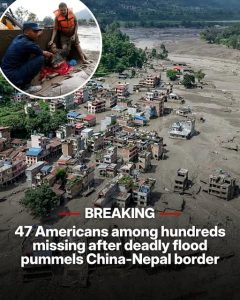
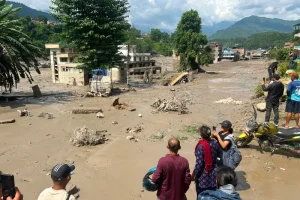
The images accompanying this story show the extraordinary scale of the destruction. Buildings are buried beneath thick layers of mud, roads have disappeared, and structures near the river have been damaged or completely swept away.
Most alarmingly, officials say 403 travelers are currently unaccounted for, including 341 foreign nationals. Among those reported missing are 47 Americans, 133 Indians, 34 Australians, 33 Britons and 24 Canadians, according to updated information from Nepal’s Tourism Board. (Nepal News)
It is important to emphasize that “missing” does not mean confirmed dead. The list is changing as authorities, travel companies and families establish contact with people who were in the affected region.
A Disaster That Struck With Extraordinary Force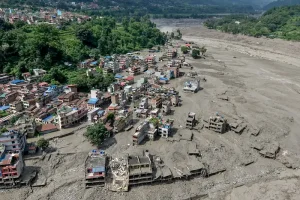
The Bhote Koshi River normally flows through a dramatic Himalayan landscape, passing between steep mountain valleys before continuing south through Nepal.
On Wednesday morning, however, the river suddenly became a destructive torrent.
A huge surge of water and debris moved downstream, overwhelming communities and infrastructure along its path. Homes, roads, bridges, vehicles, businesses, security posts and hydropower facilities were damaged or destroyed.
Nepalese authorities initially reported a much lower number of missing tourists, but as information from travel companies and other sources was gathered and verified, the figure rose to 403. Nepal News reported that the missing group includes 203 men and 200 women. (Nepal News)
That rapidly changing number illustrates how difficult it remains to determine the full human cost of the disaster.
At Least 95 Dead in Nepal
By the latest reports available on August 26, Nepalese authorities had recovered at least 95 bodies following the flooding.
China also reported casualties on its side of the border. The Associated Press reported at least three deaths in Tibet’s Gyirong County, along with hundreds of people missing there. That brings the reported combined death toll on both sides of the border to at least 98. (AP News)
Officials warn that these numbers may change as rescuers reach areas that remain difficult to access.
The disaster has been particularly devastating because of the geography.
The Himalayan valleys are narrow, steep and difficult to navigate even under normal circumstances. When a massive volume of water and debris suddenly enters such a valley, there may be almost no time for people near the river to escape.
The Mystery Behind the Sudden Flood
One of the most important questions is what caused such an enormous surge.
Early evidence points toward a geological event rather than an ordinary period of heavy rainfall.
Reuters reported that an ice-and-rock avalanche, potentially triggered by a magnitude-4.4 earthquake near the Nepal-Tibet border, may have caused the catastrophe. The movement of ice and rock appears to have affected the Lhende Khola river system, producing an enormous and sudden release of water and debris. (Reuters)
Investigators are still working to establish the precise chain of events.
One possible scenario is that an avalanche or landslide temporarily obstructed the river, allowing water to accumulate before the natural barrier failed.
If that happened, the resulting surge could have behaved like a natural dam-break flood.
Such events can be exceptionally destructive because the water does not rise gradually. Instead, a large wall of water and debris can travel downstream with little warning.
The Chinese Side Was Also Hit
The disaster did not stop at the international border.
On the Tibetan side, a mudslide struck Gyirong County, including the area around Gyirong Port, an important crossing and trading point.
Reuters reported that the mudslide caused severe damage and cut communications and power links in the area. Chinese authorities deployed hundreds of rescuers to search for survivors. (Reuters)
The Associated Press reported that Chinese state media had confirmed three deaths and 265 people missing in Tibet. (AP News)
The cross-border nature of the disaster makes the rescue operation even more complicated.
Nepal and China must coordinate efforts across difficult mountain terrain, while India and other countries are also dealing with citizens who may have been caught in the disaster.
Why So Many Foreign Travelers Were in the Region
The Rasuwa area is important for both tourism and religious travel.
Some of those reported missing were traveling toward Mount Kailash and Lake Manasarovar, sacred destinations for millions of Hindus and other religious communities.
The Nepal Tourism Board said 133 Indian nationals were among the missing travelers. (Nepal News)
Other travelers were reportedly trekking in the region or traveling with organized tour and trekking companies.
The disaster occurred during a period when large numbers of people were moving through the Himalayan region, increasing the number of travelers exposed to the danger.
The 47 Americans Reported Missing
The figure of 47 Americans has drawn particular international attention.
Earlier reports on Wednesday listed only three Americans among the missing travelers, reflecting the preliminary nature of the information available at the time. Later updates from Nepal’s Tourism Board increased the reported American figure to 47. (CBS News)
That change is an important reminder that the situation remains fluid.
Authorities are still contacting travel agencies, guides and families to determine who has survived, who has been evacuated and who remains unreachable.
Therefore, the figure should be understood as the number of Americans reported missing or unaccounted for, not the number confirmed dead.
The U.S. Embassy has expressed condolences and urged Americans in affected areas to follow local instructions, avoid low-lying areas and move toward safer ground when authorities advise them to do so. (New York Post)
Rescue Operations Face Huge Obstacles
Finding survivors is especially difficult in a mountainous disaster zone.
Several roads and bridges have been destroyed.
Mud and rocks cover transportation routes.
Communications have been disrupted.
Some communities have been isolated.
And unstable terrain creates additional risks for rescuers.
Helicopters have been deployed, but weather and geography can make landing extremely difficult. Reuters reported that helicopters were unable to land in some of the hardest-hit areas because of the conditions. (CBS News)
Rescuers therefore have to balance speed against safety.
Moving too slowly could cost lives.
But sending rescue teams into unstable areas could create additional casualties.
The Images Show the Scale of the Disaster
The photographs accompanying this story provide a stark illustration of what happened.
One aerial image shows a broad river valley covered in gray mud and debris.
Buildings that once stood close to the river appear partially destroyed or buried.
Some structures have been reduced to skeletal remains.
Others remain standing but are surrounded by mud.
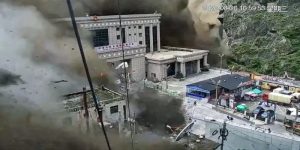
The second image appears to show a violent surge striking an area near the border crossing, with dark clouds of dust and debris surrounding buildings.
These pictures help explain why the death and missing-person figures have been changing rapidly.
The physical landscape itself has been transformed.
Hydropower Infrastructure Was Damaged
Rasuwa is also important to Nepal’s energy sector.
The district contains numerous hydropower facilities, and the flooding has damaged electricity infrastructure and access roads.
Reuters reported substantial disruption to hydropower capacity as a result of the disaster. (Reuters)
For Nepal, that creates another long-term challenge.
The immediate priority is saving lives, but rebuilding roads, bridges, power facilities and damaged communities could take months or even years.
Businesses along the border trade route may also face serious economic losses.
A Human Tragedy Beyond the Numbers
Behind every statistic is an individual story.
A missing American may have been traveling with friends.
An Indian pilgrim may have been on a religious journey.
A Nepalese resident may have been working near the river.
A police officer may have been stationed at a border post.
A shopkeeper may have been serving travelers when the water arrived.
A child may have been separated from parents.
This is why the growing number of missing people is so frightening.
Families around the world are waiting for telephone calls, messages or official confirmation that their loved ones are safe.
For many, the uncertainty may be harder than receiving definitive information.
Survivors Are Already Telling Their Stories
Some people have survived against extraordinary odds.
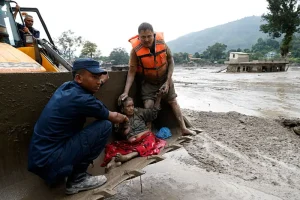
Reuters reported the story of Bibek Kumal, a 24-year-old Nepali laborer who was swept away by the flood but became trapped in a mango tree, which prevented him from being carried farther downstream. He was later rescued and taken to a hospital in Kathmandu. (Reuters)
Stories like his demonstrate both the terrifying power of the flood and the possibility of survival.
More survivors are likely to emerge as rescue teams gain access to isolated communities.
Officials Warn of Further Danger
Authorities are also concerned that the disaster may not be completely over.
Reuters reported warnings about a possible additional flood caused by an upstream blockage in the river system. (Reuters)
Residents near the Bhotekoshi, Trishuli and Narayani rivers have been warned to stay away from riverbanks.
This is particularly important because people sometimes return to damaged homes immediately after a flood to recover possessions.
But unstable slopes, weakened buildings and additional surges can create deadly secondary hazards.
International Assistance May Be Needed
Nepal has appealed for assistance from neighboring countries.
The country’s mountainous terrain and the scale of the destruction mean that outside support could be critical.
China has mobilized rescuers on its side of the border, while India has expressed readiness to provide humanitarian assistance. Other countries are monitoring the situation because their citizens are among those reported missing. (AP News)
The coming days will likely involve a major international effort to locate missing travelers and support affected communities.
A Disaster Still Unfolding
Because this is a developing emergency, readers should be cautious about social-media claims and rapidly changing casualty figures.
On Wednesday morning, reports described only a handful of deaths and hundreds missing.
By later in the day, Nepal reported 95 deaths and 403 travelers unaccounted for, while China reported additional deaths and missing people in Tibet. (Nepal News)
Those figures may change again.
People initially listed as missing may be found alive.
Additional victims may also be discovered as rescuers reach isolated areas.
The final toll cannot yet be known.
Final Thoughts
The catastrophic flooding along the Nepal-Tibet border on August 26, 2026, has become one of the region’s most serious disasters in recent years.
At least 95 people have died in Nepal, with additional deaths reported in Tibet, while 403 travelers remain unaccounted for, including 47 Americans according to updated Nepal Tourism Board figures. (Nepal News)
The disaster appears to have been associated with a sudden geological event involving an avalanche or landslide, possibly triggered by an earthquake. The resulting torrent of water, rock and mud devastated communities along the Bhote Koshi River and severely damaged roads, bridges, homes and power infrastructure. (Reuters)
But the numbers are still changing.
The most important story now is the rescue effort.
Search teams are working through dangerous terrain to find survivors and establish the whereabouts of those who remain missing. Families are waiting for news, while governments and humanitarian organizations prepare for what could be a prolonged recovery.
For everyone affected—from local Nepalese communities to the dozens of foreign nationals reported missing—the coming hours and days will be critical.
This is not simply a story about a flood. It is a story about hundreds of families waiting for answers, rescuers risking their lives to find survivors, and communities facing the enormous task of rebuilding after a disaster that arrived with devastating speed.
I can also create a news-style infographic showing the flood’s impact, affected areas, and rescue operation.