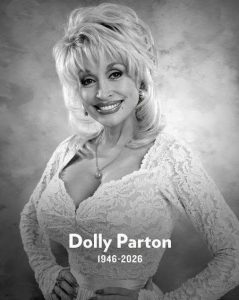
Dolly Parton: From the Mountains of East Tennessee to the Queen of Country Music
Few American entertainers have traveled a journey as remarkable as Dolly Parton’s. Born into a large family in the mountains of East Tennessee, she grew up with very little money but an abundance of love, music, faith, imagination and determination. From those humble beginnings, she built a career that transformed her into the “Queen of Country” music, a Hollywood star, a celebrated songwriter, a successful businesswoman and one of the most recognizable figures in the world.
Yet perhaps the most extraordinary part of Dolly Parton’s story is that fame never completely separated her from the little girl she once was.
She remembered where she came from.
She remembered what it felt like to grow up without much.
And throughout her life, those memories influenced the way she approached music, business, family and philanthropy.
A Childhood Shaped by the Smoky Mountains
Dolly Rebecca Parton was born in January 1946 in Sevier County, Tennessee, in the heart of the Great Smoky Mountains. She was one of twelve children born to Robert Lee Parton Sr. and Avie Lee Owens Parton.
The Parton family lived in a small home in the mountains, and money was often scarce. Her father worked hard to provide for the family, while her mother helped raise the children and filled their home with songs, stories and traditions.
The family’s financial circumstances were difficult, but Parton has repeatedly described her childhood as rich in other ways.
Music was everywhere.
Her mother sang traditional songs around the house, while relatives and neighbors contributed to the musical atmosphere of the community. Dolly began singing when she was very young, and it quickly became clear that music was more than a hobby for her.
It was her calling.
She also learned an important lesson during those early years: hardship did not have to destroy hope.
Instead, it could become material for a story.
That idea would eventually become one of the foundations of her songwriting.
Discovering a Gift for Songwriting
Parton began performing publicly while she was still a child. By her teenage years, she was already determined to make music her career.
At just 13, she appeared at the Grand Ole Opry, an extraordinary accomplishment for someone so young. The experience confirmed that the world beyond the mountains might have a place for her.
After graduating from high school, she moved to Nashville, the center of the country music industry.
Nashville was filled with talented musicians and aspiring performers, and Parton had to work hard to establish herself.
Her breakthrough initially came not simply because of her singing voice, but because of her songwriting ability.
Parton wrote songs that felt deeply personal while remaining universal. She could take an ordinary experience and turn it into something emotionally powerful.
Her compositions eventually attracted the attention of established performers, including country star Porter Wagoner.
The Porter Wagoner Years
In 1967, Parton joined “The Porter Wagoner Show,” becoming Wagoner’s duet partner.
The partnership helped introduce her to a much larger country music audience. Their performances together became enormously popular, and Parton recorded a series of successful duets with Wagoner.
But she also knew that she needed to establish herself as an independent artist.
Their professional relationship eventually became complicated as Parton sought to move forward on her own.
She famously captured the emotional experience of leaving Wagoner in one of her greatest compositions, “I Will Always Love You.”
The song became a major country hit for Parton.
Years later, Whitney Houston recorded her own version for the movie “The Bodyguard,” transforming the song into an international pop phenomenon.
That extraordinary success demonstrated the timeless quality of Parton’s songwriting.
She had written a song about saying goodbye, but the emotions were universal enough that generations of listeners could make it their own.
The Rise of the Queen of Country
During the 1970s, Parton established herself as one of country music’s most important performers.
Songs such as “Jolene,” “Coat of Many Colors,” “Love Is Like a Butterfly” and “Here You Come Again” demonstrated the remarkable range of her songwriting.
She could write about heartbreak, family, poverty, love, ambition and resilience.
“Coat of Many Colors” was especially personal. Inspired by her childhood, the song told the story of a homemade coat created by her mother from scraps of fabric.
To a child embarrassed by poverty, the coat might have seemed like something to hide.
But Parton transformed the memory into a celebration of maternal love.
That ability to find dignity in difficult circumstances became one of her defining artistic qualities.
From Country Music to Hollywood
Parton’s ambitions extended beyond music.
In 1980, she made a major Hollywood breakthrough with the comedy “9 to 5,” starring alongside Jane Fonda and Lily Tomlin.
Parton also wrote and performed the film’s title song, which became one of the biggest hits of her career.
The song connected with millions of working people because it captured the frustrations of everyday employment while delivering the message with humor and energy.
Her performance in the movie proved that she was more than a country singer.
She had a natural screen presence and a distinctive comedic personality.
Parton subsequently appeared in films including “The Best Little Whorehouse in Texas,” “Rhinestone” and “Steel Magnolias.”
Her role as Truvy Jones in “Steel Magnolias” demonstrated a different side of her abilities, allowing audiences to see both her warmth and emotional depth.
A Unique Public Image
Parton’s appearance has always been part of her public identity.
Her enormous blonde hair, sparkling clothing, colorful personality and unmistakable voice created an image that audiences could immediately recognize.
But Parton has often made it clear that there is more to her than the glamorous exterior.
Her humor became one of her greatest strengths.
She was willing to laugh at herself, joke about her appearance and use her own public image to challenge assumptions about what a woman could be.
That combination of glamour and self-awareness became an important part of her appeal.
People could see the larger-than-life entertainer while also hearing the voice of someone who remembered growing up in a small mountain community.
Dollywood and a New Chapter
Parton’s success eventually expanded far beyond music and movies.
In 1986, Dollywood opened in Pigeon Forge, Tennessee.
The theme park became both a major tourist attraction and a tribute to the culture of the region where Parton grew up.
For Parton, Dollywood represented something larger than a business venture.
It helped create jobs and economic opportunities in her home region while allowing millions of visitors to experience the landscape and traditions that shaped her.
The park also became a physical reminder of the journey from a poor mountain childhood to international fame.
The Heart Behind the Fame
Perhaps the most important part of Parton’s legacy is her philanthropy.
She has supported numerous charitable causes over the decades, but her Imagination Library has become one of her best-known contributions.
The program provides free books to young children, encouraging families to develop a love of reading.
The idea was influenced by Parton’s own childhood and her understanding of how powerful books could be for a child growing up with limited resources.
Through the program, millions of children have received books.
Parton has also supported education, disaster relief, medical research and other charitable causes.
Her philanthropy reflects a simple philosophy: success becomes more meaningful when it is used to help someone else.
A Career That Refused to Stay in One Box
One reason Parton has remained so beloved is that she never allowed herself to be confined to a single category.
She is a country singer, but she has crossed successfully into pop culture.
She is a songwriter, but many of her most famous compositions became hits for other performers.
She is an actress, but she has also created businesses and entertainment attractions.
She is a celebrity, but she has maintained a strong connection with ordinary people.
And she is a businesswoman whose public personality remains deeply connected to generosity.
Few entertainers have managed to combine all of those identities so successfully.
The Enduring Power of Her Story
Dolly Parton’s story is ultimately a story about possibility.
She began in a small mountain community with limited financial resources. She did not inherit a major entertainment empire or a powerful cultural platform.
She built her career one song, one performance and one opportunity at a time.
Her life demonstrates how talent can emerge from the most unexpected places.
But talent alone does not explain her success.
There was persistence.
There was discipline.
There was an extraordinary understanding of people.
Most importantly, there was an ability to turn personal experiences into stories that millions could recognize.
More Than a Music Legend
Calling Dolly Parton the “Queen of Country” captures only part of her legacy.
She is also a storyteller whose songs have crossed generations.
She is a Hollywood performer whose movies remain beloved.
She is a businesswoman who helped transform her hometown region into a major destination.
She is a philanthropist whose work has placed books into the hands of countless children.
And she is an enduring cultural figure whose personality has become almost as recognizable as her music.
Yet perhaps the most touching part of her story is that the girl from East Tennessee never completely disappeared behind the celebrity.
The mountains remained part of her identity.
The memories of her family remained part of her songs.
The lessons of poverty remained part of her generosity.
And the love of music that began in a humble family home continued to guide her throughout an extraordinary career.
Dolly Parton’s journey reminds us that a person’s beginnings do not have to determine the limits of their future.
A child can grow up with very little and still dream enormously.
A songwriter from the mountains can reach audiences around the world.
And a woman who became one of the most famous entertainers on Earth can still remain connected to the values she learned at home.
That is why Dolly Parton’s story continues to inspire.
It is not simply the story of a country music superstar.
It is the story of a woman who took the struggles, joys and memories of her childhood and transformed them into music, laughter, opportunity and hope for millions of other people.
From the mountains of East Tennessee to stages around the world, Dolly Parton built more than a career.
She built a legacy.