The $100 Mistake No One Noticed
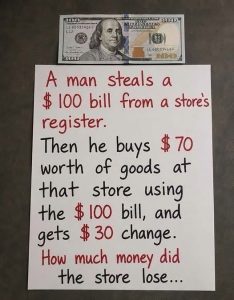
At first glance, the puzzle seems almost too easy. A man walks into a store, steals a $100 bill from the cash register, and disappears. A few moments later, he comes back and uses that same $100 bill to buy $70 worth of merchandise. The cashier accepts the bill and gives him $30 in change.
The question sounds simple:
How much money did the store actually lose?
Many people immediately start doing complicated calculations. Some say the answer is $130 because the store lost $100 and then gave away $30 in change. Others argue that the loss is only $70 because the stolen bill eventually came back. But the correct answer is simpler—and it depends on carefully tracking what happened to the store’s money and merchandise.
The store ultimately loses $100.
Here’s why.
Step One: The Theft
Imagine the store begins with a $100 bill inside its cash register.
The thief takes that $100 bill.
At this moment, the store is down $100 in cash.
So far, there is no mystery. The thief has taken something belonging to the store, and the store has suffered a $100 loss.
But the story doesn’t end there.
Instead of running away with the stolen bill, the thief walks back into the same store and uses it to make a purchase.
That detail is what makes the puzzle interesting.
Step Two: The Purchase
The thief selects $70 worth of merchandise.
He brings the items to the checkout counter and hands the cashier the same $100 bill that he stole earlier.
The cashier doesn’t know—or doesn’t consider—that the bill originally belonged to the store. From the cashier’s perspective, the customer has simply handed over a legitimate $100 bill.
The store now receives its original $100 bill back.
That means the store’s cash position has effectively recovered from the original theft.
But in exchange for receiving the $100 bill, the store gives the customer two things:
- $70 worth of merchandise
- $30 in cash as change
Together, those two things are worth $100.
This is the key to solving the puzzle.
So What Did the Store Lose?
Let’s track everything from beginning to end.
The thief originally takes:
$100 cash
Then he returns that exact $100 bill by spending it at the store.
So the original $100 cash is no longer missing.
However, the store gives him:
$70 worth of goods
and
$30 in cash
Add those together:
$70 + $30 = $100
Therefore, the store’s total loss is $100.
The stolen bill itself does not create an additional $100 loss because it comes back into the register during the purchase.
That’s where many people get tricked.
Why Some People Answer $130
The most common incorrect answer is probably $130.
The reasoning usually goes something like this:
The thief stole $100.
Then he bought $70 worth of goods.
Then the store gave him $30 change.
So someone might calculate:
$100 + $70 + $30 = $200
But that double-counts the stolen $100.
The $100 bill didn’t remain outside the store after the purchase. It came back.
If the thief had stolen $100 and then used some completely different $100 bill to make the purchase, the situation would be different. But that isn’t what happens in the puzzle.
The same $100 bill makes a round trip.
It leaves the store, returns to the store, and is then exchanged for $70 worth of merchandise plus $30 in change.
The original theft effectively disappears from the final accounting because the stolen bill is returned.
What remains is the value that the store gives away.
And that value is exactly $100.
A Simple Way to Visualize It
Imagine putting everything into three boxes.
Box One: The Store’s Original Money
The store starts with:
$100
The thief takes it.
The store is temporarily down $100.
Box Two: The Stolen Bill Comes Back
The thief uses the same $100 bill to pay for his purchase.
The store receives:
+$100
Now the stolen bill is back where it started.
Box Three: What the Store Gives the Thief
The store hands over:
$70 in merchandise
plus
$30 in cash
That equals:
$100
So the store has exchanged $100 in value for the $100 bill that was already its own property.
The final loss is therefore:
$100.
What If We Ignore the Price Tags?
There is another interesting way to look at the puzzle.
Suppose the store doesn’t care about the retail price of the merchandise and instead thinks only in terms of actual economic value.
The thief walks away with $70 worth of products and $30 in cash.
That’s $100 worth of value.
In return, the store gets its own $100 bill back.
From the store’s perspective, the final balance is therefore:
-$100
The puzzle isn’t really about complicated mathematics. It’s about avoiding double-counting.
Why This Puzzle Tricks So Many People
The human brain tends to remember events separately rather than following the complete flow of an object.
We hear:
“He stole $100.”
Then:
“He bought $70 worth of goods.”
Then:
“He received $30 change.”
Each statement sounds like a separate loss.
But they aren’t three independent losses.
The first $100 is the same money that appears again in the second transaction.
That’s the hidden trick.
Whenever a puzzle involves money moving between people, the best strategy is to follow the individual bills—or, more accurately, the value—through every step.
Don’t simply add every number you see.
Ask:
Where did the money go?
Did it come back?
What did the store give away at the end?
Once those questions are answered, the solution becomes obvious.
What Happens From the Thief’s Perspective?
The thief begins with nothing.
He steals $100.
So he now possesses:
$100
He then uses the $100 to buy $70 worth of merchandise.
The store gives him $30 change.
At the end, the thief has:
$70 worth of goods + $30 cash = $100
So the thief walks away with $100 worth of value.
The store, meanwhile, has lost $100 worth of value.
The transaction balances perfectly.
What If the Thief Had Bought $100 Worth of Goods?
That variation makes the answer even easier.
Suppose the thief stole $100 and then returned to buy exactly $100 worth of goods using that same bill.
The store would get its $100 back and give away $100 worth of merchandise.
The store would still lose:
$100
Now suppose the thief bought only $50 worth of goods and received $50 change.
Again:
$50 + $50 = $100
The store would still lose $100.
This shows the important principle: the combination of merchandise and change always equals the value of the bill used for the purchase.
What If the Thief Used Another $100 Bill?
Now imagine a different scenario.
The thief steals $100 from the store and later returns with another $100 bill that genuinely belongs to him.
He buys $70 worth of goods and receives $30 change.
The store would then have:
- Lost the original stolen $100
- Given away $70 worth of merchandise
- Given $30 in change
- Received a separate $100 bill
In that scenario, the store’s net loss would indeed be $100 from the theft plus the net value of the purchase transaction, depending on how the replacement bill is treated. But that isn’t the situation in the puzzle.
The crucial phrase is “using the $100 bill.”
It is the same bill.
That one detail determines the entire answer.
The Real Lesson
This puzzle is a wonderful example of why careful reasoning matters more than fast arithmetic.
When several transactions happen in sequence, numbers can appear to represent separate losses even when they describe the same object moving around.
The thief doesn’t magically create another $100 bill.
The bill simply leaves the register and later returns to it.
The actual loss occurs when the store gives the thief something that doesn’t come back:
$70 worth of merchandise and $30 in cash.
That adds up to $100.
So if someone asks you how much money the store lost, the cleanest answer is:
The store lost $100.
Not $130.
Not $200.
And not merely $70.
The store’s original $100 bill comes back, but the store has exchanged it for $70 worth of merchandise and $30 in cash.
The Final Answer
Let’s put the entire puzzle into one simple equation:
Original stolen money: $100
Same $100 returned to store: +$100
Merchandise given away: -$70
Change given away: -$30
The final calculation is:
+$100 – $70 – $30 = $0
That $0 represents the store’s net cash-and-goods position relative to the returned bill. But compared with the store’s original inventory and cash before the theft-and-purchase sequence, the store is missing $100 in value.
The thief walks away with $70 in products and $30 in cash.
Therefore:
The store loses $100.
That’s the trick.
The stolen $100 bill is not the final loss because it comes back. The real loss is what the store gives the thief in exchange for that bill.
And that is why this seemingly simple puzzle catches so many people: the numbers look like they should be added, but the story requires you to follow the money.
Sometimes the hardest part of a math puzzle isn’t doing the arithmetic.
It’s figuring out which numbers actually belong in the equation.