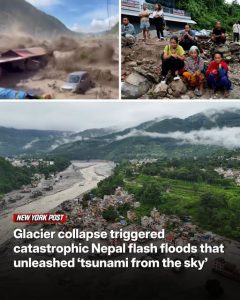
Glacier Collapse Triggered Catastrophic Nepal Flash Floods That Unleashed a ‘Tsunami From the Sky’
A devastating natural disaster struck the Himalayan region on August 26, 2026, when a massive glacier collapse near the Nepal–Tibet border unleashed a catastrophic surge of water, ice, rock, mud, and debris. What followed was not an ordinary mountain flood. A torrent raced through valleys and settlements with such extraordinary force that a Nepalese disaster expert described it as a “tsunami from the sky.” (Reuters)
The disaster has left communities facing enormous destruction, while rescue teams continue searching for hundreds of people who remain unaccounted for. Because the situation is changing rapidly, casualty and missing-person figures have varied between reports. By Thursday, August 27, authorities and news organizations were reporting hundreds of deaths and well over a thousand people missing across Nepal and Tibet. (The Guardian)
A disaster born high in the Himalayas
The chain of events began high above the valleys, where an enormous section of Himalayan glacier broke away.
Satellite imagery and geological analysis indicate that a large portion of ice detached from a glacier and plunged roughly 1.2 kilometers toward the valley below. The collapse was so powerful that seismic instruments initially interpreted the event as an earthquake. The U.S. Geological Survey later clarified that the signal came from the glacial collapse and resulting debris flow rather than a conventional tectonic earthquake. (The Guardian)
The force of the falling ice and rock was immense. When the mass struck the mountainous terrain, it displaced enormous quantities of material and disrupted the river system below.
A river was temporarily blocked by the avalanche of ice, rock, and debris. Water accumulated behind the obstruction before suddenly breaking through.
That created the deadly surge.
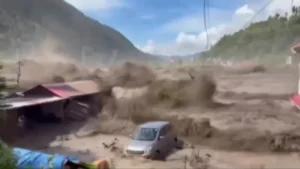
Instead of a gradual rise in river levels, communities downstream were confronted by an immense wall of water and debris moving through narrow Himalayan valleys.
Why the flood became so destructive
Mountain valleys can magnify the destructive power of sudden floods.
In a broad river basin, water may spread outward. In a steep Himalayan valley, however, enormous volumes of water can be forced through a relatively narrow channel. When that water is mixed with boulders, trees, mud, ice, and broken infrastructure, it becomes something closer to a moving landslide than a conventional flood.
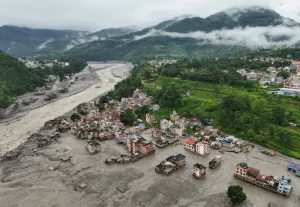
Reports indicated that river levels rose dramatically within a short period. The resulting torrent swept through settlements along a stretch estimated at roughly 40 to 50 kilometers. Roads, bridges, buildings, power infrastructure, and other vital facilities were destroyed or severely damaged. (Reuters)
Bishal Nath Upreti, president of Nepal’s Centre for Disaster Management, described the scene in extraordinarily stark terms, saying the disaster resembled a “tsunami from the sky.” Reports said entire villages were wiped out along parts of the affected corridor. (The Guardian)
The phrase captures the unusual nature of the disaster.
There was no ocean involved. Instead, the “tsunami” came from the mountains.
Roads and bridges disappeared
One of the biggest obstacles facing rescuers has been the destruction of transportation infrastructure.
Reports indicate that nearly 40 kilometers of roads were damaged in Nepal, while numerous bridges were destroyed. Some communities became extremely difficult or impossible to reach by road, forcing rescuers to rely heavily on helicopters and other aerial operations. (The Independent)
This creates a terrible cycle during a disaster.
People who need urgent medical attention may be trapped far from functioning hospitals. Rescue crews may know where survivors are located but lack a safe route to reach them. Supplies such as food, water, medicine, fuel, and emergency equipment become harder to deliver.
At the same time, damaged communications can make it difficult for families to learn whether relatives survived.
For many people waiting for news, the uncertainty may be almost as painful as the destruction itself.
Foreign travelers were caught in the disaster
The affected region is not isolated from international tourism.
The area serves as a route for travelers and pilgrims heading toward Mount Kailash, a sacred destination in Tibet. Consequently, people from numerous countries were in or near the disaster zone when the flooding occurred.
Reports on Thursday said hundreds of foreign nationals were among those missing, including British, American, Indian, Chinese, and other travelers. British authorities were working to locate dozens of British nationals reported missing, while other governments and organizations were also attempting to establish the whereabouts of their citizens. (The Guardian)
The presence of international travelers has added another layer of urgency to the rescue effort.
Families thousands of miles away have been waiting for information, while governments and consular officials have attempted to determine who survived, who was evacuated, and who remains missing.
But the overwhelming majority of people affected are local residents whose lives and livelihoods were centered in these mountain communities.
The human cost
Behind every number in a disaster report is an individual story.
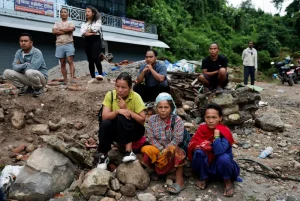
A destroyed building may have been a family’s home. A washed-away bridge may have been the route children used to reach school. A buried road may have been the only connection between a remote village and the nearest medical facility.
The flood also struck businesses and infrastructure that communities depend upon every day.
As mud and debris covered roads and buildings, residents were forced to confront the loss of homes, possessions, workplaces, and community facilities simultaneously.
And because search operations remain underway, the final human toll cannot yet be known.
That uncertainty is particularly painful for families whose loved ones disappeared in the torrent.
A warning from a warming Himalaya
The disaster has also revived urgent questions about the changing Himalayan environment.
Scientists have repeatedly warned that warming temperatures are reshaping high-mountain landscapes. Glaciers are retreating, snow and ice are changing, and thawing permafrost can weaken slopes that have remained stable for centuries.
Reuters reported that Nepal has lost approximately one-third of its glacial ice over the past three decades, while experts have warned that accelerated melting can contribute to unstable conditions. (Reuters)
That does not mean scientists can automatically attribute one specific glacier collapse entirely to climate change. Establishing such a connection requires detailed analysis of temperature records, glacier conditions, geological factors, snowpack, precipitation, and other variables.
But the broader trend is clear: a warmer Himalayan environment can create new hazards.
Glacier retreat can expose unstable terrain. Melting ice can enlarge glacial lakes. Thawing frozen ground can weaken mountain slopes. When these processes interact with steep terrain, extreme weather, earthquakes, or other disturbances, the result can be a cascading disaster.
The danger may not be over
Perhaps most frighteningly, authorities have warned that another flood could be possible.
Satellite information indicated that debris may have blocked part of the Bhote Koshi river system, creating a developing lake. Officials warned that if the accumulated water were to breach the natural barrier, another sudden flood could occur downstream. (The Independent)
This is one of the most dangerous situations rescuers can face.
Emergency workers must search for survivors while simultaneously monitoring the landscape for signs of another collapse or flood. Sending personnel into an unstable area can potentially put additional lives at risk.
The priority therefore becomes twofold: rescue as many people as possible and prevent a second disaster from overtaking those already working in the first one’s aftermath.
Why early warning systems matter
Events like this demonstrate why early warning systems are so important in mountainous regions.
A warning of even a few minutes can sometimes make the difference between life and death. Sensors capable of detecting sudden changes in river levels, seismic signals, glacier movement, or unstable slopes can provide valuable time for communities to move toward higher ground.
But technology is only part of the solution.
People must know what warnings mean. Evacuation routes must exist. Bridges and roads need to be designed with extreme events in mind. Emergency shelters must be accessible. Communication networks need backup systems.
And perhaps most importantly, governments need reliable monitoring of glaciers and potentially dangerous glacial lakes before disaster strikes.
Nepal contains thousands of glacial lakes, with some considered potentially hazardous. Scientists have emphasized that increasing instability in the Hindu Kush Himalaya makes monitoring and preparedness increasingly important. (The Guardian)
A disaster that will not be forgotten
The images emerging from the region show a landscape transformed by water and debris.
Places that were once recognizable as roads, riverbanks, bridges, and settlements have been buried or swept away. Rescue workers are moving through difficult terrain searching for survivors while families wait anxiously for news.
For Nepal, the disaster represents another painful reminder of the country’s vulnerability to natural hazards.
The Himalayas are among the most spectacular landscapes on Earth, but they are also environments where enormous amounts of energy are constantly stored in snow, ice, rock, and water. When that balance suddenly changes, the consequences can be devastating.
The phrase “tsunami from the sky” may sound almost impossible until the physical forces involved are understood.
A massive section of glacier falls from a great height. Rock and ice crash into a river. The river becomes blocked. Water accumulates. The barrier fails. Millions of cubic meters of water and debris surge downstream.
For people living in the valley below, there may be almost no time to react.
The Nepal disaster is therefore more than a story about a single flood. It is a warning about how rapidly a high-mountain landscape can transform—and how vulnerable communities can become when nature’s most powerful forces combine.
As rescue operations continue, the immediate priority remains finding survivors, helping displaced families, restoring access, and preventing another flood.
But once the emergency has passed, scientists and authorities will face another question: How can the next warning come before the next wall of water?
In the Himalayas, that question could save thousands of lives.