Girls in the 1970s and the Details That Bring the Era Back
There are photographs that do more than capture a group of people—they capture an entire era.
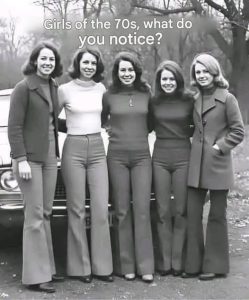
The black-and-white photograph accompanying this story is a wonderful example. Five young women stand together outdoors, smiling for the camera, dressed in outfits that immediately transport us back to the 1970s. There are flared trousers, fitted tops, practical coats, carefully styled hair and a sense of uncomplicated confidence that makes the photograph feel remarkably authentic.
At first glance, it may simply look like an old-fashioned group photograph. Look a little closer, however, and almost every detail tells a story about how women dressed, socialized and expressed themselves during one of the most distinctive decades of the 20th century.
The 1970s were not defined by a single fashion style. Instead, several different influences existed side by side. Hippie-inspired clothing, practical trousers, romantic blouses, disco glamour, tailored suits and casual denim all became part of the decade’s enormous fashion landscape. (Vogue)
And this photograph seems to capture one particularly recognizable version of that world.
The First Thing You Notice: The Trousers
Perhaps the most obvious feature of the photograph is the trousers.
All five women are wearing long, dramatically flared pants. The shape is unmistakable: relatively narrow around the upper leg before widening toward the ankle.
These were the famous bell-bottoms, or flares.
By the 1970s, flared trousers had moved from counterculture fashion into the mainstream. They could be made from denim, polyester, cotton and other fabrics, and they were worn by women and men alike. (Levi Strauss)
For women, trousers themselves represented an important change in everyday fashion. Pants had increasingly become acceptable for ordinary wear, work and social occasions, helping create a much more flexible approach to women’s clothing. (New Zealand Fashion Museum)
The women in this picture are therefore wearing something that was fashionable, practical and symbolic of changing attitudes.
Fitted Tops and Wide Legs
Another unmistakable characteristic is the contrast between the fitted upper half of the outfit and the wide lower half.
Several of the women wear relatively close-fitting tops with their flared trousers.
That combination was quintessentially 1970s.
The silhouette created a visual balance: narrow around the waist and torso, then dramatically wider below the knee.
It was not unusual for women to combine bell-bottoms with fitted T-shirts, sweaters or turtlenecks. (RetroWaste)
The result was a style that could look casual without appearing careless.
It also created the illusion of longer legs, particularly when paired with platform shoes or other elevated footwear.
The Influence of the Women’s Movement
Fashion is never completely separate from social history.
During the 1970s, women’s clothing reflected broader changes in women’s lives.
Women were increasingly entering workplaces and seeking greater independence, while traditional expectations about what women should wear were being questioned.
Trousers became especially significant because they were practical and increasingly accepted in settings where dresses and skirts had previously been expected.
Fashion historians have noted that wearing pants could represent a rejection of restrictive conventions and an expression of newly claimed freedom. (New Zealand Fashion Museum)
The photograph doesn’t necessarily make a political statement.
These women are simply smiling together.
But the clothes they are wearing belong to a period when the boundaries of women’s fashion were changing rapidly.
Hair Was Part of the Look
Clothing was only half of the 1970s appearance.
Hair was equally important.
The women in the photograph have hairstyles that are distinctly different from the ultra-sleek looks associated with some earlier decades.
There is volume, movement and carefully shaped hair.
During the decade, women’s hairstyles moved through several stages, from long and relatively straight hair toward increasingly layered and feathered styles. By the middle and later part of the decade, the feathered look associated with stars such as Farrah Fawcett became enormously influential. (Wikipedia)
The hairstyles in this particular photograph appear more restrained than the most exaggerated disco-era examples, suggesting that the image may belong to an earlier part of the decade.
That is another reason the picture feels so authentic.
It doesn’t look like a modern costume interpretation of the 1970s.
It looks like ordinary people actually living through the period.
The Coats Tell Their Own Story
Two women on the outside of the group are wearing coats.
These are not simply accessories.
They provide another clue about everyday life.
Unlike the more flamboyant styles associated with disco, everyday 1970s clothing could be practical and relatively conservative.
The coats have structured shapes and simple lines, allowing them to work naturally with the flared trousers underneath.
This combination of practicality and fashion was common during a decade when women increasingly wanted clothing that could move between different parts of daily life.
Notice the Shoes
Look closely at the lower part of the photograph and another classic detail becomes visible: the footwear is relatively understated.
That is significant because platform shoes are often treated as the defining footwear of the 1970s.
Platforms certainly became hugely popular, especially during the disco era, but not everyone wore enormous platform shoes every day.
Fashion was much more varied than the stereotype suggests.
The women in this photograph appear to favor practical shoes that work with their trousers.
That makes the image feel less like a glamorous fashion editorial and more like a genuine snapshot of ordinary young women.
The Car in the Background
There is another detail that is easy to overlook.
Behind the group is a vintage automobile.
Even without knowing the exact make or model, the vehicle immediately reinforces the period setting.
Cars were major visual symbols of their era, and photographs from the 1970s often include vehicles that now look unmistakably vintage.
The combination of the car, clothing, hairstyles and black-and-white photography creates a powerful time-capsule effect.
It feels as though the viewer has been given a brief opportunity to step backward several decades.
Why the Photograph Feels So Different From Today
One striking aspect of the picture is its simplicity.
There are no smartphones.
No carefully staged social-media poses.
No visible logos dominating the clothing.
No attempt to create an instantly marketable personal brand.
Five friends simply stand together and smile.
Of course, people in the 1970s took plenty of photographs for special occasions, but photography had a different role in everyday life. A picture like this could be a personal keepsake rather than content intended for thousands of strangers online.
That difference gives old photographs an unusual emotional quality.
They often feel intimate even when we know nothing about the people pictured.
The 1970s Were More Diverse Than the Stereotype
When people think about 1970s fashion today, they often imagine only bell-bottoms, tie-dye and disco.
The reality was much more complicated.
The decade included hippie-inspired clothing, romantic prairie styles, denim, tailored pantsuits, knitwear, jumpsuits, platform shoes, hot pants and eventually the glamorous disco aesthetic. (Vogue)
Different regions, age groups and social communities developed their own versions of these trends.
Someone living in a large city might dress very differently from someone living in a small town.
A young office worker might wear a tailored pantsuit during the day and change into something more glamorous at night.
A student might favor jeans and a simple knit top.
The photograph represents just one slice of that much larger fashion story.
Why Bell-Bottoms Became So Iconic
There is a reason flared trousers remain one of the most recognizable symbols of the decade.
They were visually dramatic.
Even a relatively simple outfit could become unmistakably 1970s when paired with a large flare.
Bell-bottoms also crossed cultural boundaries. They were associated with youth culture, music and counterculture before becoming mainstream fashion. (Levi Strauss)
By the 1970s, major clothing manufacturers were producing flared styles for women, making the look accessible to a much wider audience.
Eventually, however, the silhouette changed again.
As the decade came to an end, extremely wide flares began losing their dominance, replaced in many places by narrower trousers and emerging late-1970s styles. (Wikipedia)
Fashion moved on, as it always does.
More Than Clothing
Perhaps the most fascinating thing about this photograph is that the clothes are only part of the story.
The women appear relaxed.
They are standing close together.
They are smiling.
Their body language suggests friendship and familiarity.
That is what makes the photograph feel warm rather than simply fashionable.
We don’t know where they were going, why the photograph was taken or what happened later that day.
But we can imagine the ordinary details of life around it: conversations, work, school, weekend plans, music, family and friendships.
The photograph preserves none of those conversations.
It preserves only the moment.
And sometimes that is enough.
A Snapshot of Changing Times
The 1970s were a decade of substantial cultural change.
Music, television, cinema and fashion all influenced one another.
Young people increasingly used clothing as a way to express individuality, while traditional boundaries between men’s and women’s clothing became less rigid. (Kiwix Server)
Women wearing trousers was no longer unusual.
Casual clothing became more acceptable.
Fashion became increasingly diverse.
And individuals were encouraged to choose clothing that reflected their own personality rather than following one rigid standard.
The five women in this photograph capture that spirit beautifully.
Why People Still Love 1970s Photographs
Part of the appeal of old photographs is nostalgia.
But nostalgia isn’t always about wanting to return to the past.
Sometimes it is simply about appreciating how different everyday life once looked.
The clothes were different.
The hairstyles were different.
Cars looked different.
Photographs themselves looked different.
Yet the people in the image are instantly recognizable as people just like us: friends standing together, smiling and enjoying a moment.
That is what makes historical photographs so powerful.
They remind us that the past wasn’t just made up of famous events and famous people.
It was also made up of ordinary afternoons, friendships and photographs that someone decided were worth keeping.
Final Thoughts
The photograph titled “Girls in the 1970s and the Details That Bring the Era Back” is a wonderful visual reminder of just how distinctive that decade was.
The flared trousers, fitted tops, structured coats, hairstyles and vintage car immediately establish the period. More importantly, they reveal how fashion reflected broader changes in society, particularly the increasing acceptance of trousers and more individual approaches to women’s clothing. (Vogue)
But perhaps the most memorable detail isn’t a piece of clothing at all.
It’s the smiles.
Five young women stand together, apparently enjoying one another’s company, unaware that decades later their photograph would become a window into another time.
Fashion trends come and go.
Bell-bottoms eventually disappeared, returned, disappeared again and periodically came back into style.
Hairstyles changed.
Cars changed.
Technology transformed everyday life.
But photographs like this remain.
They preserve a moment when five friends dressed in the fashions of their time, stood beside a car and smiled for the camera.
And that is why the 1970s continue to fascinate us—not simply because of the clothes, but because every old photograph offers a tiny glimpse into the ordinary lives behind the era’s unforgettable style.