10 Fascinating Facts About Terms of Endearment
Few movies manage to make audiences laugh, cringe, fall in love and cry quite as effortlessly as Terms of Endearment.
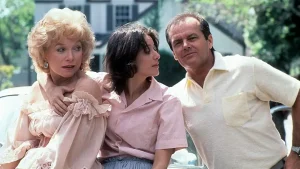
Released in 1983, James L. Brooks’ emotional comedy-drama follows the complicated relationship between Aurora Greenway, played by Shirley MacLaine, and her daughter Emma, played by Debra Winger. Jack Nicholson, Jeff Daniels, John Lithgow and Danny DeVito round out the memorable cast.
The movie became a major critical and commercial success, eventually winning five Academy Awards, including Best Picture, Best Director, Best Actress for MacLaine, Best Supporting Actor for Nicholson and Best Adapted Screenplay. (Paramount Pictures)
But behind those awards is a fascinating production story filled with surprising casting decisions, real-life tension, improvised moments and even a connection to The Simpsons.
Here are 10 fascinating facts about Terms of Endearment.
1. It was James L. Brooks’ first feature film as a director
Before Terms of Endearment, James L. Brooks was already an enormously respected television writer and producer.
He had worked on groundbreaking television programs including The Mary Tyler Moore Show, Rhoda and Taxi. But directing a feature film was a completely different challenge.
Terms of Endearment became his feature-directing debut—and it was an extraordinary one.
Brooks didn’t merely direct the movie. He also wrote and produced it.
The result was a film that immediately established him as an important Hollywood filmmaker. The movie ultimately earned him three Oscars: Best Picture as producer, Best Director and Best Adapted Screenplay. (Mental Floss)
That’s an astonishing beginning to a directing career.
2. The movie was based on a Larry McMurtry novel
The screenplay was adapted from Larry McMurtry’s 1975 novel Terms of Endearment.
McMurtry was already a highly regarded Texas writer, and his story provided the foundation for the movie’s complicated portrait of family relationships.
The film follows Aurora and Emma across roughly three decades, allowing audiences to see their relationship change as Emma grows from a young woman into a wife and mother. (Paramount Pictures)
What makes the story so powerful is that neither woman is presented as perfect.
Aurora is loving but controlling.
Emma is independent but sometimes impulsive.
They argue, disappoint each other and occasionally drive each other crazy—but underneath everything is an extraordinary bond.
That complexity is one reason the film still resonates decades later.
3. Jack Nicholson’s character wasn’t in the novel
One of the movie’s most interesting additions was Garrett Breedlove, the boozy, womanizing former astronaut played by Jack Nicholson.
Garrett was created specifically for the film.
James L. Brooks wanted a romantic interest for Aurora who could bring humor and unpredictability into the story. He also decided that making Garrett a former astronaut would make sense in the Houston setting, where NASA and the space program were part of the cultural landscape. (Mental Floss)
Nicholson’s performance became one of the movie’s highlights.
His chemistry with MacLaine was especially memorable.
The two characters could argue one minute and flirt the next, creating a completely different energy from the mother-daughter relationship at the center of the film.
4. Burt Reynolds originally had the role
It’s hard to imagine anyone other than Nicholson as Garrett Breedlove today.
But the role was originally written with Burt Reynolds in mind.
Reynolds turned down the part because of a prior commitment to Stroker Ace. Harrison Ford and Paul Newman were also among the actors associated with the role before Nicholson ultimately took it. (Mental Floss)
Reynolds later famously regretted passing on the opportunity.
The casting change turned out to be enormously important.
Nicholson brought a particular combination of danger, comedy and unpredictability to Garrett that fit perfectly with Brooks’ screenplay.
And the performance earned Nicholson the Academy Award for Best Supporting Actor.
5. Shirley MacLaine almost gave Aurora a Texas accent
Shirley MacLaine wanted Aurora to have a Texas accent.
That seems reasonable considering the character’s connection to Houston.
But Brooks eventually decided against it.
He had researched Houston and believed the city was too linguistically diverse for a broad regional accent to be necessary. Instead, the film established that Aurora was originally from Boston. (Mental Floss)
MacLaine reportedly adapted immediately.
It was a smart choice because Aurora’s personality—not a stereotypical accent—became the defining feature of the character.
Her sharp wit, possessiveness, vulnerability and emotional intensity made Aurora unforgettable.
6. The relationship between MacLaine and Winger was famously complicated
The chemistry between Aurora and Emma feels incredibly authentic on screen.
Ironically, the relationship between the two actresses was reportedly complicated behind the scenes.
Shirley MacLaine and Debra Winger have both spoken over the years about the tension surrounding the production. MacLaine later described the shoot as difficult, while James L. Brooks has acknowledged the unusual dynamic between the two performers. (People.com)
The stories about their interactions have become part of Hollywood folklore.
Some of the more colorful anecdotes come from MacLaine’s memoir, including an outrageous story involving Winger during the first day of filming. (Remind)
Whatever the truth behind every individual anecdote, there is no question that their performances were remarkably powerful.
The tension may even have helped create the emotional electricity between Aurora and Emma.
And both actresses received Oscar nominations for their work.
7. MacLaine and Winger competed against each other for an Oscar
At the 56th Academy Awards, both Shirley MacLaine and Debra Winger were nominated for Best Actress.
That made the competition particularly unusual because they were playing mother and daughter in the same film.
MacLaine ultimately won.
During her acceptance speech, she famously praised Winger’s performance and described her as possessing “turbulent brilliance.” (AFI)
The moment has become part of the film’s Oscar history.
Winger’s performance remains one of the movie’s most acclaimed elements, even though MacLaine ultimately took home the statue.
8. The famous hospital scene became one of cinema’s most emotional moments
Spoiler warning: this fact concerns a major event near the end of the movie.
One of the most devastating sequences involves Emma’s battle with cancer and her relationship with her young children.
The hospital scenes are remembered for their raw emotional intensity, particularly Aurora’s desperate efforts to protect her daughter.
The famous moment when Aurora demands that doctors do everything possible to help Emma became one of the most recognizable scenes in American cinema.
And yet director James L. Brooks has emphasized that he did not see Terms of Endearment simply as a tragedy.
In a recent interview, Brooks explained that audiences have often misunderstood the movie because he considered it fundamentally a comedy, even though it contains deeply painful material. (People.com)
That’s an important insight.
The movie’s emotional power comes partly from the fact that life itself isn’t neatly divided into comedy and tragedy.
People laugh while they’re hurting.
They make jokes during difficult moments.
Families argue even when they love one another.
Brooks captured that contradiction beautifully.
9. The movie was filmed in several real locations
Although Terms of Endearment is strongly associated with Houston, filming took place in several locations.
Principal photography began in Houston, Texas, in March 1983. Production also traveled to Nebraska, including Lincoln and Kearney, before moving to New York City for additional scenes. (AFI Catalog)
Lincoln locations included parts of the University of Nebraska campus, Lincoln General Hospital and other recognizable locations around the city.
The Texas Film Commission has also highlighted the film as an important part of Houston’s cinematic history. (Texas Governor’s Office)
The use of real locations helped the movie maintain its grounded feeling.
It doesn’t look like a fantasy version of American family life.
It looks like a place where ordinary people actually live.
10. The film indirectly helped lead to The Simpsons
Here’s perhaps the strangest fact of all.
After production wrapped, James L. Brooks received a book of Matt Groening’s Life in Hell cartoons as a gift.
Brooks was impressed.
That eventually led him to ask Groening to develop animated shorts for The Tracey Ullman Show.
Those shorts eventually became The Simpsons. (IMDb)
So there is an unexpected line connecting Terms of Endearment to one of television’s most successful shows.
A movie about a mother and daughter.
A cartoonist’s gift.
A television producer’s curiosity.
And eventually, Homer, Marge, Bart, Lisa and Maggie Simpson.
It’s one of those Hollywood connections that sounds almost too strange to be true.
A Movie That Still Endures
More than four decades after its release, Terms of Endearment remains one of those rare films that refuses to fit neatly into a single category.
It’s a family story.
It’s a romantic comedy.
It’s a drama.
It’s a tragedy.
And, according to its director, it’s fundamentally a comedy.
Paramount describes the movie as a story of the evolving 30-year relationship between Aurora and Emma, blending broad humor with deeply emotional moments. (Paramount Pictures)
That mixture is exactly what makes the film memorable.
Shirley MacLaine gives Aurora an extraordinary combination of toughness and vulnerability. Debra Winger brings enormous emotional depth to Emma. Jack Nicholson turns Garrett into a scene-stealing character whose humor keeps the film from becoming unbearably heavy.
Together, they created something that Hollywood rarely gets exactly right: a movie that can make you laugh at one moment and reach for a tissue the next.
And perhaps that’s why Terms of Endearment has lasted.
It isn’t really about perfect families.
It’s about complicated ones.
It’s about mothers and daughters who love each other even when they don’t understand each other.
It’s about mistakes, marriages, children, romance, illness and loss.
Most of all, it’s about the extraordinary emotional ties that can survive all of those things.
Ten facts may explain how Terms of Endearment was made—but the reason audiences still remember it is much simpler: the movie understands that the people who drive us crazy can also be the people we love most.