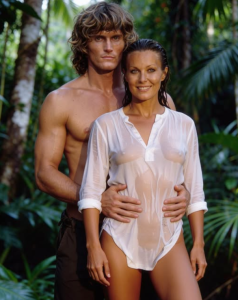
The star is Bo Derek, the film is Tarzan, the Ape Man (1981), and her vine-swinging co-star is Miles O’Keeffe.
Released on this day in 1981, Tarzan, the Ape Man was one of the most talked-about films of its year—not simply because it revisited one of literature’s most enduring adventure heroes, but because it placed one of Hollywood’s hottest new stars firmly at the centre of the story. Bo Derek, whose name had become synonymous with glamour after her sensational breakthrough in 10, stepped into the role of Jane Parker, bringing beauty, confidence and unmistakable star power to this bold reimagining of Edgar Rice Burroughs’ classic tale.
While the film divided critics upon its release, it became a significant pop culture event, cementing Bo Derek’s status as one of the defining screen icons of the early 1980s. More than forty years later, it remains one of the most recognizable Tarzan adaptations ever produced, remembered as much for its leading lady as for its jungle adventure.
Born Mary Cathleen Collins on November 20, 1956, in Long Beach, California, Bo Derek did not initially set out to become one of Hollywood’s biggest sex symbols. Raised in Southern California, she enjoyed horses, animals and the outdoors from an early age. Her striking blonde hair, athletic figure and effortless confidence quickly attracted attention, leading to modelling opportunities while she was still a teenager.
Her life changed dramatically when she met actor and filmmaker John Derek. Despite the considerable age difference between them, the two formed both a personal and professional partnership that would shape much of her early career. John Derek believed Bo possessed extraordinary screen presence and worked tirelessly to help launch her as a movie star.
That breakthrough arrived in spectacular fashion in 1979 with Blake Edwards’ romantic comedy 10.
Although Dudley Moore was the film’s central character, it was Bo Derek who became the movie’s cultural phenomenon. Her famous slow-motion run along the beach, wearing a flesh-coloured swimsuit and distinctive cornrow braids, instantly became one of the most iconic images in modern cinema.
Virtually overnight, Bo Derek became an international sensation.
Magazine covers followed.
Television appearances multiplied.
Fashion trends were influenced by her hairstyle.
Her name became shorthand for glamorous beauty throughout popular culture.
When producers sought someone to headline a fresh interpretation of Tarzan, the Ape Man, Bo Derek was one of the biggest stars they could possibly cast.
Rather than presenting the traditional Tarzan story from the jungle hero’s perspective, the 1981 film shifted much of its attention toward Jane Parker. This approach made the movie unusual among Tarzan adaptations and allowed Bo Derek to occupy the centre of the narrative.
Jane is introduced as the adventurous daughter of explorer James Parker, who travels deep into the African wilderness during the late nineteenth century. Curious, intelligent and increasingly fascinated by the mysterious jungle man she encounters, Jane gradually finds herself drawn into Tarzan’s extraordinary world.
Bo Derek portrayed Jane with confidence and curiosity, emphasizing her independence rather than presenting her simply as a damsel in distress. While the film leaned heavily into romance and sensuality, she also conveyed Jane’s growing admiration for the natural world and the man who had grown up within it.
Opposite her was newcomer Miles O’Keeffe, making his first major film appearance as Tarzan.
Before entering acting, O’Keeffe had been a successful college football player, standing well over six feet tall with the athletic physique producers believed ideal for the legendary jungle hero. His physical presence certainly suited the role, and Tarzan, the Ape Man introduced him to international audiences.
Although he would later enjoy a long career in action films and television, this remained the role for which he is best remembered.
One of the most distinctive aspects of the film was its visual style.
Director John Derek emphasized sweeping African landscapes, lush jungle scenery and striking cinematography that highlighted both the exotic locations and his leading stars. The production featured beautiful wildlife photography and spectacular natural settings, creating an atmosphere that felt far removed from traditional Hollywood studio productions.
The movie also generated considerable discussion because of its emphasis on romance and sensuality. Unlike many previous Tarzan adaptations aimed primarily at family audiences, this version adopted a far more adult tone. That creative choice attracted enormous publicity before the film even reached cinemas.
Critics were sharply divided.
Some admired the film’s visual beauty and unconventional approach.
Others criticised its screenplay and departure from Edgar Rice Burroughs’ original stories.
Yet regardless of critical opinion, audiences remained fascinated by Bo Derek’s star appeal, ensuring that Tarzan, the Ape Man became one of the most widely discussed films of 1981.
Following the success of 10 and the attention surrounding Tarzan, the Ape Man, Bo Derek became one of the most recognizable actresses of the early 1980s.
She appeared in films including Bolero, Ghosts Can’t Do It, Tommy Boy, Malibu’s Most Wanted and later television productions. While not every project achieved critical acclaim, Derek consistently maintained her popularity as a celebrity whose image became closely associated with Hollywood glamour.
Away from acting, she developed a strong commitment to animal welfare and horse breeding.
An accomplished equestrian, Derek has spent decades supporting organizations dedicated to protecting horses and wildlife. She has frequently spoken about her lifelong love of animals and has used her public profile to promote conservation efforts and responsible care for domestic and wild species.
She also became involved in veterans’ causes and various charitable initiatives, demonstrating that her interests extended well beyond Hollywood.
Over the years, public perception of Bo Derek has evolved considerably.
While she initially became famous largely because of her appearance, many later interviews revealed a thoughtful, articulate woman with a sharp sense of humour and a grounded perspective on fame. She often reflected candidly on the extraordinary media attention that followed 10, acknowledging both the opportunities it created and the challenges of becoming one of the world’s most recognizable faces almost overnight.
Looking back today, Tarzan, the Ape Man occupies a unique place in film history.
It represents an era when Hollywood frequently revisited classic literary adventures while reimagining them for contemporary audiences. Whether admired for its lush visuals, remembered for its controversy or appreciated as a showcase for Bo Derek’s undeniable screen presence, the film continues to attract curiosity more than four decades after its release.
For Bo Derek herself, the role of Jane remains one of the defining performances of her career. It allowed her to build upon the extraordinary momentum created by 10 and confirmed her status as one of the most talked-about actresses of the early 1980s.
Meanwhile, Miles O’Keeffe’s portrayal of Tarzan introduced audiences to a new interpretation of the legendary jungle hero, launching his own acting career and ensuring that both performers became forever linked with one of cinema’s most enduring fictional characters.
Released on this day in 1981, Tarzan, the Ape Man may have divided reviewers, but it undoubtedly succeeded in becoming one of the year’s biggest conversation pieces. At its heart stood Bo Derek, whose beauty, charisma and unmistakable screen presence transformed Jane from a supporting character into the true focal point of the adventure.
More than forty years later, audiences still remember the sweeping jungle scenery, the romance, the controversy and, above all, the blonde star whose glamour helped make this bold Tarzan remake one of the most memorable adventure films of its era. Bo Derek’s performance remains an enduring reminder of a moment when Hollywood was captivated by a new superstar whose impact on popular culture reached far beyond the silver screen.