Kimmel’s Melania Joke Triggers Studio Shockwave
A joke that lasted only a few seconds has become the center of a much larger argument about comedy, political criticism, free speech and the limits of late-night television.
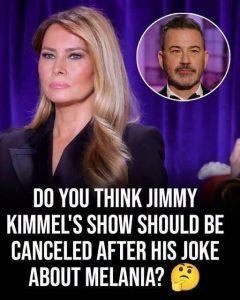
Jimmy Kimmel found himself at the center of controversy after making a joke about First Lady Melania Trump during a parody of the White House Correspondents’ Association dinner. What might ordinarily have been treated as another sharp political joke quickly became something much more serious after events surrounding the actual dinner transformed the context in which the remark was being discussed. (FactCheck.org)
The resulting backlash raised a question that has become increasingly familiar in American television: When does political comedy cross the line from satire into unacceptable rhetoric?
And perhaps even more importantly, who gets to decide where that line is?
The Joke That Started the Controversy
On April 23, 2026, Kimmel staged a fictional version of the White House Correspondents’ Dinner on Jimmy Kimmel Live! The segment was deliberately presented as a comedy roast, with Kimmel pretending to host the political event and delivering jokes about President Donald Trump, his administration and other public figures.
During the routine, Kimmel turned his attention toward Melania Trump.
The line that generated the controversy described the first lady as having “a glow like an expectant widow.” The joke was made two days before an attempted attack disrupted the actual White House Correspondents’ Association dinner. (Lead Stories)
That timing became crucial.
After the attempted attack, discussion of Kimmel’s earlier joke took on a dramatically different tone. Critics argued that the wording was deeply inappropriate given what had happened, while Kimmel maintained that the joke had nothing to do with the later incident.
Fact-checking reports have specifically emphasized that the joke was broadcast before the attack, not afterward. (Lead Stories)
Why the Timing Became So Important
Comedy depends heavily on context.
A joke about an elderly politician and his younger spouse can be interpreted one way when delivered during a conventional political roast. The exact same sentence can sound much darker if it is viewed after an attempted attack on that politician.
That distinction became the heart of the dispute.
Critics of Kimmel argued that the remark was unacceptable because it referenced the possibility of the president’s death. Supporters of the comedian argued that connecting the joke to the subsequent attack was misleading because Kimmel could not have known what would happen two days later.
Kimmel himself rejected the interpretation that he was encouraging violence.
During his response on Jimmy Kimmel Live!, he explained that the joke was about the age difference between Donald and Melania Trump and the expression he perceived on Melania’s face during public appearances. He described the remark as a light roast rather than a threat. (Los Angeles Times)
That distinction is important because political comedy routinely uses exaggeration, absurdity and intentionally uncomfortable premises.
The question is whether an audience should interpret every provocative joke literally—or whether some jokes are simply jokes, even when they are in poor taste.
Melania Trump Responds
The controversy escalated when Melania Trump publicly criticized Kimmel.
She characterized his comments as hateful and violent rhetoric and called on ABC to take action. Her reaction was unusually direct, transforming what might have remained a comedian-versus-audience controversy into a dispute involving the White House and a major television network. (CBS News)
President Donald Trump also called for Kimmel to be fired.
That immediately expanded the debate.
It was no longer simply about whether Kimmel had told a bad joke. It became a discussion about whether a sitting president and first lady should be able to pressure a broadcaster to remove a comedian because of political commentary.
For critics of Kimmel, the answer was straightforward: celebrities are not immune from consequences, and television networks have the right to determine what material they want associated with their programming.
For Kimmel’s defenders, however, the issue was much bigger.
They saw a powerful political administration attempting to punish a television personality for criticizing the president.
Kimmel’s Response
Rather than quietly withdrawing the joke, Kimmel addressed the controversy on his program.
He pointed out that the joke had been delivered before the actual dinner incident and argued that the interpretation being placed upon it was unfair.
He also emphasized his long-standing opposition to gun violence and rejected the suggestion that his comedy constituted a call for assassination. (Los Angeles Times)
His response reflected something characteristic of political comedy: once a joke becomes controversial, the comedian often has to explain what the audience was supposed to understand.
That can be difficult.
Comedy is usually strongest when the audience does not need an explanation. But when political circumstances change, a joke can suddenly acquire meanings that the comedian never intended.
Should a Comedian Be Fired?
This is perhaps the biggest question raised by the controversy.
If a comedian makes an offensive joke, should the consequence be cancellation?
There are arguments on both sides.
Television networks are private businesses. They make decisions about programming every day. If executives believe a host has damaged the show’s reputation or alienated advertisers and viewers, they can theoretically decide that the program should change.
But political speech introduces another layer.
Late-night comedians have traditionally occupied a strange position in American culture. They are entertainers, but they are also commentators. Their programs frequently criticize presidents, senators, governors and political parties.
If every controversial joke resulted in a firing, political comedy would become significantly more cautious.
That could change the character of late-night television.
At the same time, freedom of expression does not mean audiences are required to like every joke. People can condemn a comedian’s material while still believing the comedian should be allowed to say it.
Those two ideas can coexist.
The Bigger Problem With Political Comedy
Political comedy has become more difficult because American politics itself has become extraordinarily polarized.
A joke that one audience considers hilarious may be viewed by another audience as an attack on their identity.
Late-night television therefore operates in an environment where almost every political joke has the potential to generate outrage.
Kimmel is hardly the only comedian facing this problem.
Stephen Colbert, Jimmy Fallon and other late-night hosts have repeatedly faced criticism for jokes involving presidents and political figures. Political humor has become part entertainment and part cultural warfare.
The audience is no longer simply watching a comedian.
It is often watching someone whom they already associate with a particular political viewpoint.
That makes every joke more consequential.
The Role of Context
The Kimmel controversy also demonstrates why context matters so much in modern media.
A short clip can circulate independently of the program in which it originally appeared.
Someone might encounter only the controversial sentence on social media without seeing the preceding jokes, the parody format or the date on which it was broadcast.
That can dramatically alter perception.
In this case, fact-checkers specifically noted that the joke was made before the attempted attack at the Correspondents’ Dinner. (Lead Stories)
This does not mean people are required to find the joke funny.
It simply means the chronology matters.
A joke made before an event is fundamentally different from a joke made in response to that event.
Where Should the Line Be?
There is no universal answer.
Comedy has always pushed boundaries. Political satire in particular often relies on exaggeration, irony and deliberately uncomfortable subjects.
But there is also a legitimate argument that comedians should understand the consequences of their words.
The difficult part is determining whether a joke crosses the line because of what it literally says or because of how people interpret it.
If the standard becomes purely subjective, almost anything could become grounds for cancellation.
One person may hear satire.
Another may hear cruelty.
A third may hear political propaganda.
That is why the debate surrounding Kimmel has become larger than one joke.
It is ultimately about what kind of public conversation Americans want.
A Divided Audience
Perhaps the most predictable result of the controversy is that Kimmel’s existing supporters and critics largely moved deeper into their respective camps.
Those who already disliked Kimmel saw the controversy as evidence that his political comedy had gone too far.
Those who supported him saw the demand for his firing as an attack on free expression.
Very few people changed their minds.
That is one of the defining characteristics of modern political media.
Controversy does not always persuade people.
Often, it simply confirms what they already believed.
The Future of Late-Night Comedy
Whatever happens next, the incident is likely to become another example cited whenever the future of political comedy is debated.
Late-night television remains one of the few places where millions of Americans can watch political figures mocked in front of a national audience.
That role comes with considerable responsibility.
It also comes with considerable risk.
Comedians need freedom to be provocative. Audiences need freedom to criticize them. Networks need freedom to make programming decisions. Political leaders need to accept that public life comes with scrutiny.
Balancing all four is difficult.
But that balance is essential.
The controversy surrounding Kimmel and Melania Trump therefore deserves to be viewed as more than a celebrity feud or a sensational headline.
It is a case study in how quickly a joke can become political news, how social media can strip words from their original context and how the boundary between entertainment and political discourse continues to disappear.
Whether viewers believe Kimmel went too far or believe the backlash went too far, one fact is difficult to ignore: the joke has become much bigger than the comedian who told it.
And that may be the most revealing part of the entire story.
In today’s media environment, a few seconds of late-night comedy can trigger days of political debate, presidential criticism, public outrage and questions about censorship.
The laughter ends quickly.
The argument can last much longer.