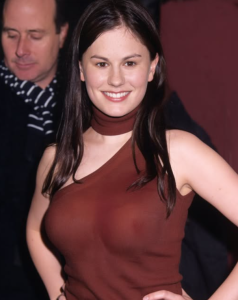
The actress is Anna Paquin. Anna Paquin
Born in New Zealand on July 24, 1982, Anna Paquin remains one of the most remarkable child stars in Hollywood history. By the time this photograph was taken at the New York premiere of Almost Famous on September 11, 2000, she had already achieved something most actors spend an entire career chasing—an Academy Award. Yet her story was only just beginning. She would later reinvent herself for a new generation as a superhero in the X-Men franchise before becoming the unforgettable Sookie Stackhouse in HBO’s wildly successful vampire drama True Blood.
Few performers have successfully navigated the difficult journey from child prodigy to respected adult actress, but Paquin managed it through talent, determination and an impressive willingness to take risks.
Anna Hélène Paquin was born in Winnipeg, Canada, but moved to Wellington, New Zealand, with her family while still a young child. Acting wasn’t initially part of her plan. In fact, she had no professional experience whatsoever when she accompanied her older sister to an open casting call for a new film directed by Jane Campion.
That film was The Piano (1993).
Out of thousands of hopeful young actresses, the nine-year-old Paquin landed the role of Flora McGrath, the spirited daughter of Holly Hunter’s mute heroine. Despite never having acted before, she delivered a performance of astonishing maturity and emotional intelligence.
Critics immediately recognized they were witnessing something special.
Her work earned widespread acclaim, culminating in one of the biggest surprises in Academy Awards history. At just eleven years old, Anna Paquin won the Oscar for Best Supporting Actress, becoming the second-youngest competitive acting winner ever, behind Tatum O’Neal.
The victory instantly placed enormous expectations on her shoulders.
Many child actors struggle after such early success, either becoming trapped by their youthful image or disappearing from the spotlight altogether. Paquin, however, approached her career carefully, choosing projects that allowed her to grow naturally rather than chasing instant stardom.
Throughout the remainder of the 1990s she appeared in a variety of respected productions.
She starred in Fly Away Home, the heartwarming adventure about a young girl helping geese migrate. She appeared in adaptations of classic literature including Jane Eyre, A Walk on the Moon, and Hurlyburly. Each performance demonstrated increasing confidence and versatility.
By the time of the Almost Famous premiere in September 2000, Paquin was no longer simply “the little girl who won an Oscar.”
She was steadily establishing herself as one of Hollywood’s most promising young actresses.
Then came one of the biggest franchises of the new millennium.
In Bryan Singer’s X-Men (2000), Paquin was cast as Rogue, the mutant whose touch absorbs the memories and powers of others. Rogue’s inability to physically connect with people made her one of Marvel’s most emotionally complex characters, and Paquin brought vulnerability, loneliness and quiet strength to the role.
The first X-Men helped transform superhero movies into blockbuster cinema.
Rather than relying solely on spectacle, it explored prejudice, identity and acceptance through its mutant characters. Paquin’s Rogue became an audience favorite because she represented the emotional heart of the team—a young woman desperate for normal human contact yet unable to experience it safely.
She reprised the role in X2 (2003), X-Men: The Last Stand (2006), X-Men: Days of Future Past (2014), and later appeared in the extended “Rogue Cut,” which restored several scenes omitted from the theatrical release.
For an entire generation, Anna Paquin wasn’t simply an Oscar winner.
She was Rogue.
While blockbuster films expanded her global profile, Paquin never abandoned smaller, more challenging work. She appeared in independent dramas, television movies and stage productions, building a résumé that reflected genuine artistic curiosity rather than commercial calculation.
Then, in 2008, her career entered an entirely new chapter.
HBO premiered True Blood, adapted from Charlaine Harris’s bestselling Southern Vampire Mysteries novels.
Paquin was cast as Sookie Stackhouse, a telepathic waitress living in the fictional Louisiana town of Bon Temps.
The series mixed horror, romance, mystery, dark comedy and fantasy in ways television audiences had rarely seen before. Vampires had “come out of the coffin,” thanks to synthetic blood allowing them to coexist with humans, but prejudice, politics and violence simmered beneath the surface.
At the center stood Sookie.
Although initially presented as an ordinary small-town waitress, Sookie gradually emerged as a character possessing extraordinary supernatural origins. Paquin balanced innocence with resilience, making Sookie believable as both romantic heroine and fearless survivor.
True Blood quickly became one of HBO’s signature hits.
Its mix of gothic atmosphere, explicit horror, sharp humor and outrageous storytelling developed an intensely loyal fanbase. Week after week viewers tuned in for its vampires, werewolves, witches, shapeshifters and fairies, but many stayed because of Paquin’s engaging central performance.
The role earned her widespread recognition, including a Golden Globe Award for Best Actress in a Television Drama.
During production of True Blood, life imitated art in one important respect.
Paquin met English actor Stephen Moyer, who portrayed vampire Bill Compton, Sookie’s first great love on the series.
Their on-screen chemistry blossomed into a real-life relationship.
The couple married in 2010 and later welcomed twins, becoming one of television’s most enduring celebrity marriages.
Away from the camera, Paquin has consistently demonstrated intelligence, independence and a refusal to be defined by public expectations.
She has spoken openly about equality, representation and LGBTQ+ rights. In 2010 she publicly identified as bisexual, helping increase visibility at a time when relatively few major Hollywood stars were discussing their sexuality so openly.
Rather than allowing labels to define her, she has emphasized authenticity and acceptance.
Professionally, she has continued exploring diverse projects after True Blood concluded in 2014.
She starred in the miniseries Roots, appeared in Alias Grace, took leading roles in Flack, and featured in numerous independent films that showcased her dramatic range.
Unlike many former child stars, she has never relied solely on nostalgia.
Instead, she continues evolving with each stage of her career.
One of the most impressive aspects of Anna Paquin’s journey is how naturally she transitioned between entirely different phases of stardom.
She began as an Oscar-winning child actress.
She became part of one of cinema’s defining superhero franchises.
She then reinvented herself once again as the leading lady of one of television’s most distinctive fantasy dramas.
Each success could have overshadowed the previous one, yet together they form a remarkably balanced career spanning more than three decades.
Looking back at that photograph from the Almost Famous premiere in September 2000, it’s fascinating to realize that the poised teenager on the red carpet had already achieved what countless actors only dream about.
Yet her biggest television triumphs, blockbuster fame and long-lasting popularity were still ahead.
At 44, Anna Paquin remains a unique figure in modern entertainment—a performer who conquered Hollywood as a child, survived the notoriously difficult transition into adulthood, thrived in blockbuster franchises, dominated prestige television and continues to choose roles that challenge both herself and audiences.
Very few actors can claim an Academy Award, superhero icon status and cult television immortality.
Anna Paquin is one of those rare exceptions, and her remarkable career shows no sign of slowing down.