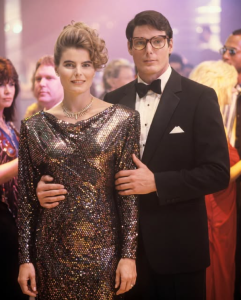
The two stars are Christopher Reeve and Mariel Hemingway. The 1987 sequel is Superman IV: The Quest for Peace.
Released on July 24, 1987, Superman IV: The Quest for Peace marked the final time Christopher Reeve donned the famous red cape in a feature film. While the movie has often been criticized for its limited budget and uneven visual effects, it remains an important chapter in Superman history. It represented the end of an era that had begun almost a decade earlier, when audiences first believed a man could fly. Alongside Reeve was Mariel Hemingway, the granddaughter of legendary novelist Ernest Hemingway, who brought sophistication and 1980s glamour to the role of Lacy Warfield, a wealthy newspaper executive who complicates Clark Kent’s personal life.
By 1987, Christopher Reeve had become inseparable from Superman. For millions around the world, he wasn’t simply playing the character—he was Superman. Tall, handsome, athletic, and effortlessly sincere, Reeve had accomplished what many thought impossible when he was cast in Richard Donner’s Superman (1978). Unknown to most audiences at the time, the Juilliard-trained actor had beaten hundreds of more established names for the coveted role.
His performance transformed the superhero genre forever.
One of Reeve’s greatest achievements was making audiences believe that Superman and Clark Kent were genuinely different people, despite wearing little more than a pair of glasses to distinguish them. As Superman, he projected confidence, strength and optimism. As Clark Kent, he became awkward, slightly clumsy and charmingly self-conscious. The transformation relied entirely on posture, body language and subtle acting choices rather than makeup or elaborate disguises.
It became one of cinema’s most celebrated performances.
The original Superman was a landmark blockbuster, featuring groundbreaking special effects and an all-star cast that included Marlon Brando as Jor-El, Gene Hackman as Lex Luthor, Glenn Ford and Phyllis Thaxter as Jonathan and Martha Kent, Jackie Cooper as Perry White, and Margot Kidder as the unforgettable Lois Lane.
Its famous tagline promised audiences they would “believe a man can fly.”
Against all expectations, they did.
Superman II (1980) expanded the mythology by introducing General Zod and his fellow Kryptonian villains, allowing Reeve to explore Superman’s emotional vulnerability as he considered giving up his powers for love.
Although production issues led to major changes behind the scenes, the sequel became another enormous success and remains one of the most beloved superhero films ever made.
Superman III (1983) took a lighter, more comedic direction, pairing Reeve with comedian Richard Pryor. While financially successful, it divided fans who preferred the epic tone of the first two films.
Four years later came one final adventure.
Superman IV: The Quest for Peace was developed during a period of heightened Cold War tensions. Christopher Reeve himself played an active role in shaping the story, wanting Superman to address the growing global fear surrounding nuclear weapons. Rather than simply battling another criminal mastermind, Superman would attempt something unprecedented: eliminating every nuclear weapon on Earth.
It was an ambitious concept.
The film opens with Superman receiving a heartfelt letter from a young boy asking him to rid the world of nuclear arms. Inspired by the plea, Superman addresses the United Nations and announces that he will collect every nuclear missile and throw them into the Sun.
The decision creates worldwide debate and, naturally, earns the wrath of Lex Luthor.
Once again played with theatrical delight by Gene Hackman, Luthor devises a plan to destroy Superman using a strand of the hero’s hair recovered from a museum display. Combining Superman’s DNA with advanced nuclear technology, he creates the powerful Nuclear Man, portrayed by bodybuilder Mark Pillow with Gene Hackman providing the character’s speaking voice.
The resulting battle becomes the film’s central conflict.
Although the production was hampered by a dramatically reduced budget after Cannon Films acquired the Superman franchise, Reeve remained fully committed to portraying the character with sincerity and dignity.
Even when surrounded by visual effects that could not match those of earlier entries, his performance never felt cynical or half-hearted.
He understood exactly why audiences loved Superman.
That same sincerity extended to Clark Kent’s personal life, which introduces one of the film’s most memorable new characters.
Mariel Hemingway plays Lacy Warfield, the glamorous daughter of media tycoon David Warfield, who purchases the Daily Planet and begins modernizing the newspaper into a more commercially driven publication.
Lacy immediately becomes fascinated by Clark Kent.
Unlike Lois Lane, whose attention is usually focused on Superman, Lacy finds Clark’s kindness, humility and quiet intelligence deeply attractive. This creates an unusual romantic triangle in which Clark receives affection from someone who doesn’t realize his extraordinary secret.
Mariel Hemingway brought considerable star power to the production.
Born in 1961, she came from one of America’s most famous literary families as the granddaughter of Nobel Prize-winning author Ernest Hemingway. Despite the immense expectations attached to her surname, she established herself independently as a talented actress.
Her breakthrough came with Woody Allen’s Manhattan (1979), where her sensitive performance opposite Allen earned her an Academy Award nomination for Best Supporting Actress.
She followed that success with acclaimed roles in films such as Personal Best, demonstrating both dramatic ability and natural screen charisma.
As Lacy Warfield, Hemingway embodied sophisticated 1980s corporate elegance.
Fashionable, intelligent and confident, Lacy represented a different romantic possibility for Clark Kent than Lois Lane ever had. Rather than chasing Superman headlines, she genuinely appreciated Clark himself.
Although their relationship never fully develops, Hemingway’s performance adds warmth and charm to the film.
The supporting cast also included veteran actor Sam Wanamaker as David Warfield and Margot Kidder returning as Lois Lane, ensuring continuity with the earlier films.
While Superman IV struggled critically upon release, much of its reputation stems from circumstances beyond the cast’s control.
The production suffered extensive budget cuts during filming, with many planned sequences either shortened or abandoned entirely. Visual effects companies had less time and fewer resources than those employed on the earlier films, resulting in flying scenes that lacked the polish audiences had come to expect.
Even so, many fans continue to appreciate the film’s idealism.
Unlike darker superhero stories that became popular decades later, The Quest for Peace embraced Superman’s belief that compassion, hope and diplomacy could overcome humanity’s greatest problems.
Its central message—that extraordinary power should be used to protect life rather than dominate others—remains faithful to the character created by Jerry Siegel and Joe Shuster nearly fifty years earlier.
Sadly, Superman IV proved to be Christopher Reeve’s final appearance as the Last Son of Krypton.
The series ended after four films, and Superman would not return to the big screen until Superman Returns in 2006.
Reeve himself continued acting, directing and advocating for numerous charitable causes. Following his devastating horseback riding accident in 1995, which left him paralyzed from the neck down, he became an inspirational campaigner for spinal cord research and disability rights.
His courage in real life ultimately became as inspiring as the fictional hero he portrayed on screen.
Christopher Reeve passed away in 2004, but his legacy as Superman remains unmatched for many fans. Every actor who has worn the cape since—whether Dean Cain, Tom Welling, Brandon Routh, Henry Cavill or David Corenswet—has inevitably been measured against the warmth, humanity and quiet heroism Reeve brought to the role.
Mariel Hemingway has likewise continued to enjoy a varied career across film, television and writing, while also becoming an advocate for mental health awareness, carrying forward her family’s complicated legacy with honesty and resilience.
Looking back nearly four decades later, Superman IV: The Quest for Peace may not possess the technical brilliance or critical acclaim of its predecessors, but it occupies a unique place in superhero history. It closed the book on Christopher Reeve’s unforgettable tenure as the Man of Steel and offered audiences one last chance to see the actor who made generations truly believe that a man could fly.
For all its flaws, the film remains a nostalgic farewell to one of cinema’s greatest superheroes—and to the actor whose grace, optimism and sincerity defined Superman for an entire generation.