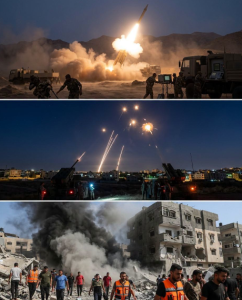
🇮🇷🇺🇸🇯🇴🇮🇱 Iran Responded After U.S. Attack — What We Know About the Latest Escalation
Tensions between Iran and the United States have erupted once again, raising fears that the already dangerous conflict in the Middle East could enter another and even more unpredictable phase.
A dramatic claim spreading across social media says that Iran responded within two hours of a U.S. attack, launching missiles toward American positions in Jordan. While the precise “two-hour” timeline has circulated online, the broader event behind the claim is real: U.S. forces recently struck Iranian military launchers on Larak Island, and Iran subsequently announced retaliatory attacks against American military facilities in Jordan.
The rapid exchange has once again demonstrated how quickly an incident involving Washington and Tehran can spread across borders.
What Happened?
The latest escalation followed a U.S. military strike against Iranian rocket launchers on Larak Island, a strategically important location in the Strait of Hormuz.
According to reporting, the United States said the launchers posed a potential threat connected to Iranian preparations in the strategically vital waterway. The U.S. action represented the first direct American attack on Iranian territory in roughly a month, immediately raising questions about whether the fragile pause in fighting was coming to an end.
Iran responded forcefully.
The Islamic Revolutionary Guard Corps announced that it had launched ballistic missiles against two U.S. military bases in Jordan: King Hussein Air Base and Al Azraq Air Base. Reuters reported that the Iranian military described the attacks as retaliation for the U.S. strike on Larak Island.
The developments marked another dangerous exchange between the two countries.
Why Jordan Matters
Jordan has attempted to maintain its own security while finding itself increasingly caught between competing military powers.
The country hosts American forces and facilities that have become potential targets during the broader conflict. At the same time, Jordan has repeatedly emphasized the importance of protecting its territory and airspace.
When Iranian missiles are launched toward U.S. positions inside Jordan, Amman faces a difficult situation.
Jordan must defend its territory while also managing its relationship with Washington and avoiding becoming an even larger battlefield.
Reports indicated that the latest Iranian missiles aimed at U.S. facilities in Jordan were intercepted. The incident nevertheless demonstrated how the conflict can quickly extend beyond the borders of Iran and Israel.
The Conflict Is No Longer Limited to Two Countries
One of the most worrying aspects of the current crisis is its regional nature.
The conflict has already affected several countries and strategic locations throughout the Middle East.
Iran has previously targeted American military facilities in the region, while the United States has conducted strikes against Iranian military infrastructure. Israel remains deeply involved in the wider confrontation, and Gulf states have found themselves dealing with the consequences.
The Strait of Hormuz has become particularly important.
The waterway is one of the world’s most strategically significant shipping routes. Any prolonged military disruption there can affect energy markets, shipping companies and consumers far beyond the Middle East.
Recent reporting indicates that commercial traffic through the strait has been disrupted, forcing some cargo to take alternative routes. Jordan’s Aqaba port, for example, has experienced increased transit activity as traders search for alternatives.
Why the “Two Hours” Claim Is So Powerful
The phrase “Iran responded within two hours” has become one of the most attention-grabbing elements of the story.
It creates an image of an almost immediate military response.
However, readers should be careful with exact timelines circulating on Facebook, X, TikTok and other platforms. Social-media posts often compress complicated military events into a simple sequence of minutes or hours.
The broader sequence is confirmed: the United States attacked Iranian military launchers, and Iran subsequently retaliated against U.S. positions in Jordan.
But the exact timing should not automatically be treated as independently verified simply because it appears in a viral headline.
That distinction matters.
Military operations can involve preparation, surveillance, command decisions and launches occurring at different times. The public may only learn about those events after official statements or media reports are released.
Iran’s Message
Iran’s retaliation carries a clear political message.
Tehran wants Washington to understand that American military attacks on Iranian territory will not necessarily go unanswered.
Iranian officials have repeatedly argued that the country has the right to defend itself against foreign attacks. The latest strike demonstrates that Iranian forces remain capable of launching missiles and drones against American military assets in the region.
At the same time, Iranian President Masoud Pezeshkian has indicated that Tehran remains open to diplomacy under certain conditions.
Reuters reported on September 1 that Pezeshkian said Iran would reciprocate if the United States returned to its commitments under an interim memorandum of understanding. He also indicated that Iran remained interested in diplomatic solutions while linking freedom of navigation through the Strait of Hormuz to Washington’s adherence to the agreement.
That combination—military retaliation alongside diplomatic messaging—illustrates the complexity of the situation.
Trump’s Response
President Donald Trump has warned that the United States could respond forcefully to Iranian attacks.
Following the latest exchange, Trump threatened further action against Iran. Reuters reported that the president warned of additional strikes after the two sides exchanged attacks for the first time in about a month.
That creates a dangerous cycle.
Iran attacks U.S. positions.
Washington threatens retaliation.
Another American strike follows.
Iran then promises another response.
Each step increases the possibility that an incident intended to send a limited message could develop into a much larger confrontation.
The Risk of a Wider War
The biggest concern is not necessarily the individual strike itself.
It is what could happen next.
The Middle East already contains multiple overlapping conflicts and military alliances. A single missile attack can create pressure for retaliation, while retaliation can generate another response.
The presence of American troops and facilities throughout the region increases the number of potential targets.
Israel’s involvement adds another layer.
Iran has already demonstrated its willingness to launch missiles and drones beyond its immediate borders, while Israel continues to view Iran’s military capabilities as a major security threat.
Meanwhile, countries such as Jordan and the Gulf states must protect their own populations and territory while trying to avoid being pulled deeper into the conflict.
Oil Markets Are Watching Closely
The latest military confrontation is also an economic story.
The Strait of Hormuz carries a substantial portion of the world’s oil trade. Any serious disruption can have consequences for global energy prices.
Recent market reporting showed oil prices rising following the renewed U.S.-Iran fighting. The concern is straightforward: if shipping through the strait becomes significantly more difficult, supplies could be delayed and transportation costs could increase.
Higher energy costs can eventually affect transportation, manufacturing, food prices and household budgets.
That means an event occurring thousands of miles away can have consequences for people who have never visited the Middle East.
What Happens Next?
The immediate question is whether the latest exchange remains limited or develops into another sustained military campaign.
Both Washington and Tehran have reasons to demonstrate strength.
Neither side wants to appear weak.
But both also face enormous costs if the conflict expands.
The United States has significant military capabilities in the region, while Iran possesses missiles, drones, naval assets and a network of regional partners and allies.
That makes escalation particularly dangerous.
A relatively small exchange can quickly become something much larger if either side miscalculates the other’s intentions.
The Bottom Line
The viral headline claiming that “Iran responded within two hours” should be treated carefully when discussing the precise timeline.
However, the underlying development is genuine.
The United States recently struck Iranian military launchers on Larak Island, and Iran responded by announcing ballistic-missile attacks against U.S. military facilities in Jordan. Additional Iranian drone activity has also been reported in the region.
The incident represents another serious escalation in an already volatile conflict.
For now, the most important question is not simply how quickly Iran responded.
It is what Washington and Tehran decide to do next.
If the two governments choose restraint and diplomacy, the latest exchange could remain limited.
If either side responds with a significantly larger attack, however, the consequences could spread rapidly across the Middle East, affecting Israel, Jordan, Gulf states, international shipping, energy markets and American forces throughout the region.
The coming days will therefore be watched closely.
What began as another exchange of military strikes could either become a temporary flare-up—or mark the beginning of a much more dangerous chapter in the U.S.-Iran confrontation.