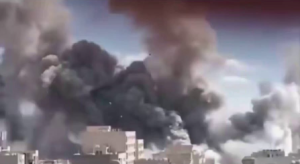
BREAKING: Reports Claim U.S. Has Attacked Military Target in Tehran — What We Know So Far
A dramatic claim is spreading rapidly across social media and online news platforms, alleging that the United States has launched a fresh attack on a military facility in Tehran, Iran.
The report has immediately attracted worldwide attention because any confirmed American strike inside the Iranian capital would represent a major escalation in the already dangerous confrontation between Washington and Tehran.
However, at the time of writing, the claim that the United States has just attacked a military base in Tehran has not been independently confirmed by the major sources currently reporting on the conflict.
What has been confirmed is already extremely serious.
The United States recently carried out strikes against Iranian launchers on Larak Island, while Iran subsequently retaliated against American military positions in Jordan. Reuters reported that the exchange represented the first known direct U.S.-Iran military confrontation in several weeks.
A Rapidly Changing Situation
The situation is developing quickly, making verification particularly important.
According to current reporting, American forces targeted two Iranian launchers on Larak Island. The island sits in the Strait of Hormuz, one of the world’s most strategically important waterways.
The American action was followed by an Iranian military response.
Iran’s Revolutionary Guard said it launched ballistic missiles toward two U.S. bases in Jordan. The reported targets included King Hussein Air Base and Al Azraq Air Base.
The exchanges have increased fears that the conflict could once again move into a broader phase.
That is why the latest claim about Tehran is attracting so much attention.
Why a Strike on Tehran Would Be Significant
Tehran is not simply another military location.
It is Iran’s capital and the center of the country’s political, governmental and military leadership.
A confirmed American attack on a military facility inside Tehran would therefore carry enormous symbolic significance.
It could be interpreted by Iranian leaders as a direct escalation against the heart of the country.
Such an operation could also create pressure on Tehran to respond.
Iran has repeatedly warned that attacks against its territory could trigger retaliation against American military forces throughout the region.
Reuters reported earlier this year that Iranian officials had warned that if the United States attacked Iran, Tehran would target U.S. bases in the region rather than the countries hosting those bases.
That warning has become particularly relevant during the latest escalation.
What Has Actually Been Confirmed?
The verified sequence is important.
First, U.S. forces struck Iranian launchers on Larak Island.
Second, Iran announced retaliatory missile attacks against American military facilities in Jordan.
Third, tensions continued to rise across the region, including around the Strait of Hormuz.
But there is currently a crucial distinction between these confirmed events and the new social-media claim about a military base in Tehran.
A viral headline can spread worldwide within minutes.
A military operation, however, can take hours to confirm.
Satellite imagery, government statements, eyewitness accounts and independent reporting may all be required before journalists can establish what actually happened.
For that reason, reports describing an alleged attack on Tehran should not automatically be treated as confirmed simply because they are being shared thousands of times online.
Tehran Watches Washington Closely
Iranian leaders are clearly aware of the possibility of further American military action.
Iranian President Masoud Pezeshkian said on September 1 that Tehran would be prepared to reciprocate if Washington returned to commitments made under an interim agreement reached in June. He also indicated that Iran remained open to diplomacy under certain conditions.
Those comments are significant because they demonstrate that military confrontation and diplomatic efforts are continuing simultaneously.
Iran is signaling that it can retaliate while also leaving open the possibility of negotiations.
That combination could determine what happens next.
Trump Has Threatened Further Action
The White House has also issued warnings.
President Donald Trump has threatened further strikes against Iran following the recent exchange of attacks.
Reuters reported that Trump warned Iran after American and Iranian forces exchanged fire for the first time in weeks.
That means the possibility of another U.S. military operation cannot simply be dismissed.
But there is a major difference between saying further attacks are possible and confirming that a particular attack has already occurred.
That distinction is especially important when reporting on breaking military events.
The Strait of Hormuz Is at the Center of the Crisis
One of the major reasons the current confrontation matters far beyond Iran and the United States is the Strait of Hormuz.
The narrow waterway connects the Persian Gulf with the Gulf of Oman and the Arabian Sea.
It is one of the most important routes for international energy shipments.
The continuing confrontation has already affected commercial shipping and global energy markets.
Reuters reported on September 1 that Iranian oil exports through the Strait of Hormuz had effectively stalled for weeks amid a U.S. naval blockade, placing additional pressure on Tehran’s economy.
Any major expansion of military operations could therefore have consequences far beyond the battlefield.
Oil prices could rise.
Shipping costs could increase.
Insurance premiums could climb.
And countries that depend heavily on Middle Eastern energy supplies could face additional economic pressure.
Other Countries Are Becoming Involved
The conflict is also increasingly regional.
Iran has attacked or threatened American military positions located in countries such as Jordan and has issued warnings concerning U.S. bases across the Gulf.
The United Arab Emirates has also reported dealing with a drone that came from Iran, while regional governments have become increasingly concerned about the possibility of attacks spilling across their borders.
For countries hosting American military forces, the situation presents an extremely difficult balancing act.
They have security relationships with Washington, but they do not necessarily want their territory to become a battlefield between the United States and Iran.
Could the Tehran Report Be a False or Premature Claim?
It is possible.
During rapidly developing conflicts, social media often becomes flooded with old photographs, unrelated explosions, recycled videos and unverified claims.
A headline saying that an attack occurred “just now” may actually refer to an older event.
In some cases, reports can also originate from anonymous sources before government officials have publicly confirmed the information.
That does not mean the report is necessarily false.
It means the information should be treated as unconfirmed until credible independent sources establish what happened.
What Would Happen If It Were Confirmed?
If the United States were confirmed to have struck a military facility inside Tehran, the consequences could be significant.
Iran would face enormous pressure to respond.
The Iranian government could order missile or drone attacks against American forces in the region.
Shipping through the Strait of Hormuz could become even more dangerous.
Israel could also become more closely involved.
And the possibility of a wider regional conflict would increase.
The United States, meanwhile, could argue that the strike was necessary for defensive or strategic reasons.
The result could be another cycle of attack and retaliation.
The Diplomatic Door Is Still Open
Despite the military confrontation, diplomacy has not completely disappeared.
Iran’s president has publicly indicated that Tehran could return to an interim agreement if Washington fulfills its commitments.
That creates an important opening.
The two governments may be able to use negotiations to prevent the current escalation from becoming a full-scale regional war.
But diplomacy becomes much more difficult when missiles are flying and military forces are preparing for possible attacks.
Every new strike reduces trust.
Every retaliation increases the political cost of compromise.
The Bottom Line
The headline claiming that the United States has launched an attack on a military base in Tehran should currently be regarded as unconfirmed.
The verified developments are serious enough on their own.
The United States has struck Iranian launchers on Larak Island.
Iran has responded with attacks against U.S. military positions in Jordan.
President Trump has threatened further action, while Iranian officials have simultaneously signaled both a willingness to retaliate and an interest in diplomacy.
The next hours could therefore be crucial.
If reports of a new attack inside Tehran are confirmed, the region could face another major escalation.
If they prove premature or inaccurate, the episode will nevertheless demonstrate how quickly misinformation can spread during a military crisis.
For now, the safest conclusion is simple:
The situation is extremely volatile, but the alleged new U.S. strike on a Tehran military base has not yet been independently confirmed by the sources reviewed.
As the conflict develops, verified information from governments, reputable news organizations and independent observers will be essential.
In a crisis this dangerous, the difference between a confirmed military strike and an unverified social-media claim is not a minor detail.
It could be the difference between understanding what is actually happening—and accidentally spreading a story that has not happened at all.