BREAKING NEWS: 13 Countries Join Forces to Attack — What’s Really Behind the Viral Claim?
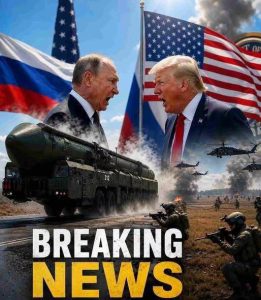
A dramatic image showing Vladimir Putin and Donald Trump facing one another amid missiles, military vehicles, helicopters, smoke and national flags has begun circulating online alongside a sensational headline:
“BREAKING NEWS: 13 countries join forces to attack…”
At first glance, the picture looks like a scene from an unfolding global conflict. The combination of military hardware, battlefield smoke and political leaders creates the impression that a major international attack has just been launched.
But there is an important distinction between a dramatic viral graphic and verified breaking news.
As of September 3, 2026, there is no credible evidence establishing that 13 countries have suddenly formed a military coalition to launch an attack matching the claim in the image. Searches for the exact wording mainly lead to low-quality or sensational websites repeating the headline rather than authoritative announcements confirming such an attack. One site carrying essentially the same headline provides a military-themed description but does not establish that the alleged 13-country attack actually occurred. (Amazing)
That doesn’t mean the international security situation is calm. Far from it. Tensions involving Russia, Ukraine, NATO and the United States remain serious, and European governments have been strengthening their defenses. But those real developments should not automatically be transformed into a claim that a 13-nation military assault has begun.
The image itself tells a story — but not necessarily a factual one
The photograph used with the headline is designed to provoke an immediate emotional reaction.
Putin and Trump dominate the upper portion of the picture. Behind them are Russian and American flags, while the lower half shows what appears to be a battlefield containing a huge missile system, soldiers, helicopters and smoke.
It is the visual language of a major-war poster.
Such images are increasingly common online. A photograph, digitally created composite or AI-generated graphic can be paired with a genuine-sounding headline and shared thousands of times before anyone checks whether the event actually happened.
The presence of recognizable political leaders does not prove that the depicted scene occurred.
Nor does the presence of military equipment prove that a particular operation has been launched.
That distinction is especially important when dealing with claims involving nuclear weapons, ballistic missiles or an alleged attack involving multiple countries.
Why the number “13” may sound familiar
Interestingly, 13 countries is a number that has appeared in several genuine military and security contexts, which may help explain why sensational posts using the number can appear believable.
For example, a recent analysis from the Center for Strategic and International Studies discussed counterspace capabilities across 13 countries. Its assessment included countries with different levels of military activity involving space and counterspace technologies. (CSIS)
Separately, military exercises have also involved groups of 13 countries.
A major Swedish-led exercise, Aurora 26, involved approximately 18,000 participants from 13 countries and included training relating to drones, contested communications and modern warfare. (Meta-Defense)
Those are very different things from 13 countries joining together to launch an attack.
A multinational exercise is not the same as a declaration of war.
A defense coalition is not automatically an offensive alliance.
And countries cooperating on military preparedness does not mean they have agreed to attack another nation.
Europe is nevertheless preparing for a more dangerous security environment
The background to the viral claim is important.
European governments have spent years reassessing their military readiness because of Russia’s war against Ukraine and concerns about the possibility of wider confrontation.
Drone warfare has become particularly significant.
A recent report discussed by the International Institute for Strategic Studies examined 144 drone-related incidents across 13 European countries between August 2024 and February 2026. The analysis attributed the pattern to what researchers described as a coordinated Russian campaign involving surveillance and drones launched from vessels associated with Russia’s so-called shadow fleet. (LBC)
Those allegations are serious, but again, they are not evidence that 13 countries have launched an attack.
Instead, they illustrate why governments are increasing surveillance, air defenses and military preparedness.
NATO’s role makes headlines especially sensitive
Any suggestion that multiple European countries are preparing to attack Russia immediately raises questions about NATO.
NATO is a defensive alliance, and its members have repeatedly emphasized deterrence and collective defense. At the same time, Russia and NATO have experienced an increasingly tense relationship since the full-scale invasion of Ukraine.
The danger in sensational headlines is that they can erase the distinction between deterrence and war.
A country moving troops to protect critical infrastructure does not necessarily mean it is preparing an invasion.
A military exercise does not necessarily mean an attack is imminent.
And a coalition discussing missile defense does not mean those countries have authorized offensive strikes.
In July, Ukraine and nine other countries were reported to have announced a coalition aimed at protecting Europe from ballistic missiles. That development demonstrated growing concern about missile threats, but defensive cooperation should not be confused with a 13-country attack. (KSAT)
The nuclear imagery makes the headline even more alarming
The enormous missile launcher in the viral image is another important detail.
Images of ballistic missiles carry extraordinary psychological weight because they immediately suggest nuclear war.
Russia and the United States possess enormous nuclear arsenals, and both countries remain central to global nuclear deterrence.
That is precisely why claims about an imminent military confrontation between Moscow and Washington require an exceptionally high standard of verification.
If 13 countries had actually launched a coordinated attack involving Russia or the United States, it would not simply appear as an unexplained social-media graphic.
There would be statements from governments, defense ministries, military commands and major international news organizations. Markets would react. Emergency diplomatic meetings would be reported. International organizations would respond.
A genuine event of that magnitude would leave an enormous public information trail.
What should readers do when they see posts like this?
The first step is simple:
Stop before sharing.
Look beyond the headline.
Ask who originally published the claim.
Is there a named journalist?
Is there an identifiable location and time?
Are governments confirming the event?
Are established news organizations independently reporting the same thing?
Are there official statements from the countries allegedly involved?
If the answer to those questions is no, the headline should be treated as unverified.
This is particularly important with posts containing phrases such as “BREAKING NEWS,” “WORLD WAR,” “ATTACK HAS BEGUN,” or “13 COUNTRIES JOIN FORCES.”
Those phrases are designed to create urgency. Urgency can encourage people to share first and verify later.
Real tensions should not be exaggerated
There are plenty of genuine developments that deserve attention without inventing an attack.
European countries are increasing defense spending.
NATO members are conducting exercises.
Ukraine continues to face Russian military pressure.
Drones and missiles have transformed modern warfare.
Governments are increasingly concerned about sabotage, cyber operations and attacks against infrastructure.
And relations among major powers remain unpredictable.
These are serious issues.
But exaggerating them into a fictional declaration of war can have consequences of its own.
False reports can cause unnecessary fear, distort public understanding and make it more difficult to distinguish genuine emergencies from manufactured social-media content.
The bigger picture
The most important lesson from the viral “13 countries” headline is not that a massive international attack has begun.
It is that modern conflict increasingly takes place in the information environment as well as on the battlefield.
A dramatic photograph can travel across social media in seconds.
A sensational headline can be copied by multiple websites.
Readers may then see the same claim in several places and assume that repetition equals confirmation.
It doesn’t.
The same unverified story can be reproduced dozens of times without becoming true.
At the moment, the available evidence does not substantiate the claim that 13 countries have suddenly joined forces to launch the attack suggested by the viral image. What can be verified is a broader increase in military preparedness, multinational exercises, missile-defense cooperation and concern over Russian activity in Europe. (Meta-Defense)
That reality is already serious enough.
There is no need to add an unverified war to it.
The bottom line
The image is striking, the headline is alarming and the geopolitical environment is undeniably tense.
But “13 countries join forces to attack” should not currently be presented as confirmed breaking news.
Until credible governments and multiple authoritative news organizations verify such an extraordinary event, the responsible conclusion is that the claim is unverified and likely misleading.
In an era when a dramatic image can become a global headline within minutes, the most powerful response is sometimes the simplest one:
Check before you share.