🔴 BREAKING NEWS!!! “30 Minutes Ago in New York” — What We Actually Know About the Explosive U.S.-Iran Claim
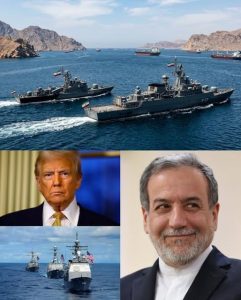
A dramatic image circulating online is carrying an alarming message suggesting that a major geopolitical development has just taken place “30 minutes ago in New York.” The graphic features U.S. President Donald Trump alongside Iranian Foreign Minister Abbas Araghchi, Iranian naval vessels in the Strait of Hormuz, and American warships at sea.
The implication is unmistakable: something enormous has happened between the United States and Iran.
But there is an important difference between the dramatic claim being circulated online and what can actually be verified.
As of September 3, 2026, the United States and Iran are already engaged in a serious and rapidly changing military confrontation. Recent fighting has involved American strikes against Iranian military infrastructure and Iranian missile and drone attacks against U.S. positions in the region. Reuters reports that the latest escalation has included attacks involving Bahrain, Jordan, Kuwait and Iraq, while concerns have grown over the Strait of Hormuz and global energy supplies. (Reuters)
However, the particular social-media graphic does not by itself establish that a new attack or extraordinary diplomatic announcement occurred 30 minutes ago in New York.
The picture is designed to look like an emergency bulletin
The image combines several powerful visual elements.
At the top are Iranian naval vessels flying Iranian flags. At the bottom are American warships sailing in formation. Between them are photographs of Trump and Araghchi.
The arrangement makes the image look like a breaking-news television graphic.
But it is important to remember that such composites are not evidence of an event.
A photograph of Iranian ships can be genuine without having been taken during the event described by the accompanying headline. Likewise, photographs of political figures can be old, unrelated to the claimed event, or combined digitally into a completely new composition.
The words “BREAKING NEWS” and “30 minutes ago” create urgency, but they don’t establish when or where the underlying photographs were taken.
That distinction matters enormously when the subject is a possible military confrontation.
The real story is already serious
There is no need to invent a crisis to make the situation alarming.
The United States and Iran have recently exchanged direct attacks.
Reuters reported on September 2 that the U.S. campaign against Iran had intensified, with American strikes targeting Iranian radar, missile systems and other military installations near the Strait of Hormuz. President Trump said the renewed campaign would not last indefinitely but warned that the United States remained prepared to conduct additional strikes if necessary. (Reuters)
Iran subsequently retaliated.
According to Reuters, Iranian missile and drone attacks targeted American assets in several countries, including Bahrain, Jordan, Kuwait and Iraq. The escalation has raised fears that fighting could spread throughout the region. (Reuters)
The Strait of Hormuz is particularly important because it is one of the world’s most strategically significant energy routes.
Any prolonged disruption there could affect shipping, oil prices and economies far beyond the Middle East.
Reuters reported September 3 that Brent crude was around $95 a barrel, while West Texas Intermediate was around $90, with markets reacting to uncertainty surrounding renewed U.S.-Iran strikes and the reduced flow of shipping through the strait. (Reuters)
Why New York matters
The reference to New York is another reason the claim may appear convincing.
New York is home to the United Nations headquarters and is frequently the setting for major international diplomatic meetings.
Whenever tensions rise between Washington and Tehran, references to New York can therefore sound especially significant.
But an alleged emergency announcement in New York involving an attack would require substantially more evidence than a social-media graphic.
A genuinely major development would normally generate statements from governments, diplomats, military authorities or international organizations and would quickly be reported independently by major news agencies.
The absence of such confirmation is a warning sign.
Who is the Iranian official pictured?
The Iranian official shown beside Trump is Abbas Araghchi, Iran’s foreign minister and one of Tehran’s most prominent diplomatic figures.
His appearance in the graphic is significant because it creates the impression that the story concerns negotiations or a confrontation directly involving senior Iranian leadership.
But a photograph of Araghchi does not establish that he has just met Trump in New York.
This is one of the most common techniques used in viral political graphics: combine recognizable faces with military imagery and an urgent headline so that viewers instinctively connect the photographs into one story.
The resulting picture can feel like evidence even when it is simply a collage.
The Strait of Hormuz is at the center of the crisis
The Iranian vessels shown in the graphic are particularly relevant because the Strait of Hormuz has become one of the central flashpoints in the current conflict.
The waterway separates Iran from Oman and provides a critical route for international energy shipments.
The latest fighting has centered partly on efforts by Washington to maintain freedom of navigation while Iran has threatened or restricted shipping in response to American military operations.
The stakes are enormous.
A prolonged closure or severe disruption could affect fuel prices, shipping insurance, transportation costs and global markets.
Reuters reported that only a small number of commodity vessels passed through the strait on Wednesday amid the heightened tensions. (Reuters)
That means the world is watching the region closely.
But again, heightened military tension is not the same thing as confirmation of the specific event depicted in a viral image.
Iran’s retaliation has expanded the geographic danger
One of the most worrying aspects of the current conflict is its potential to move beyond the immediate U.S.-Iran battlefield.
Iranian attacks have reached areas surrounding U.S. bases in Bahrain, Jordan, Kuwait and Iraq.
The Associated Press reported that Kuwait’s air defenses intercepted Iranian drones and that Bahrain and Jordan also intercepted Iranian attacks. (AP News)
This creates a complicated situation for regional governments.
Countries that may not want to become direct participants in the conflict can nevertheless become involved because American military forces are stationed on their territory or because missiles and drones cross their airspace.
Every additional country touched by the fighting increases the possibility of miscalculation.
Trump is facing pressure on several fronts
The crisis is also unfolding against a complicated political background in Washington.
Trump has publicly indicated that the United States remains willing to continue military operations if necessary, while also suggesting that the renewed campaign against Iran should not continue indefinitely. (Reuters)
That creates uncertainty about what comes next.
Will Washington intensify its attacks?
Will Tehran increase retaliation?
Can diplomatic channels reopen?
Or could another strike trigger a much larger confrontation?
Those questions remain central to the crisis.
At the same time, Reuters reports that the conflict is already producing economic consequences, particularly through its impact on oil markets and shipping. (Reuters)
What the viral headline gets wrong
The biggest problem with a headline such as “BREAKING NEWS!!! 30 minutes ago in New York…” is that it gives readers a sense of certainty that the available evidence does not necessarily justify.
There is a real war.
There are real missile and drone attacks.
There are real American and Iranian military forces operating in the region.
There are real concerns about the Strait of Hormuz.
But those facts cannot automatically authenticate every dramatic photograph or social-media headline connected to them.
This is precisely why readers should be cautious when a post claims that something happened only minutes ago.
Before believing or sharing it, ask:
- Is the event confirmed by multiple reputable news organizations?
- Has the U.S. government issued a statement?
- Has Iran issued a statement?
- Are military authorities confirming the alleged attack?
- Is there a specific location and timestamp for the photographs?
- Does the image appear to be a composite?
- Is the headline describing an actual event or simply asking viewers to click?
If those questions cannot be answered, the claim should be treated as unverified.
A crisis that doesn’t need exaggeration
The truth is already dramatic enough.
The United States and Iran are engaged in direct hostilities. American forces have conducted strikes inside Iran, while Iranian forces have retaliated against U.S. positions across the region. The Strait of Hormuz remains a major strategic pressure point, and the possibility of further escalation is a serious international concern. (Reuters)
At the same time, diplomatic possibilities have not disappeared completely. Reporting indicates that discussions and proposals surrounding a potential U.S.-Iran arrangement have continued, even as military operations have intensified. (The Daily Star)
That contradiction — warfare alongside diplomacy — is one of the defining features of the current crisis.
The bottom line
The viral image is certainly designed to make viewers believe that an extraordinary announcement has just occurred in New York.
But the image itself cannot prove that.
The broader U.S.-Iran conflict is real and has escalated sharply. Recent American strikes and Iranian retaliatory attacks have created a dangerous situation across the Middle East, while the Strait of Hormuz has become an increasingly important military and economic flashpoint. (Reuters)
What remains unconfirmed is the specific claim suggested by the graphic — that a new, extraordinary event occurred “30 minutes ago in New York.”
In a rapidly moving international crisis, the most responsible approach is to separate verified developments from viral claims.
The world is watching Washington, Tehran and the Strait of Hormuz closely.
And if a genuinely historic announcement does emerge, it will require more than a dramatic picture and a red BREAKING NEWS banner to establish that it happened.