Iran War Live: Tehran Says It Targeted Kuwait, UAE Over U.S. Military Support
The war involving Iran and the United States has entered another dangerous phase, with Tehran saying its forces targeted U.S.-linked military facilities in Kuwait and the United Arab Emirates in retaliation for American attacks inside Iran.
The latest developments have intensified fears that the conflict could spread across the Persian Gulf, drawing more countries directly into the fighting and placing additional pressure on one of the world’s most important energy routes.
Iran’s army said Thursday that it had launched missile and drone attacks against military bases used by U.S. forces in Kuwait and the UAE. Iranian statements said the attacks were carried out in response to American military operations against Iran. (Al Jazeera)
The Kuwaiti government, meanwhile, described the Iranian attacks as a serious violation of its sovereignty and said its air defenses had responded to incoming missiles and drones.
The developments come after the United States conducted a new series of strikes against Iranian military targets, marking a major escalation following a period of reduced fighting.
Iran says U.S. bases were the targets
According to Iranian military statements reported by ABC News, Tehran said its forces targeted Ahmed al-Jaber Air Base in Kuwait, striking facilities it described as satellite communications systems, equipment depots and fighter-jet hangars.
Iran also claimed that its forces attacked Al Minhad Air Base in the UAE, targeting troop positions and radar systems. (ABC News)
The Iranian military’s statements are significant because both locations have links to U.S. military operations in the region.
Tehran has repeatedly warned that countries hosting American forces could become targets if they assist Washington’s campaign against Iran.
That creates an extraordinarily difficult position for Gulf states.
Countries such as Kuwait and the UAE may host American forces for defensive and strategic purposes, while simultaneously trying to prevent their territories from becoming launchpads for a wider war.
Kuwait responds
Kuwait has condemned the Iranian attacks and said its armed forces responded to incoming threats.
The country’s military reported missile and drone attacks directed toward its territory. According to the Associated Press, Kuwait described the action as “blatant Iranian aggression.” (AP News)
The immediate concern is that repeated attacks could transform what has largely been a U.S.-Iran confrontation into a broader regional conflict.
If Gulf states are repeatedly struck, they could face growing domestic pressure to respond.
That would introduce another dangerous variable into an already volatile situation.
The UAE is also caught in the middle
The United Arab Emirates faces a similar dilemma.
The UAE has strong economic and diplomatic interests in maintaining regional stability, while American military facilities operating in the country make it strategically important to Washington.
Iran’s decision to say it targeted U.S.-linked facilities in the UAE therefore carries a clear message: Tehran wants Washington to understand that its military campaign has consequences beyond Iran’s borders.
At the same time, striking facilities located inside another sovereign country risks generating a much broader diplomatic crisis.
The distinction between attacking American military assets and attacking the territory of a Gulf state may be extremely important in determining how governments respond.
The conflict began escalating again this week
The latest attacks follow a new American military campaign against Iranian targets.
The U.S. military said it had begun striking Islamic Revolutionary Guard Corps targets in Iran on Tuesday. American officials said the strikes followed attempted Iranian attacks involving commercial shipping in the Strait of Hormuz and American service members deployed in the region. (ABC News)
President Donald Trump has defended the American military campaign and warned that Washington remains prepared to conduct additional operations.
Reuters reported that Trump said the renewed U.S. campaign against Iran would not last indefinitely, while also indicating that Washington was prepared to strike again if necessary. (The Guardian)
That combination of statements has left the region watching closely for signs of either further escalation or a return to negotiations.
The Strait of Hormuz is at the center of everything
One of the biggest reasons the latest developments are attracting global attention is the Strait of Hormuz.
The narrow waterway is one of the most strategically important shipping routes on Earth.
Large quantities of oil and other energy products normally pass through the strait, meaning that prolonged military disruption can have consequences far beyond the Middle East.
Recent fighting has already affected shipping activity.
Reuters reported that oil prices have risen sharply amid concerns over the conflict, with Brent crude trading above $96 a barrel during the latest escalation. (Reuters)
For consumers around the world, the consequences could eventually appear in fuel prices, transportation costs and inflation.
For governments, the concern is even greater.
A prolonged disruption could create an energy shock affecting countries that are thousands of miles away from Iran.
Iran’s strategy is becoming increasingly regional
The latest attacks demonstrate the geographical complexity of Tehran’s response.
Iran is not limiting its retaliation to targets inside Iran or Israel.
Instead, Iranian missiles and drones have been directed at locations connected to U.S. military operations throughout the region.
Reuters reported that Iranian attacks have also targeted U.S. assets in Bahrain, Jordan, Kuwait and Iraq. (Reuters)
That creates the possibility of a chain reaction.
Every new attack creates another opportunity for retaliation.
Every retaliation creates another reason for Iran to strike again.
And as more countries become involved, the possibility of an accidental escalation increases.
Civilian casualties add another layer of urgency
The renewed fighting is also producing a growing humanitarian toll.
Reuters reported Thursday that Iran was holding funerals for victims of a U.S. strike that Iranian authorities said hit a wedding in the southern village of Kuhestak. The report said several civilians were killed and dozens wounded. (Reuters)
The United States has also suffered military casualties during the wider conflict.
Reuters reported that Iranian military personnel were killed in recent U.S. strikes, including members of Iran’s regular military, the Basij and the Islamic Revolutionary Guard Corps Aerospace Force. (Reuters)
As the fighting continues, casualty figures are likely to remain disputed, particularly when governments involved in the war release competing accounts.
What does Iran want?
Tehran’s immediate objective appears to be demonstrating that American military pressure comes with a cost.
Iran has sought to make the presence of U.S. forces throughout the Gulf increasingly difficult and expensive.
By targeting American-linked bases, Tehran can attempt to pressure Washington without necessarily launching attacks directly against the continental United States.
But this strategy carries enormous risks.
An attack against an American installation can provoke another American attack against Iran.
That creates a cycle in which each side claims its actions are retaliatory.
The longer that cycle continues, the harder it becomes to find a path toward de-escalation.
Trump faces a difficult decision
For President Trump, the situation presents competing pressures.
On one hand, the administration has demonstrated its willingness to use significant military force against Iran.
On the other, an indefinitely expanding conflict could become increasingly costly.
The Wall Street Journal reported that U.S. military deployments in the Middle East are now being extended into 2027, reflecting the growing possibility that American forces could remain heavily committed to the region for much longer than initially anticipated. (The Wall Street Journal)
That development highlights the central question facing Washington:
How far does the United States intend to go?
A short military campaign is one thing.
A prolonged regional war involving dozens of bases, naval forces, aircraft, missile defenses and tens of thousands of American personnel is something entirely different.
Could the conflict spread further?
That is now one of the most important questions.
The possibility of additional attacks on U.S. facilities in Gulf countries cannot be dismissed.
Iran has already demonstrated that it can launch missiles and drones toward multiple countries.
Meanwhile, the United States has significant military capabilities throughout the region.
If another major attack results in large numbers of American casualties, pressure for a powerful U.S. response could increase substantially.
That could lead to another cycle of escalation.
Regional governments are therefore attempting to protect their territory while avoiding becoming full participants in the conflict.
What the dramatic image means
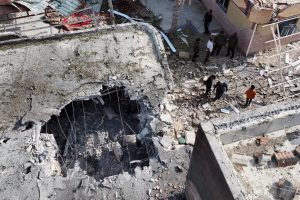
The photograph accompanying this story shows extensive destruction, with people examining the remains of damaged buildings.
However, the photograph alone should not be treated as proof that the pictured destruction resulted from the latest Iranian attacks on Kuwait or the UAE.
Online posts frequently combine genuine photographs from previous conflicts with current headlines.
Without reliable information identifying the exact location, date and circumstances of the photograph, it is impossible to establish that the image depicts the events described in the headline.
The verified story is already dramatic enough.
The bigger danger
The greatest concern is not simply one missile attack.
It is the possibility of a much wider regional conflict.
Iran has demonstrated its willingness to strike American-linked facilities in neighboring countries.
The United States has demonstrated its willingness to strike Iranian military targets.
Gulf states are increasingly caught between the two.
And the Strait of Hormuz remains a strategic pressure point capable of affecting the global economy.
That combination makes the present moment particularly dangerous.
The road ahead
For now, the situation remains fluid.
Iran says its attacks are retaliation for American military operations.
Kuwait has condemned the attacks against its territory.
The UAE has been drawn into the confrontation because of American military facilities operating there.
Washington has warned that additional strikes remain possible.
And diplomatic efforts have not completely disappeared, despite the renewed fighting.
The immediate future could therefore move in two very different directions.
The conflict could escalate further, with additional missile and drone attacks and increasingly severe American retaliation.
Or the enormous military and economic costs could eventually push the parties back toward negotiations.
For the moment, however, the battlefield is speaking louder than diplomacy.
The bottom line
Iran says it has targeted U.S.-linked military facilities in Kuwait and the UAE with missiles and drones. Kuwait has reported responding to Iranian attacks, while the wider conflict has already involved American and Iranian strikes across several Middle Eastern countries. (Al Jazeera)
The developments represent a significant escalation because they increase the number of countries directly exposed to the consequences of the U.S.-Iran war.
But the most dangerous question is what happens next.
If Washington retaliates against Iran, Tehran could respond again.
If Iran attacks additional U.S. bases, the United States could expand its campaign.
And if more Gulf countries are drawn into the fighting, a conflict that began primarily as a confrontation between Washington and Tehran could become a much broader regional war.
For millions of people across the Middle East — and for governments and markets around the world — the coming days could prove decisive.