Threat of Unprecedented Global Conflict Escalates as Intelligence Reports Warn of Imminent Strikes
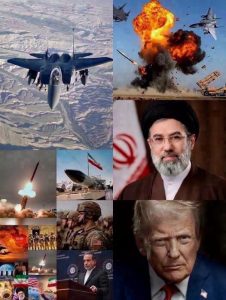
The Middle East is facing another dangerous moment as the United States and Iran exchange attacks and the risk of a wider regional confrontation grows. A dramatic collage circulating online—featuring military aircraft, missile launches, explosions, Iranian imagery and U.S. President Donald Trump—captures the atmosphere of fear surrounding the conflict.
But the reality is more complicated than the headline suggests. There is no reliable public evidence establishing that an “unprecedented global conflict” is certain to begin imminently. What is clear is that the U.S.-Iran confrontation has intensified sharply in recent days, with attacks extending beyond Iran and increasing pressure on countries across the Gulf. (Reuters)
A conflict that has entered a dangerous phase
Recent developments have shattered what had been a period of relative calm.
Reuters reported that the United States launched new strikes against Iran on September 1, while Iran subsequently retaliated with missile and drone attacks against U.S. interests and facilities in the region. The renewed fighting has raised fears that the conflict could once again spiral into a much larger confrontation. (Reuters)
The geographical dimension is particularly concerning.
Iranian attacks have not been limited to targets inside Israel or Iran’s immediate adversaries. Reports indicate strikes involving U.S. military facilities and allies across the Gulf, including Kuwait and the United Arab Emirates. The Institute for the Study of War said Iranian forces conducted a missile and drone attack targeting U.S. bases in Kuwait and the UAE on September 3. (Institute for the Study of War)
That creates a difficult calculation for Washington and regional governments.
Every additional attack creates the possibility of another response, and every response creates opportunities for further escalation.
Why the Gulf matters so much
The Persian Gulf is one of the most strategically important regions in the world.
Energy supplies, shipping routes and major military installations are concentrated there. Any prolonged disruption can affect countries far beyond the Middle East.
The Strait of Hormuz is particularly important because a substantial share of global oil shipments passes through the waterway.
Recent fighting has therefore produced consequences well beyond military targets. Reuters reported that renewed tensions pushed oil prices higher, while another report noted that crude prices were on course for a significant weekly gain amid continuing U.S.-Iran hostilities. (Google)
For ordinary people, this means geopolitical confrontation can quickly become an economic issue.
Higher energy prices can influence transportation, electricity, manufacturing and food costs. A conflict that begins thousands of miles away can therefore eventually affect household budgets around the world.
The danger of miscalculation
One of the greatest risks in a confrontation involving several heavily armed countries is not necessarily a deliberate decision to begin a world war.
It is miscalculation.
A missile launched at a military facility could accidentally strike civilians. A defensive interception could be interpreted as an offensive act. A military aircraft could be brought down. A regional ally could respond independently, forcing another government to react.
Each step can create pressure for the next.
The Institute for the Study of War has outlined several possible Iranian responses following recent Israeli military operations against Hezbollah positions. These range from a major missile and drone attack to a limited symbolic response—or no military response at all. Importantly, the organization also reported that Israeli officials had not observed Iranian intentions to attack Israel in the immediate term as of September 3. (Institute for the Study of War)
That distinction matters.
Escalation is a serious possibility, but possibility is not the same thing as certainty.
Civilian casualties raise the stakes
Perhaps the most troubling development has been the reported civilian death toll associated with the renewed strikes.
Reuters reported that an explosion during a wedding gathering in Kuhestak, southern Iran, on September 1 killed civilians and wounded dozens more. Analysis by weapons experts cited by Reuters suggested that the explosion was likely caused by a U.S. munition, while U.S. officials said the incident was under investigation. (Reuters)
The Associated Press separately reported that civilians, including women and a child, were killed in the incident. (AP News)
Such incidents can have consequences far beyond the immediate loss of life.
Civilian casualties increase domestic pressure on governments to retaliate. They can reduce the political space available for diplomacy and strengthen hard-line arguments on all sides.
That makes an already dangerous situation even more difficult to control.
Trump’s difficult position
President Donald Trump has become one of the central figures in the confrontation.
The administration has combined military pressure with economic measures intended to force Tehran toward a different strategic position. But military pressure can produce an unintended problem: the more intensely one side applies pressure, the greater the incentive for the other side to retaliate.
Trump has warned Iran against continuing attacks, while Iranian officials have maintained that Tehran will respond to military action against it.
The result is a familiar escalation cycle.
One side strikes.
The other side responds.
The first side announces that it must respond to the response.
And suddenly a conflict that neither side necessarily intended to expand begins spreading geographically.
Iran’s strategic calculations
Iran faces its own complicated choices.
Tehran wants to demonstrate that attacks against Iranian territory or its regional partners carry costs. At the same time, Iranian leaders have to consider the possibility that a major attack could trigger an even larger U.S. or Israeli military response.
That creates a narrow path between appearing weak and provoking overwhelming retaliation.
The recent attacks against U.S. positions in the Gulf appear to be part of that broader calculation. ISW assessed that Iran was seeking to increase the costs of the U.S. campaign, while also noting uncertainty about what Tehran might do next. (Institute for the Study of War)
The same problem applies to Israel.
Israel has its own security concerns involving Iran and Hezbollah and has continued military operations in the region. But an Iranian attack on Israeli territory could trigger another Israeli response, potentially drawing the United States deeper into the confrontation.
Hezbollah and Lebanon
Another major factor is Hezbollah.
The group remains a key component of Iran’s regional network, and Israeli military operations against Hezbollah positions have the potential to create another front.
According to ISW, Israeli forces recently announced that they had cleared a major Hezbollah underground facility beneath the Ali al-Taher Ridge in southern Lebanon. The organization identified several possible Iranian responses, including a large-scale missile and drone attack against Israel. (Institute for the Study of War)
This illustrates why analysts are concerned about the conflict becoming regional rather than remaining a direct U.S.-Iran confrontation.
A single development in Lebanon could trigger action from Iran.
That action could prompt Israel to respond.
The United States could then become involved.
And other regional actors could face pressure to choose sides.
Russia and China
Whenever a major conflict develops involving the United States and a strategically important Middle Eastern state, attention inevitably turns toward Russia and China.
Neither country’s interests perfectly align with Iran’s, and neither automatically wants a direct military confrontation with Washington.
Nevertheless, prolonged instability in the Middle East creates opportunities for rival powers to challenge U.S. influence, reshape diplomatic relationships and take advantage of economic disruptions.
This is one reason the phrase “global conflict” appears so frequently in online discussions.
But it is important to distinguish between global consequences and a global war.
A conflict can produce worldwide economic and political effects without becoming a direct military confrontation between all of the world’s major powers.
The economic shock is already visible
Even without a global war, the economic consequences can be serious.
Oil markets have reacted strongly to renewed fighting, particularly because of concerns surrounding the Strait of Hormuz. Reuters reported that oil prices reached six-week highs amid renewed U.S. strikes and Israeli threats. (Google)
In the United States, the effects are already being felt in fuel markets.
A Reuters report published September 4 said oil prices were heading toward a weekly gain of more than 6% despite falling that day. (Google)
Another report indicated that U.S. diesel prices had reached a record level amid the continuing conflict. (Al Jazeera)
These developments demonstrate something important: modern conflicts do not need to reach American territory to affect Americans.
Energy markets respond almost instantly to threats involving major supply routes.
What happens next?
The most important question is whether diplomacy can regain momentum before another major military exchange occurs.
There are still incentives for all sides to avoid an uncontrolled regional war.
The United States does not want an open-ended conflict that consumes enormous military and financial resources. Iran has strong incentives to avoid catastrophic damage to its infrastructure and government. Israel wants security but also has to consider the consequences of a prolonged regional war. Gulf states have an enormous interest in protecting their territory, economies and energy infrastructure.
These competing interests create possibilities for negotiations.
But diplomacy becomes increasingly difficult when missiles are flying.
Why dramatic headlines need caution
The image accompanying this story is designed to provoke an immediate emotional reaction.
It combines military aircraft, explosions, missiles, Iranian symbols and political leaders into one dramatic composition. Such imagery can make a complex geopolitical situation appear simpler than it really is.
The truth is already serious enough without exaggeration.
The United States and Iran are engaged in renewed military confrontation. Attacks have spread across the region. Civilian casualties have been reported. Oil markets are reacting. U.S. allies have become potential targets. And military operations involving Israel and Hezbollah create additional opportunities for escalation. (Institute for the Study of War)
But none of those facts proves that a third world war is imminent.
The responsible conclusion is more measured—and perhaps more alarming precisely because it is grounded in what is actually known.
The region is experiencing a highly dangerous escalation, and the possibility of further expansion is real.
The coming days could determine whether the current cycle of strikes eventually gives way to negotiations or develops into an even broader regional conflict.
For governments around the world, the priority will be preventing miscalculation.
For civilians, the hope is simpler: that the people making decisions in distant capitals understand just how devastating another step toward escalation could become.