Two Men Found Alive After 9 Days Inside a Flooded Nepal Tunnel — The Extraordinary Rescue That Gave a Nation New Hope
For nine long days, rescuers in Nepal worked through mud, rock, floodwater and enormous uncertainty, searching for workers believed to be trapped deep beneath a devastated hydropower project.
Then, on September 4, came the sound everyone had been hoping for.
Voices.
Deep inside the buried tunnel of the Upper Trishuli 3A Hydropower Project, rescuers heard signs that someone was still alive. Teams moved carefully toward the sound, eventually reaching two men who had somehow survived for nine days underground after catastrophic flooding swept through the region.
The survivors were identified as Sanjay Sah, a 30-year-old mechanical foreman, and Kabir Maharjan, a 45-year-old mechanical supervisor. Both were brought out alive and taken for medical treatment. (ABC News)
Their rescue became one of the most remarkable moments of a disaster that has caused enormous loss across Nepal.
The disaster that buried the tunnels
The crisis began on August 26, when devastating floods and torrents of mud and rock tore through parts of Nepal.
The Upper Trishuli 3A hydropower project was among the facilities badly affected. The floodwaters buried or blocked access to underground structures, leaving workers trapped in tunnels while rescue teams struggled to determine exactly where survivors might be.
The scale of the wider disaster was enormous. Hundreds of workers across hydropower projects were believed to be missing, with roughly 500 thought to be trapped in tunnels, according to authorities cited by ABC News. (ABC News)
At Trishuli 3A alone, more than 40 workers were believed to have been inside the tunnel system, although officials could not initially determine how many remained alive. (The New York Times)
For families waiting outside, every passing day brought increasing fear.
Nine days underground seemed almost impossible.
Then the rescuers heard something.
“We are coming”
According to reports from the rescue operation, teams heard voices from inside the tunnel on the morning of September 4.
The discovery immediately changed the atmosphere.
Instead of working only from maps, satellite imagery and assumptions about where survivors might have taken shelter, rescuers now had something much more valuable: human voices coming from beneath the debris.
One rescue leader called out to the trapped workers, reassuring them that the Nepali Army was coming.
The teams then crawled through narrow, sludge-filled sections of the tunnel in an effort to reach them. The operation was extremely dangerous because the passageways remained contaminated with mud and water, while huge rocks blocked sections of the route. (The New York Times)
Eventually, rescuers reached the men.
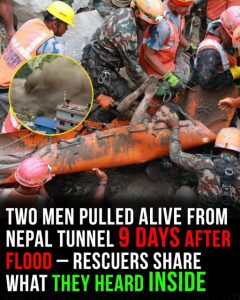
The first images showed the extraordinary moment one survivor was carried out, covered in mud and exhausted after spending more than a week underground.
Cheers reportedly erupted as the rescue workers brought him into the open air.
After nine days of uncertainty, two families suddenly had their loved ones back.
Who were the two survivors?
The two men were not simply lucky bystanders.
They were workers at the hydropower facility.
Sanjay Sah worked as a mechanical foreman, while Kabir Maharjan was a mechanical supervisor. (The Print)
Sah later described what happened when the flooding struck.
He said there had been dozens of people in the control area and that he tried to warn others about the danger.
His responsibility, he explained, was to help people escape.
He managed to get others out, but ultimately ran out of time to save himself.
That detail adds another dimension to his survival story.
The man who eventually emerged from the tunnel had spent the final moments before his entrapment trying to help other people escape.
What did they hear inside?
The headline accompanying the supplied image asks what rescuers heard inside the tunnel.
The answer is remarkably simple — and extraordinarily important.
They heard voices.
Those voices gave rescuers confirmation that their search had found a living person.
According to reports, the sound helped the teams establish where the survivors were located and guided the final stage of the rescue. (CBS News)
The significance of hearing a human voice after nine days cannot be overstated.
Rescue teams had been working against the clock while confronting the possibility that the tunnels contained only bodies or empty spaces.
Instead, there were survivors.
And potentially more.
“How many days has it been?”
Perhaps the most haunting detail from the rescue came after Sanjay Sah reached safety.
When speaking to people around him, he reportedly asked:
“How many days has it been?”
The question revealed just how completely time had disappeared underground.
For someone trapped in darkness without normal communication, daylight or a functioning sense of routine, nine days can become almost impossible to comprehend.
Sah also described repeatedly saying prayers while trapped.
Reports said he was able to answer questions while receiving oxygen after his rescue. (The New York Times)
His words offered rescuers something else besides relief: information about the possibility of additional survivors.
Sah reportedly believed that several other people might still be alive in the area where he had been found.
That meant the rescue operation was far from finished.
A rescue measured in meters
The search was painstaking.
The entrance to the tunnel had been buried beneath enormous quantities of mud and rock. Rescuers had to use engineering plans, satellite imagery, machinery and other information to work out where the underground structures were located.
The tunnel itself presented another problem.
Floodwater had to be removed, while huge rocks blocked the way forward. Rescue specialists also used controlled explosions to clear particularly difficult sections. (The New York Times)
According to reports, the survivors were found roughly 170 meters inside the tunnel.
That distance might sound relatively short under ordinary circumstances.
In a buried, flooded tunnel filled with unstable debris, however, 170 meters represented an enormous challenge.
Every section had to be approached carefully.
The condition of the survivors
Being rescued did not mean the ordeal was immediately over.
The men were suffering from injuries and the effects of spending nine days in exceptionally harsh conditions.
Reports indicated that Maharjan’s condition was initially more serious, while Sah was described as being in more stable condition. Both required medical treatment. (ABC News)
They were transported for treatment in Kathmandu.
Maharjan’s wife described the moment of reunion as an extraordinary blessing, saying her husband had effectively been given a second life.
At one point, she said, he was so disoriented that he did not immediately recognize her.
That reaction is understandable after nine days trapped underground.
The body and mind do not simply switch back to normal when someone reaches daylight.
Hope for those still missing
The rescue of Sah and Maharjan produced something the wider disaster desperately needed:
hope.
If two people could survive nine days inside a buried tunnel, then the possibility remained that others might also be alive.
Reports said rescuers heard additional voices deeper inside the tunnel system, although officials cautioned that it remained unclear how many people could still be rescued. (CBS News)
That uncertainty made the rescue effort even more urgent.
Every hour mattered.
Families gathered around hospitals and rescue centers waiting for news.
For those whose relatives remained missing, the survival of two workers offered a reason not to give up.
More than a dramatic rescue
It is tempting to describe the story simply as a miracle.
And for the families involved, it undoubtedly felt that way.
But the rescue was also the result of sustained technical work, coordination and extraordinary persistence.
Nepali Army and police teams worked alongside specialists, using heavy machinery, pumps, engineering information, satellite imagery and controlled excavation to reach the underground spaces. (ABC News)
The moment the rescuers heard voices was therefore not an isolated miracle.
It was the breakthrough produced by days of relentless searching.
The sound of those voices told them that their work had found its target.
A moment of light after darkness
The photographs and video from the rescue are powerful because they capture a remarkable contrast.
For nine days, the men had known darkness.
Then suddenly there were rescuers, daylight, oxygen, medical personnel and the sound of people cheering.
The first survivor emerged covered in mud.
But he was alive.
Then the second man was brought out.
Again, the rescue teams had succeeded.
For a country facing an enormous disaster, those images offered a rare moment of joy amid overwhelming grief.
They also reminded the world that behind the statistics of a natural disaster are individual people — workers, husbands, brothers, sons and friends.
The headline is true — but the full story is even more remarkable
The dramatic headline accompanying the supplied image says that two men were pulled alive from a Nepal tunnel nine days after the flood and that rescuers heard something inside.
That central claim is supported by multiple reports.
The men were Sanjay Sah and Kabir Maharjan, and they were rescued from the Upper Trishuli 3A hydropower project on September 4, nine days after the flooding. (ABC News)
The crucial breakthrough came when rescuers heard voices from within the tunnel.
And those voices did more than confirm that two men were alive.
They gave rescuers, families and a nation something desperately needed after days of devastation:
hope.
The rescue does not erase the enormous tragedy caused by the floods. Many people remain missing, and countless families are still waiting for answers.
But the survival of these two workers stands as one extraordinary chapter in the disaster — a reminder that even after nine days in darkness, a faint human voice can change everything.
And when the rescuers heard those voices underground, they knew they were no longer searching only for the missing.
They were searching for survivors. (ITVX)