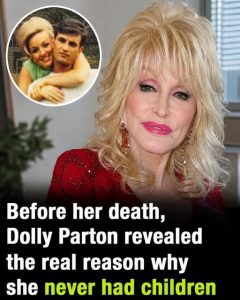
Dolly Parton Explained Why She and Carl Dean Never Had Children
For nearly six decades, Dolly Parton and Carl Dean built a marriage that remained remarkably private despite the singer’s extraordinary fame. They married in 1966 and remained together until Dean’s death in 2025. One question followed them throughout those years: why did they never have children?
Parton addressed that question many times, and her explanations were more nuanced than the sensational headlines often suggest. She spoke about her career, her independence, her health, her faith and, eventually, her belief that perhaps her life had taken a different path for a reason. (People.com)
The result was a family story unlike the traditional Hollywood narrative. Dolly and Carl did not become parents themselves, but Parton became an extraordinary presence in the lives of nieces, nephews and millions of children around the world.
A marriage that began in 1966
Parton met Carl Dean shortly after arriving in Nashville as a young woman determined to establish herself in country music. Their relationship developed away from the spotlight, and they married on May 30, 1966.
Their marriage was famously private. While Parton’s career grew into an international phenomenon, Dean generally avoided public life. The couple’s contrasting personalities became part of their story: Parton embraced performing and publicity, while Dean preferred a quieter existence.
They nevertheless remained deeply connected for almost 60 years.
Although they never had children together, that did not mean children were absent from Parton’s life.
She came from a very large family herself and remained particularly close to her younger siblings and their children. Several of her younger brothers and sisters lived with Dolly and Carl for periods of time, and their extended family became an important part of their lives. (ABC News)
“It just wasn’t one of those burning things”
One of Parton’s most revealing explanations came in an interview published in 2023.
Looking back on her younger years, she explained that having children was something she had once expected might happen, but it was never an overwhelming desire that dominated her life.
She described it as something that simply wasn’t a “burning” priority for her. (E! Online)
That distinction is important.
The story wasn’t simply that Parton rejected motherhood. Rather, life developed differently from what she might have imagined when she was younger.
Her career was accelerating rapidly, and she was traveling, recording music, performing concerts and building a business empire. The choices she made gradually created a life in which motherhood never became part of the equation.
Her extraordinary career played a major role
Parton’s professional ambition was enormous.
She arrived in Nashville with very little money but a determination to make something of herself. Her songwriting eventually brought her recognition, and her performances transformed her into one of the most successful country entertainers of all time.
But success required sacrifice.
Touring meant spending long periods away from home. Recording meant demanding schedules. Television and film projects added even more responsibilities.
Parton later explained that not having children gave her a degree of freedom that was important to her career.
During a 2020 appearance on The Oprah Conversation, she said that because she had no children and Carl was independent, she had the freedom to work. She believed that freedom contributed significantly to everything she was able to accomplish. (The Independent)
That does not mean she believed every woman should make the same choice.
It was simply her explanation of her own life.
Health also became part of the story
Parton’s medical history also affected the possibility of having biological children.
She experienced endometriosis and underwent a partial hysterectomy after suffering abdominal problems. According to accounts of her interviews, the procedure meant that she would not be able to give birth naturally. (E! Online)
Parton subsequently spoke about the situation through the lens of her faith.
Rather than describing herself as someone who had been deprived of a family, she came to believe that her life had simply been directed somewhere else.
That perspective became an important part of how she discussed motherhood.
“Everybody’s kids could be mine”
Perhaps the most memorable explanation Parton offered was spiritual.
She said she believed God had a plan for her not to have children so that, in her words, “everybody’s kids could be mine.” (ABC News)
For Parton, that idea eventually became more than a comforting statement.
She turned her affection for children into one of the most significant philanthropic projects associated with her name.
In 1995, she launched Dolly Parton’s Imagination Library, a program designed to provide children with books from birth through age five. The initiative grew enormously and became one of the most recognizable literacy programs in the world. (Us)
In that sense, Parton’s influence on children reached far beyond what she might have achieved as an individual parent.
Her nieces and nephews became family
Parton never needed a biological child to experience the bonds of family.
She maintained close relationships with her nieces and nephews, many of whom regarded her as a central figure in their lives.
Her family even developed affectionate names for her. Some younger relatives called her “Aunt Granny,” reflecting the role she played within the extended family. (ABC News)
Her relationship with Miley Cyrus is another famous example of her role as a maternal figure. Parton became Cyrus’s godmother and maintained a close relationship with the singer throughout her career.
Parton’s connection to children was therefore never merely theoretical.
She genuinely enjoyed being around them.
She once explained that children seemed to respond to her because they viewed her almost like a fairy-tale character or Fairy Godmother. (ABC News)
She didn’t appear to regret the decision
Perhaps the most striking part of Parton’s comments is that she generally did not frame her childlessness as a source of regret.
In a 2014 interview with Billboard, she explained that she and Carl were extremely close to their nieces and nephews. She also reflected on their later years and joked that they could appreciate not having children to worry about as they grew older. (Us)
Her perspective evolved over time.
What might once have seemed like something missing from her life eventually became something she accepted as part of her identity.
And that acceptance seems to have been genuine.
A different kind of motherhood
Parton’s story also challenges the assumption that motherhood can only be defined biologically.
Through the Imagination Library, she became connected to millions of children.
Through her extended family, she played an important role in the lives of nieces, nephews and younger relatives.
Through her music and public image, she became a beloved figure for generations of families.
Her songs often contained themes of family, poverty, perseverance, childhood and love. Those themes reflected the environment in which she was raised.
Parton grew up in a large, poor Tennessee family, and those early experiences remained central to her worldview. (ABC News)
Rather than allowing her childhood circumstances to define her limitations, she turned them into inspiration.
Carl Dean’s independence mattered too
Parton frequently described Dean as an independent person.
That independence helped make their unusual marriage work.
She could spend long periods traveling while he maintained a private life away from the entertainment industry. Parton has repeatedly credited that arrangement with giving her room to pursue an extraordinarily demanding career. (The Independent)
Their relationship therefore operated differently from many celebrity marriages.
There was no expectation that Dean would constantly accompany Parton on red carpets or become part of her professional brand.
Instead, their private partnership remained largely separate from her public career.
Her legacy is much bigger than whether she had children
Following Parton’s death in August 2026 at age 80, renewed attention has naturally turned toward her personal life and legacy. She left behind an enormous body of music, acting work, business achievements and philanthropy. (People.com)
The question of children is therefore only one small piece of a much larger story.
Parton once imagined that perhaps she would become a mother. Life took her somewhere else.
Her health affected the possibilities available to her. Her career demanded enormous amounts of time. Her marriage to Carl Dean provided a partnership built around independence. And her faith eventually gave her a framework through which she understood the path she had taken.
Instead of raising children of her own, she devoted enormous energy to helping children.
That may be the most fitting way to understand her story.
Dolly Parton did not leave behind a traditional family tree centered on biological children. She left behind something much larger: songs that became part of people’s lives, books placed into children’s hands, opportunities created through philanthropy and an extended family that remained close to her.
Her decision not to have children was never simply one thing.
It was a combination of circumstance, choice, health, career, marriage and faith.
And, most importantly, Parton herself repeatedly indicated that she was at peace with it.
Her life demonstrated that there is no single definition of family—and no single path to leaving a lasting legacy.