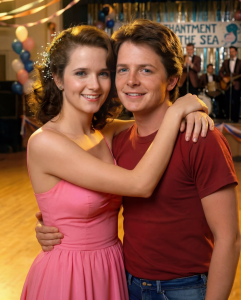
The actress is Lea Thompson. Lea Thompson
The film is Back to the Future (1985), and Thompson played Lorraine Baines, the teenage girl who unknowingly falls for her own future son, Marty McFly, after he accidentally travels back to 1955.
Few films have achieved the timeless appeal of Back to the Future. Released in the United States on July 26, 1985, Robert Zemeckis’ science-fiction comedy became an instant classic, blending action, humor, romance and heart into one of the most beloved adventures ever made. While audiences naturally remember the DeLorean time machine, Doc Brown’s wild inventions and Michael J. Fox’s irresistible performance as Marty McFly, one of the film’s greatest achievements was its unforgettable supporting cast.
Among them was Lea Thompson, whose performance as the teenage Lorraine Baines remains one of the funniest and most emotionally important parts of the story.
The film’s central idea is wonderfully simple.
Seventeen-year-old Marty McFly is accidentally transported from 1985 back to 1955 in a time-traveling DeLorean invented by the eccentric scientist Dr. Emmett “Doc” Brown.
Instead of simply observing history, Marty accidentally changes it.
His first major mistake?
Preventing his father, George McFly, from being hit by a car.
That single heroic act has enormous consequences.
In the original timeline, George is struck by a vehicle driven by Lorraine Baines’ father. Lorraine cares for him while he recovers, and the two eventually fall in love.
When Marty interrupts that event, however, Lorraine ends up meeting Marty instead.
Suddenly the impossible happens.
His own future mother develops a crush on him.
The resulting comedy forms one of the film’s most memorable storylines.
Lea Thompson handled this delicate premise with remarkable skill.
The situation could easily have become uncomfortable or unbelievable, but Thompson’s performance keeps it playful, innocent and genuinely funny. Lorraine is portrayed as an impulsive, romantic teenager who simply doesn’t realize the strange truth behind her mysterious new classmate.
Meanwhile Marty becomes increasingly horrified as history begins changing around him.
Every interaction threatens his own existence.
Adding to the tension is the famous Enchantment Under the Sea Dance, one of cinema’s most iconic high-school dances.
This is where history must finally return to its proper course.
George McFly must find the courage to stand up for himself, rescue Lorraine from school bully Biff Tannen and share the kiss that will ensure Marty’s future.
Until that happens, Marty literally begins disappearing.
One of the film’s most brilliant visual ideas involves the family photograph Marty carries from 1985.
As history changes, his brother and sister gradually fade from the picture.
Eventually Marty himself starts vanishing.
It is an elegant way of showing the audience exactly what’s at stake.
Without George and Lorraine falling in love, Marty will never be born.
The dance sequence combines suspense, romance and comedy with astonishing precision.
George finally confronts Biff.
Lorraine sees George’s courage for the first time.
The kiss happens.
Marty begins playing Chuck Berry-inspired rock and roll on stage before launching into the now-famous performance of “Johnny B. Goode.”
History is restored.
Behind much of the film’s emotional success stands Lea Thompson.
Born on May 31, 1961, in Rochester, Minnesota, Thompson initially dreamed of becoming a professional ballet dancer.
She trained extensively throughout her childhood and earned scholarships to prestigious dance companies, displaying exceptional promise.
Eventually, however, she chose acting instead.
It proved to be a life-changing decision.
Her early film appearances included Jaws 3-D (1983), where she began attracting Hollywood attention.
Soon afterward she starred opposite Patrick Swayze in Red Dawn (1984), playing one of a group of American teenagers resisting a fictional Soviet invasion.
It was during the filming of Red Dawn that Thompson met actor Howard Deutch, whom she later married.
The couple have remained together for decades and raised two daughters, Madelyn Deutch and Zoey Deutch, both of whom entered the entertainment industry, with Zoey becoming a successful actress in her own right.
Then came Back to the Future.
One remarkable aspect of Thompson’s performance is the range she demonstrates within a single film.
She doesn’t simply play teenage Lorraine.
She also portrays Lorraine as an adult in 1985.
The contrast is striking.
The teenage Lorraine is energetic, hopeful and romantic.
The original 1985 Lorraine has become discouraged, unhappy and trapped in an unfulfilling life.
After Marty repairs history, audiences meet a third version.
This Lorraine is confident, successful and happily married to George.
Without elaborate makeup or lengthy exposition, Thompson convincingly creates three distinct versions of the same woman.
It remains one of the film’s quiet acting triumphs.
The chemistry between Thompson and Michael J. Fox proved essential.
Although their characters face an absurd situation, both actors commit completely to the emotional reality of the story.
Fox expertly balances panic with humor, while Thompson ensures Lorraine remains sympathetic rather than ridiculous.
Equally important is her chemistry with Crispin Glover, whose eccentric portrayal of George McFly creates one of cinema’s most charming romances.
Watching George gradually gain confidence becomes every bit as satisfying as the science-fiction adventure itself.
Back to the Future became one of the biggest films of 1985.
Produced by Steven Spielberg and directed by Robert Zemeckis from a screenplay by Zemeckis and Bob Gale, it earned more than $380 million worldwide, making it the year’s highest-grossing film.
Critics praised its originality, pacing, performances and ingenious screenplay.
It won the Academy Award for Best Sound Effects Editing and received several additional Oscar nominations.
Its popularity inspired two equally ambitious sequels.
Thompson returned as Lorraine in both Back to the Future Part II (1989) and Back to the Future Part III (1990), portraying alternate versions of the character across multiple timelines and even the Old West.
Each film expanded the mythology while giving Thompson fresh opportunities to reinterpret Lorraine under wildly different circumstances.
Beyond the trilogy, Thompson built an impressive career across film and television.
She starred in Some Kind of Wonderful (1987), another beloved 1980s coming-of-age film directed by Howard Deutch.
She also headlined The Beverly Hillbillies (1993), appeared in numerous television movies and became widely known for starring in the NBC sitcom Caroline in the City, which ran successfully throughout the 1990s.
In more recent years, she has established herself as a respected television director, working on series including Jane the Virgin, The Goldbergs, Young Sheldon, Resident Alien and many others.
Her transition behind the camera has earned admiration throughout the industry.
Looking back nearly four decades later, Back to the Future remains a rare cinematic achievement.
Its visual effects may reflect the technology of the mid-1980s, but its storytelling feels timeless.
The film celebrates family, courage, friendship and the belief that individuals can shape their own futures.
As Doc Brown famously tells Marty:
“Your future hasn’t been written yet.”
That optimistic message continues to resonate with audiences of every generation.
Lea Thompson’s contribution to that success should never be underestimated.
Lorraine Baines could easily have been reduced to a simple plot device, existing only to motivate Marty’s mission.
Instead, Thompson turned her into a fully realized character—funny, vulnerable, impulsive, romantic and ultimately deeply human.
Whether portraying the dreamy teenager at the awkward school dance or the wiser adult whose life changes because of one extraordinary adventure through time, she brought warmth and authenticity to every version of Lorraine.
Nearly forty years after its release, Back to the Future continues to delight new audiences around the world. At the heart of its enduring charm is a remarkable ensemble cast, and among its brightest stars remains Lea Thompson—the actress who made one of cinema’s strangest family predicaments not only believable, but unforgettable.