1964 Chevrolet Impala Convertible — A Timeless American Classic
Few American cars capture the spirit of the 1960s quite like the 1964 Chevrolet Impala Convertible. Long, low, elegant and unmistakably American, the Impala combined the practicality of a full-size family automobile with the glamour of a genuine open-air cruiser. More than six decades later, it remains one of the most recognizable classic Chevrolets ever produced.
The 1964 model year was particularly significant because Chevrolet gave the Impala a fresh, refined appearance while retaining the qualities that had made the nameplate so popular. With its long hood, sculpted sides, extensive chrome and distinctive rear styling, the car looked every bit like a product of an era when automobiles were designed to make an impression.
And when the roof was folded down, the Impala Convertible became something even more special.
A New Look for 1964
The 1964 Chevrolet Impala belonged to the fourth generation of the nameplate, and Chevrolet gave the full-size lineup a substantial styling update for the new model year.
The design was smoother and more restrained than some of the flamboyant shapes associated with earlier American cars. Yet it was still unmistakably a 1960s Chevrolet.
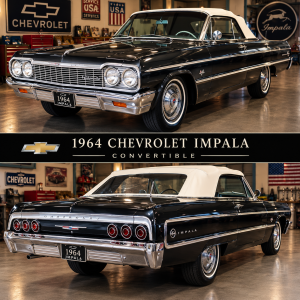
The front end featured a wide horizontal grille surrounded by bright chrome, with the familiar quad-headlight arrangement giving the car an unmistakable presence. The hood stretched forward with a clean, confident profile, while the body sides incorporated subtle sculpting rather than excessive ornamentation.
At the rear, the Impala featured the styling detail that immediately identifies the car to enthusiasts: three round taillights on each side.
Those six circular lamps became one of the most famous visual signatures of the Impala.
The proportions were equally important. This was a large automobile, with a long wheelbase and substantial overhangs, but Chevrolet’s designers managed to make it appear graceful rather than simply enormous.
The convertible version was especially attractive because removing the fixed roof visually lowered the entire car.
The Beauty of the Convertible
The Impala Convertible was not simply a sedan with its roof removed. It had the proportions and visual character expected from a genuine American grand cruiser.
With the soft top raised, the car could provide a surprisingly formal appearance. Lower the top, however, and its personality changed immediately.
The windshield, beltline and long body became the dominant visual elements. The absence of a permanent roof emphasized the car’s length and gave passengers an unobstructed connection with the surroundings.
This was an automobile designed for cruising.
Imagine a warm summer evening in 1964. The top is down, the chrome is catching the sunlight, and the large Chevrolet is moving effortlessly down a wide boulevard. The experience is difficult to reproduce with a modern automobile.
That is one reason classic convertibles remain so desirable.
They are not merely transportation. They provide an experience.
A Range of Engines
Chevrolet offered buyers a broad selection of engines for the 1964 full-size lineup, allowing the Impala to appeal to a remarkably wide range of customers.
At the more economical end were Chevrolet’s six-cylinder offerings, while V8 buyers could choose from several small-block and big-block configurations.
The 283-cubic-inch V8 was one of the familiar choices, while the 327-cubic-inch V8 provided a substantial increase in performance. For enthusiasts looking for something considerably more powerful, Chevrolet also offered the legendary 409-cubic-inch V8.
The 409 had already developed an extraordinary reputation by this point.
It had become closely associated with Chevrolet’s performance image during the early 1960s and had even found its way into popular music. The engine’s reputation extended far beyond the specifications printed in a brochure. It represented the rapidly developing American muscle-car culture that was beginning to emerge.
Not every Impala needed a huge engine, of course.
For many owners, the appeal was the combination of smooth V8 power, comfortable cruising and effortless highway performance. The Impala was a large car, and its character suited relaxed driving as much as outright speed.
Inside the Impala
The interior reflected the philosophy of the period: generous space, comfortable seating and an impressive dashboard.
The Impala was intended to carry families, friends and luggage, so interior room was one of its major advantages. Front and rear passengers benefited from the car’s substantial dimensions.
The dashboard was also distinctly early-1960s Chevrolet, with large instruments and a broad horizontal design.
Depending on equipment and trim, buyers could specify different interior materials, colors and convenience features. Chevrolet understood that an Impala was not merely an inexpensive means of getting from one place to another. It was positioned toward the more desirable end of the company’s full-size range.
That combination of size, comfort and style helped make the Impala enormously successful.
Chrome Everywhere
One of the first things people notice about a restored 1964 Impala is the chrome.
The front grille, bumpers, headlight surrounds, side trim and rear details all contribute to the car’s visual character. Even the smallest pieces of brightwork can make a significant difference.
This is particularly obvious on a black Impala.
A deep black body provides an almost mirror-like contrast with polished chrome. The result is dramatic without requiring an extravagant paint scheme.
The car pictured with a light-colored convertible top demonstrates another classic combination: a dark body paired with a contrasting roof.
That contrast emphasizes the separation between the upper and lower portions of the car and gives the convertible a more formal appearance when the top is raised.
For collectors, properly restored chrome can be one of the most important elements in making a 1964 Impala look authentic.
The Six-Tailed Signature
If the front grille announces that this is a Chevrolet, the rear practically shouts that it is an Impala.
The six round taillights are among the most recognizable features in the model’s history.
Arranged as three lamps on each side, they give the rear of the car a symmetrical appearance that is instantly associated with the Impala name.
The rear design also features extensive chrome, lettering and carefully shaped bodywork.
When viewed from behind, the car’s broad stance becomes especially apparent. It looks substantial and planted, yet the rounded taillights prevent the design from appearing overly heavy.
This is one of those rare automobiles where the front and rear views are almost equally memorable.
Why the 1964 Model Matters
The 1964 Impala arrived at an important moment in American automotive history.
The postwar fascination with increasingly elaborate styling was beginning to evolve. Buyers still wanted large, powerful cars, but design was gradually moving toward cleaner lines.
At the same time, performance was becoming increasingly important.
The coming muscle-car era would soon transform the American automotive landscape, but the Impala represented a different side of that culture. It offered power without sacrificing size, comfort or elegance.
In other words, it could be both a family car and a performance machine.
That versatility was one of Chevrolet’s greatest strengths.
Restoration and Collectibility
Today, a 1964 Impala Convertible can attract considerable attention at classic-car shows, auctions and enthusiast gatherings.
Condition is enormously important.
A car that has been carefully restored can look spectacular, but restoration is not simply a matter of repainting the body. A proper restoration may involve rebuilding the engine and transmission, repairing the frame and body, replacing weather seals, restoring the interior, rechroming trim and ensuring that the convertible mechanism operates correctly.
Convertible cars can require particular attention because the roof structure and folding mechanism are integral to their usability.
Originality can also influence desirability.
Collectors may pay close attention to the engine, transmission, interior, trim, factory options and documentation. A car with a well-documented history can be particularly appealing because it gives future owners a clearer understanding of what they are buying.
Of course, not every collector insists on absolute originality.
Some owners prefer tasteful upgrades such as modern brakes, improved suspension components, air conditioning or modernized ignition systems. These modifications can make an old car considerably easier to enjoy on today’s roads while preserving its classic appearance.
More Than an Old Car
The enduring appeal of the 1964 Impala Convertible goes beyond specifications.
It represents a particular moment in American culture.
Cars were becoming symbols of personal identity. Families took long road trips. Teenagers associated automobiles with independence. Drive-in restaurants and movie theaters helped turn cars into social spaces.
The convertible occupied an especially romantic position in that world.
It represented freedom.
The ability to fold away the roof and experience the road without a barrier overhead was something fundamentally different from driving a conventional sedan.
That emotional quality is difficult to measure, but it explains why these cars remain so popular.
A Design That Still Turns Heads
Walk around a beautifully preserved 1964 Impala Convertible today and the reason for its reputation becomes obvious.
The long hood.
The quad headlights.
The wide grille.
The sweeping body sides.
The polished chrome.
The distinctive six taillights.
And, of course, the folding soft top.
Every element contributes to a cohesive design.
Modern cars often prioritize aerodynamic efficiency, safety requirements and manufacturing practicality. Those are important considerations, but they have also made automobile styling more standardized.
The 1964 Impala came from another world.
It was created at a time when a car could have a huge personality.
A Timeless American Classic
The 1964 Chevrolet Impala Convertible remains one of the defining American automobiles of its generation because it successfully combined several qualities that rarely exist together.
It was large without looking clumsy.
It was elegant without being delicate.
It could be luxurious without abandoning Chevrolet’s accessible character.
And with the right engine, it could deliver genuinely impressive performance.
Most importantly, however, it looked like nothing else.
Whether finished in glossy black, bright red, white or another period color, a well-preserved Impala Convertible commands attention. Its combination of chrome, sweeping proportions and open-air design instantly transports observers back to an era when American cars were bold expressions of optimism and individuality.
More than 60 years after it first appeared on American roads, the 1964 Impala still possesses something many newer vehicles struggle to achieve: presence.
It doesn’t need a badge to explain what it is.
The moment those six round taillights, four headlights and long convertible body come into view, the identity is unmistakable.
It is an Impala.
And for classic-car enthusiasts, the 1964 Chevrolet Impala Convertible remains not merely an old automobile, but a rolling piece of American automotive history—one that continues to turn heads, spark memories and remind us why the great cars of the 1960s remain so difficult to forget.