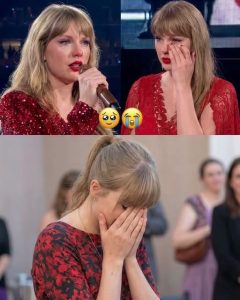
Taylor Swift Reveals That She Tested Positive for… See More: What the Viral Claim Really Says
A dramatic headline claiming that Taylor Swift tested positive for COVID-19 has been circulating online, accompanied by emotional photographs of the singer appearing to cry during performances and public appearances. The wording is deliberately incomplete — “Taylor Swift reveals that she tested positive for… See more…” — encouraging readers to click in order to discover what the alleged diagnosis was.
But there is an important distinction between the viral headline and independently verified reporting.
Several websites have published versions of this story claiming that Swift tested positive for COVID-19 and was forced to postpone a concert. However, the versions circulating online appear to repeat essentially the same narrative, rather than providing strong independent confirmation. One such article, published August 18, 2026, claims Swift tested positive and that a Chicago concert was postponed. (Newspost Times)
That means the story should be approached carefully rather than treated as a confirmed breaking-news announcement.
The Headline Is Designed to Make Readers Click
The phrase “tested positive for…” is one of the oldest tricks in social-media headline writing.
Instead of stating the supposed diagnosis, the headline deliberately stops short. Readers are left asking: positive for what?
The answer, according to several versions of the circulating story, is COVID-19.
The emotional photographs make the claim appear even more convincing. Swift is shown with tears in her eyes, holding a microphone, wiping her face, and appearing visibly upset. Those images can create the impression that the photographs were taken immediately after the alleged diagnosis.
But photographs do not establish when or why they were taken.
A celebrity can cry during a performance for countless reasons. Swift’s concerts are well known for emotionally charged moments, and photographs of her crying have circulated for years. Pairing those photographs with a health-related headline does not establish that the two events are connected.
The Story Behind the Viral Claim
The versions of the story currently circulating claim that Swift became ill during her touring schedule, tested positive for COVID-19 and postponed a scheduled Chicago performance.
Some versions describe her as feeling exhausted and achy following a long performance before taking a rapid test. They then claim that the positive result prompted her team to implement testing and precautions for people working on the production. (OneSportz)
Those details sound plausible because they resemble what happened to many performers during the pandemic: illness could force an enormous production to stop suddenly, particularly when hundreds of employees and thousands of audience members were involved.
However, plausibility should not be confused with verification.
Several sites repeating the claim appear to use almost identical language, including descriptions of a supposed emotional social-media announcement and the postponement of a Chicago concert. (now-information.com)
That repetition can make a story look widely confirmed when it may simply be the same unverified narrative being republished.
Why the Photographs Are So Powerful
The photographs accompanying the claim are particularly effective because they show genuine-looking emotional moments.
Swift is photographed with red lipstick, a microphone and a glamorous stage outfit in one image. In another, she appears to wipe away tears.
For fans, such images immediately create an emotional connection.
A headline saying that a performer has tested positive is one thing. A headline accompanied by photographs of that performer visibly crying feels much more immediate.
But there is no reason to assume that every emotional photograph associated with a story was taken during the event described by the caption.
This is an important lesson for anyone consuming celebrity news online.
An image can be authentic while the caption attached to it is misleading.
A real photograph does not automatically validate a claim.
Taylor Swift’s Relationship With Her Audience
Part of what makes stories about Swift’s health so emotionally powerful is the unusually close relationship she has developed with her audience.
Throughout her career, Swift has cultivated a reputation for communicating directly with fans. Her songwriting often draws from deeply personal experiences, while her concerts frequently include emotional speeches and intimate moments between songs.
As a result, fans tend to pay close attention whenever she appears vulnerable.
A health announcement would naturally generate an enormous reaction.
People who have followed her career for years would immediately worry about her wellbeing, while concertgoers would worry about postponed shows, travel arrangements and refunds.
For a touring production of enormous scale, an illness isn’t simply a personal matter. It can potentially affect musicians, dancers, technicians, drivers, security workers, venue employees and thousands of ticket holders.
The Real Consequences of Illness During a Major Tour
If a performer at Swift’s level actually tested positive for a contagious illness during a major tour, postponing a performance could be the responsible decision.
Large concerts involve extremely close contact among performers, employees and audience members.
A singer may spend hours backstage with dancers, musicians and crew before appearing in front of tens of thousands of fans. Many workers travel together from city to city, making illness particularly difficult to contain.
From that perspective, postponing a concert would not necessarily be a sign of weakness.
It could demonstrate responsibility.
The circulating articles portray the supposed cancellation in precisely that way, emphasizing concern for Swift’s crew and audience. (Newspost Times)
But again, the central question remains whether the specific story being circulated is genuinely confirmed.
The Importance of Checking Dates
Another reason readers should be cautious is that online celebrity stories are frequently recycled.
A story can appear with one publication date, disappear from social media, and then return months later with slightly altered wording.
The current versions of the Taylor Swift claim have appeared across multiple sites and at different times. Search results show versions published in 2025 as well as versions appearing in 2026. (News Lighttopix)
That makes the exact timeline particularly important.
Readers should ask:
When supposedly did this happen?
Was it actually a recent event?
Was the original article reporting a real announcement?
Or is an old story being repackaged as new?
Without answering those questions, it is easy for a recycled celebrity story to look like breaking news.
Swift’s Life Has Changed Since Earlier Tour Stories
There is another reason current context matters.
In July 2026, Swift married NFL star Travis Kelce at Madison Square Garden in New York. The wedding was widely reported by major news organizations, including CBS News, the Associated Press and the Los Angeles Times. (The Washington Post)
Swift has also remained publicly active in 2026. In June, she made a surprise appearance alongside Lainey Wilson at a Nashville event connected with Travis Kelce. (ABC News)
Those verified reports demonstrate why context matters when evaluating an isolated viral post.
A social-media graphic may present itself as a current revelation, but the surrounding timeline can tell a very different story.
Why “See More” Headlines Are a Warning Sign
The words “See more” are another clue.
They are commonly used in viral Facebook-style posts that intentionally conceal the most important part of a story.
Instead of:
Taylor Swift tested positive for COVID-19.
the post says:
Taylor Swift reveals that she tested positive for…
The reader has to click.
That click can generate advertising revenue, engagement or additional social-media exposure.
There is nothing inherently wrong with encouraging readers to continue an article. But when an emotionally loaded headline withholds its central fact, readers should be especially careful.
What We Can Safely Conclude
The viral claim is that Taylor Swift tested positive for COVID-19 and that a concert was postponed.
Several low-authority websites have published versions of that claim. (Newspost Times)
However, the repetition of the story across those sites does not necessarily constitute independent confirmation.
The emotional photographs should also not be treated as proof that Swift was crying because of a positive medical test.
In other words, there are two separate things:
- The existence of online articles making the claim.
- Independent confirmation that the alleged event actually happened as described.
Those are not the same thing.
A Reminder for Swifties and Celebrity-News Readers
Celebrity news moves incredibly quickly.
One emotional photograph can generate millions of views. One dramatic sentence can be copied by dozens of websites. Before long, repetition can create the illusion that something has been confirmed simply because it appears everywhere.
The best approach is to slow down.
Check the original source.
Look for a statement from Swift’s representatives.
Look for reporting from established news organizations.
Check the date.
Compare the story with the broader timeline.
And most importantly, don’t allow an emotional photograph to substitute for evidence.
Taylor Swift’s enormous popularity means that virtually anything involving her can attract attention. Her health is no exception.
The viral “tested positive for…” headline is certainly designed to provoke concern, particularly among fans who immediately recognize the emotional images accompanying it. But the available versions of the story should be treated as an unverified or poorly sourced celebrity-news claim, rather than automatically accepted as confirmed breaking news.
For readers, the larger lesson is simple: when a headline makes you gasp, that’s exactly when you should slow down and verify it.
A dramatic photograph may be real. A headline may be widely shared. And an article may confidently describe an event.
But none of those things, individually or collectively, replaces reliable confirmation.
Until stronger primary or reputable independent sources verify the specific claim, Taylor Swift fans should be cautious about treating the viral “tested positive” story as established fact.