Urgent Iran Will Strike America Tonight and Start With the State of… — What We Actually Know
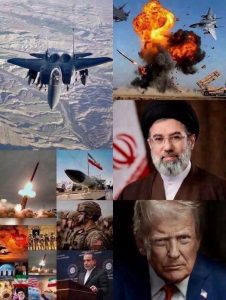
A dramatic image circulating on social media claims that Iran will strike the United States “tonight” and that an American state will be the first target. The post uses photographs of fighter jets, explosions, missiles, Iranian military equipment, Iranian officials and President Donald Trump to create the impression that a direct attack on the United States is imminent.
But there is an important distinction between the real and extremely serious U.S.-Iran military confrontation and the specific claim made by the viral post.
There is currently no credible evidence establishing that Iran has announced an attack on a U.S. state tonight or that a particular American state has been selected as the first target.
That does not mean the underlying conflict is fictional. Quite the opposite: the situation in the Middle East is highly volatile, and there have been direct attacks involving Iranian and U.S. forces. Reuters reported on September 9 that Iran had launched ballistic missiles at a U.S. base in Jordan and had attacked commercial shipping in the Gulf, while U.S. forces had struck Iranian oil tankers. (Reuters)
The problem is that a real war can still be surrounded by false or unsupported social-media predictions.
The conflict is already serious
The viral headline sounds as though a future war is about to begin.
In reality, the United States and Iran are already involved in a dangerous military confrontation.
Reuters reported Wednesday that Iran and the United States had carried out their most intense exchange of maritime attacks since the conflict began. Iran reportedly targeted 10 ships near the Strait of Hormuz after U.S. forces destroyed five Iranian oil tankers. (Reuters)
Iran also launched ballistic missiles toward a U.S. base in Jordan.
Jordan said its defenses intercepted most of the missiles, with Reuters reporting that 18 of 20 missiles were intercepted and that there were no reported casualties from that particular attack. (Reuters)
These events demonstrate that Iranian retaliation is not merely theoretical.
But there is a major difference between Iran attacking U.S. military interests in the region and Iran announcing an imminent missile strike against a U.S. state on the American mainland.
Those should not be presented as the same thing.
What about the claim that a state will be attacked first?
The viral headline appears deliberately incomplete.
It says Iran will strike America and “will start with the state of…” without reliably establishing which state is supposedly being threatened.
That wording is a classic feature of engagement-driven social-media posts.
The missing information encourages people to click, comment and share.
A reader may immediately wonder:
Is it Texas? Florida? California? New York?
The post does not provide reliable evidence for such a prediction.
More importantly, credible reporting available today does not establish that Iran has publicly selected a U.S. state for an imminent attack.
Current reporting instead focuses heavily on Iranian attacks and threats in the Middle East, particularly around the Strait of Hormuz, U.S. military positions in the region and Gulf shipping.
The Strait of Hormuz is a major flashpoint
One of the biggest concerns right now is not an attack on an American state but the escalating confrontation around the Strait of Hormuz.
The waterway is one of the world’s most important energy routes.
Iran has threatened shipping in the region, while the United States has conducted operations aimed at restricting Iranian oil exports.
Reuters reported that the latest escalation has severely affected commercial shipping and pushed Brent crude above $100 a barrel. (Reuters)
The economic consequences could extend far beyond Iran and the United States.
Higher oil prices can raise transportation costs, increase gasoline and heating expenses and contribute to inflation around the world.
That is why governments and financial markets are watching developments around Hormuz so closely.
Iran has already demonstrated its willingness to retaliate
The danger should not be minimized simply because the viral claim about a U.S. state is unsupported.
Iran has already demonstrated that it is willing to retaliate against American military assets and U.S.-aligned targets.
Reuters reported that Iran launched missiles toward a U.S. military base in Jordan following the destruction of Iranian oil tankers. (Reuters)
The Iranian Revolutionary Guard has also threatened additional retaliation and indicated that its naval activity could expand.
That creates a genuine possibility of further escalation.
However, predicting a specific attack against a specific U.S. state on a specific night requires evidence.
At present, the viral image provides none.
The photographs don’t prove the headline
Another reason the post can appear convincing is its collage.
The image contains military aircraft, missile launches, explosions, Iranian imagery and photographs of Trump and Iranian political figures.
To someone scrolling quickly through social media, the combination looks like a breaking-news graphic.
But photographs don’t establish that the events shown are connected.
A fighter jet photographed during one military operation can be placed beside an explosion from an entirely different event.
A missile launch can be years old.
A photograph of a political leader can be unrelated to the claim accompanying it.
This is one of the most common techniques used by viral misinformation: real photographs are combined to create an unsupported narrative.
Iran’s threats are not necessarily the same as an attack on the U.S. homeland
Another important distinction involves geography.
Iran possesses missiles and other weapons capable of threatening American military installations and interests throughout the region.
The United States also maintains extensive military forces outside the continental United States.
Consequently, when Iran says it will retaliate against America, that does not automatically mean a missile is headed toward California, Florida, New York or another American state.
A potential target could be a military facility, naval vessel, base or other American interest located overseas.
Current reporting illustrates this distinction clearly.
The most recent confirmed Iranian ballistic-missile attack discussed by Reuters was directed toward a U.S. base in Jordan, not a U.S. state. (Reuters)
That difference is essential when interpreting alarming headlines.
There is a real risk of further escalation
Even though the viral claim is unsupported, the situation remains dangerous.
The United States and Iran have exchanged military attacks.
Commercial vessels have been damaged.
Oil shipments have been disrupted.
Regional actors are becoming increasingly involved.
Reuters reported that Iranian-backed Houthi forces have also intensified attacks against Saudi Arabia, striking cities and energy-related infrastructure and injuring dozens of people. (Reuters)
That creates the possibility of the conflict spreading geographically.
Every additional participant increases the number of potential targets and makes miscalculation more likely.
This is why governments around the region are calling for restraint.
Why “tonight” headlines are particularly dangerous
Words such as “tonight,” “imminent,” “breaking,” and “first target” create a powerful emotional reaction.
They tell readers that they have only minutes or hours to respond.
That can lead people to share information without checking whether it is authentic.
During a genuine international crisis, this can be especially harmful.
False warnings can create unnecessary panic, encourage people to flood emergency communication channels and make it harder for the public to distinguish official warnings from social-media speculation.
A responsible approach is therefore simple:
Do not treat a viral graphic as an emergency alert.
If a major attack against the U.S. homeland were imminent, Americans should look for confirmation from official government agencies and multiple established news organizations—not an anonymous or sensational social-media post.
What Americans should watch instead
For people concerned about the possibility of escalation, several developments are much more meaningful than an unidentified viral graphic.
First, watch statements from the U.S. government and military.
Second, monitor credible reporting concerning Iranian missile launches and U.S. military movements.
Third, pay attention to official emergency warnings if an incident actually threatens American territory.
And finally, distinguish between attacks on U.S. forces abroad and attacks on the U.S. homeland.
That distinction can prevent unnecessary panic.
The bigger danger may be escalation
The most credible concern right now isn’t necessarily that Iran has secretly selected one American state for an attack tonight.
The larger danger is that the current cycle of retaliation could continue to expand.
Iran attacks American or allied interests.
The United States responds.
Iran retaliates.
Other regional forces become involved.
Shipping is disrupted.
Energy prices rise.
Each side then faces pressure to demonstrate strength.
That cycle can become extremely difficult to control.
Reuters reported that the latest escalation has already contributed to oil prices rising above $100 per barrel, while shipping through the Gulf has been disrupted. (Reuters)
A real crisis doesn’t make every viral claim true
Perhaps the most important lesson from the circulating image is that misinformation can flourish during genuine crises.
The fact that the U.S. and Iran are actually exchanging attacks makes sensational claims sound more believable.
But reality doesn’t need exaggeration.
The conflict is already serious enough.
Iran has attacked vessels.
Iran has launched missiles toward a U.S. base in Jordan.
The United States has attacked Iranian assets.
The Strait of Hormuz is under enormous pressure.
And the consequences are being felt in global energy markets. (Reuters)
Those are substantial developments that can be independently reported and verified.
There is no need to add an unsupported claim that Iran will strike a particular American state tonight.
Bottom line
The headline “Urgent: Iran will strike America tonight and will start with the state of…” should not be treated as a confirmed warning.
As of September 9, 2026, credible reporting confirms a major and escalating U.S.-Iran confrontation, including Iranian missile attacks against a U.S. base in Jordan and attacks on shipping, as well as U.S. military action against Iranian vessels. (Reuters)
But those confirmed events do not establish that Iran is about to attack a U.S. state tonight.
The viral collage appears to use dramatic military imagery to amplify an alarming message, rather than providing evidence of an imminent attack on the American homeland.
The safest conclusion is therefore neither to dismiss the broader conflict nor to believe every frightening prediction circulating online.
The U.S.-Iran conflict is real. The escalation is real. The threat of further retaliation is real. But the specific claim that Iran will begin striking a particular American state tonight remains unsubstantiated.
In a fast-moving crisis, that distinction matters.