BREAKING: Viral Reports Claim Russian Su-57 Pilot Carried Out Devastating Strike — But What Do We Actually Know?
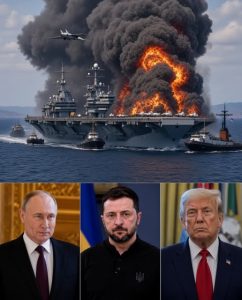
A dramatic military claim is circulating online, accompanied by striking images of a burning aircraft carrier and photographs of Russian President Vladimir Putin, Ukrainian President Volodymyr Zelenskyy and U.S. President Donald Trump. The headline suggests that a Russian Su-57 stealth fighter pilot has carried out a devastating strike against a major military vessel.
The story is designed to sound like an extraordinary breaking-news event. But there is an important distinction between a claim circulating online and an event that has been independently confirmed.
At present, there is no credible evidence confirming that a Russian Su-57 has destroyed a U.S. aircraft carrier. Versions of essentially the same story have circulated repeatedly in recent months, often changing details such as the number of troops or military vehicles supposedly aboard the vessel. Independent confirmation from major news organizations or official military authorities has not emerged. (starempire9)
That does not mean the Su-57 is fictional or that Russia has not used the aircraft in combat. It means that the specific carrier-destruction story should not be presented as established fact.
The Claim Spreads
The wording of the viral story is typical of sensational military content: a highly advanced aircraft, a powerful enemy vessel, an apparently devastating attack and the suggestion that the world may be on the edge of a much larger confrontation.
Some versions of the story claim the American carrier was transporting more than 700 tanks. Other versions have circulated with different numbers, including claims involving thousands of troops.
Those changing details are significant.
When a supposedly major military event occurs, basic facts generally become clearer as governments, military officials, journalists and independent analysts examine what happened. Instead, these online versions frequently repeat similar language while changing crucial details.
That pattern is one reason readers should be cautious.
A website specifically examining the viral claim found that there was no credible confirmation of a Su-57 attack on a U.S. carrier and noted that some of the material associated with the story appears to originate from social-media posts and simulated military footage. (starempire9)
Why the Story Sounds Plausible
The Su-57 is a real and sophisticated Russian fifth-generation fighter.
It was designed as a low-observable multirole aircraft capable of air-to-air and air-to-surface missions. Russia has promoted the aircraft as one of the most advanced components of its tactical aviation fleet.
The aircraft has also been associated with Russia’s war in Ukraine.
Reports have described Su-57s being used to launch long-range weapons against Ukrainian targets, including the Kh-69 cruise missile. Open-source reporting has documented the aircraft’s presence at Russian bases and its growing importance to Moscow’s military aviation ambitions. (Wikipedia)
That real combat history can make fictional or exaggerated stories about the aircraft sound convincing.
But attacking a U.S. aircraft carrier would be something on an entirely different scale.
A Carrier Attack Would Be Extraordinary
An American aircraft carrier is not an ordinary military target.
A modern carrier operates as the centerpiece of a larger carrier strike group containing multiple warships, aircraft and sophisticated defensive systems. It is designed to detect and respond to threats from the air, surface and underwater domains.
Consequently, a confirmed destruction of a U.S. carrier by a Russian fighter would represent an enormous geopolitical event.
It would almost certainly trigger immediate statements from governments and militaries around the world. Defense analysts would examine satellite imagery, maritime tracking information, photographs, video and other evidence.
Instead, the current viral claim remains largely confined to sensational websites and social-media-style reports.
That gap between the scale of the allegation and the quality of the evidence is one of the biggest reasons for skepticism.
The Images Can Be Misleading
The image accompanying the viral story shows an aircraft carrier engulfed in flames, with an aircraft appearing overhead.
At first glance, such imagery can look like genuine combat photography.
But realistic military imagery is now easy to create using computer-generated graphics, video-game engines, digital compositing and artificial intelligence.
In fact, previous versions of the same Su-57-versus-carrier narrative have been associated with military simulations rather than authentic combat footage. One widely circulated video explicitly describes itself as an Arma 3 simulation, meaning the dramatic scenes were created for entertainment rather than documenting a real battle. (YouTube)
That distinction matters enormously.
A dramatic explosion on screen is not automatically evidence that an explosion happened in the real world.
The Real Su-57 Story Is Still Significant
The fact that this particular carrier claim appears unsupported should not distract from the genuine developments surrounding the Su-57.
Russia continues to promote the aircraft internationally.
This week, Russia is displaying the export version of the aircraft, the Su-57E, at the El Alamein International Airshow in Egypt. Russian state defense company Rostec announced that the aircraft would be displayed alongside new weapons that had not previously been publicly demonstrated abroad. (Rostec)
The new weapons attracted considerable attention from aviation specialists.
The Aviationist reported that Russia unveiled several stealthy air-launched weapons at the Egyptian airshow, including members of the S-71 family. The systems are designed to blur the traditional distinction between inexpensive attack drones and cruise missiles. (The Aviationist)
That is a genuine military development and arguably a much more interesting story than an unsupported claim about a carrier being destroyed.
It demonstrates how Russia is attempting to market the Su-57 not simply as a fighter but as part of a broader weapons ecosystem.
Why These Stories Keep Appearing
Sensational military stories thrive online because they combine several ingredients that naturally attract attention.
There is fear.
There is national rivalry.
There are powerful weapons.
There are recognizable political leaders.
And there is the possibility of a dramatic escalation between nuclear-armed states.
A headline suggesting that a Russian stealth fighter has suddenly destroyed an American carrier contains all of those ingredients.
The problem is that emotional intensity can easily outrun factual evidence.
Readers may see thousands of shares and assume that a story must be true because so many people are discussing it. In reality, repetition can create the illusion of confirmation.
One website publishes the claim. Another copies it. Social-media accounts repeat it. Videos are uploaded with increasingly dramatic titles. Soon, the same allegation appears in dozens of places.
But ten copies of an unverified claim do not equal ten independent sources.
They may all trace back to the same original post.
The Broader Military Situation Is Real
The caution surrounding this particular story should not be mistaken for a claim that there is no serious military escalation in the world.
The Russia-Ukraine war remains active, with both sides continuing long-range attacks and counterattacks.
Recent reporting has documented renewed Russian missile and drone attacks against Ukraine, including major strikes on Kyiv. Reuters reported that a September 8 attack killed people and damaged numerous buildings and other infrastructure. (Reuters)
The conflict also continues to involve increasingly sophisticated drones, cruise missiles, electronic warfare and long-range weapons.
Ukraine has carried out attacks deep inside Russian territory, while Russia continues to use missiles and drones against Ukrainian targets.
Meanwhile, diplomatic efforts have continued.
U.S. envoys Jared Kushner and Steve Witkoff recently met with Russian officials in Moscow as part of renewed efforts to explore a possible settlement to the war. Those discussions produced no immediate breakthrough, and major disagreements remain. (Reuters)
Against that background, sensational reports about dramatic confrontations between Russia and the United States can easily gain traction.
What Would Confirm Such an Attack?
If a Russian aircraft really destroyed a U.S. aircraft carrier, the evidence would be difficult to conceal.
There would likely be satellite imagery.
There would be statements from the U.S. Department of Defense.
There would be reactions from Moscow.
International news organizations would send correspondents and analysts to investigate.
Commercial satellite companies would likely provide imagery.
Maritime tracking specialists would examine the ship’s movements.
Independent military analysts would compare photographs and videos.
None of those forms of confirmation has established the viral claim.
That does not prove that every detail of every circulating report is false, but it does mean there is currently no responsible basis for presenting the alleged carrier destruction as a confirmed event.
A Reminder in the Age of AI
The episode also illustrates a growing challenge for anyone following breaking news.
Military images can now be generated or altered with remarkable realism.
A photograph showing flames, aircraft and warships can appear convincing even when it has no connection to an actual event.
Video can be even more persuasive.
A realistic simulation can reproduce radar screens, missile launches, aircraft maneuvers and explosions so convincingly that viewers may assume they are watching authentic combat.
That is why context is increasingly important.
Before sharing an extraordinary military claim, readers should ask three simple questions:
Who reported it first?
Has an independent credible source confirmed it?
Is the accompanying footage actually verified?
If the answer to those questions is unclear, the safest description is that the event is alleged or unverified, not confirmed.
The Bottom Line
The idea of a Russian Su-57 suddenly destroying a U.S. aircraft carrier is undoubtedly dramatic. It is also precisely the kind of story that requires extraordinary evidence.
At the time of writing, credible reporting does not confirm that such an attack occurred.
What is confirmed is that the Su-57 is a real fifth-generation Russian fighter, that Russia has used the aircraft in connection with its war against Ukraine, and that Moscow is currently showcasing the export version of the aircraft and new weapons in Egypt. (Rostec)
The viral carrier story appears to belong to a different category: a sensational claim circulating online without reliable independent confirmation.
That distinction is more important than ever.
In an era when military simulations can look like documentary footage and a dramatic headline can travel around the world within minutes, the most responsible response to shocking breaking news is not to share it immediately.
It is to pause, check the evidence and separate what is known from what is merely claimed.
For now, the alleged Su-57 carrier strike belongs firmly in the second category.