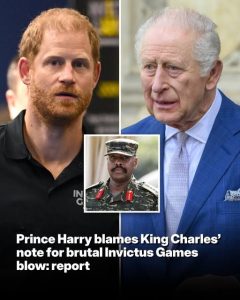
Prince Harry Blames King Charles’ Note for Brutal Invictus Games Blow Just Weeks After UK Return: Report
Prince Harry’s return to the United Kingdom was supposed to mark a new chapter for the Duke of Sussex and his family. After years living in California, Harry and Meghan Markle recently returned to Britain with their children, raising hopes that the move might eventually lead to warmer family relations and a renewed connection with Harry’s homeland.
Instead, their return has been followed by another extraordinary royal controversy.
Uganda has withdrawn from the 2027 Invictus Games, the international sporting event founded by Harry for wounded, injured and sick military personnel and veterans. The decision came only days after Buckingham Palace issued a letter clarifying that Harry and Meghan remain non-working royals and private citizens.
According to a source close to Harry, the Sussex camp believes the Palace communication was directly connected to Uganda’s decision. (Page Six)
The development has created an uncomfortable question: Did a letter intended simply to clarify Harry and Meghan’s status inadvertently contribute to a country abandoning an event created by Harry himself?
The Palace has not said that its letter caused Uganda’s withdrawal, and there is no independent confirmation proving a direct causal link. But the timing has made the controversy impossible to ignore.
The Letter That Changed the Conversation
King Charles recently took the unusual step of formally clarifying Harry and Meghan’s status following their return to the UK.
The letter, issued through the Lord Chamberlain, was distributed to senior government, military and regional officials. It made clear that Harry and Meghan had not resumed royal duties and would continue to operate as non-working members of the Royal Family.
It also emphasized that their charitable activities are undertaken in a private capacity and that they are regarded as private citizens with commercial and charitable interests. (Reuters)
The Palace said the communication was intended to prevent confusion among officials now that the Sussexes were spending more time in Britain.
From the Palace perspective, the message was essentially administrative.
But the timing was extraordinary.
Harry and Meghan had only recently returned to the UK after roughly six years away. Their arrival had generated intense speculation about whether their return could eventually improve relations with the Royal Family.
Instead, the letter appeared to draw a firm line under any suggestion that their move represented a return to official royal life.
Then Came Uganda’s Shock Announcement
Only shortly afterward, Uganda announced that it would no longer participate in the 2027 Invictus Games.
General Muhoozi Kainerugaba, Uganda’s chief of defence forces, announced the decision publicly and made his reasoning unusually explicit.
He said Uganda did not want its participation to be interpreted as opposition to King Charles, whom he described as deeply revered.
The general also stated that Uganda would not participate in activities that lacked the monarch’s approval. (ITVX)
The timing immediately raised eyebrows.
Uganda had only recently joined the Invictus community and had been publicly welcomed by Harry during a ceremony in London in July. Harry had personally participated in the welcome for Ugandan representatives.
Just weeks later, the country was gone.
That reversal naturally led observers to connect the decision with the Palace’s newly released guidance.
Harry’s Camp Pushes Back
A source close to Harry reportedly described the situation as an unintended consequence of the Lord Chamberlain’s guidance.
The source argued that the letter had been released quickly and without adequate consultation and suggested that the only people ultimately harmed by the dispute would be the athletes themselves. (Page Six)
That is an important distinction.
The claim is not that King Charles deliberately tried to damage the Invictus Games.
Rather, Harry’s side appears to believe that the Palace’s decision to publicly clarify the Sussexes’ status created uncertainty inside Uganda’s military establishment.
That uncertainty may then have contributed to the withdrawal.
Whether that interpretation is correct remains disputed.
The Palace Does Not Appear to Oppose Invictus
There is another important part of the story that can easily become lost amid the headlines.
There is no suggestion that King Charles personally opposes the Invictus Games.
In fact, Charles attended the inaugural Invictus Games in London in 2014, when Harry launched the initiative. The event has become one of Harry’s most significant philanthropic achievements.
A senior royal source has indicated that the King supports organizations working to assist wounded service personnel. (ITVX)
That means the controversy is less about whether Charles supports veterans and more about whether Harry’s current status as a private citizen affects how foreign governments and military organizations interact with his projects.
That distinction could become increasingly important.
Why Harry’s Royal Status Matters
The Invictus Games have always occupied an unusual position.
They were founded by a member of the British Royal Family, but Harry stepped away from official royal duties in 2020.
Since then, the event has continued as an international organization rather than a formal arm of the British monarchy.
That creates a complicated situation.
Harry remains a prince and the Duke of Sussex. He remains internationally famous and closely associated with the British Royal Family.
But he no longer represents the monarch in an official working capacity.
For most participants, that distinction may not matter.
For a military organization closely connected to a foreign government, however, it potentially can.
Uganda’s decision demonstrates how seriously some officials may take the difference between supporting Harry personally and being perceived as acting with the approval of King Charles.
The General’s Comments Made Things Even More Dramatic
General Kainerugaba did not merely announce Uganda’s withdrawal.
He went further in comments reported by British media, saying there were factions within Uganda’s Ministry of Defence that supported what he referred to as “Harry-Meghan nonsense” and that he needed to quash that support.
He also emphasized his loyalty to the monarch. (Page Six)
Those remarks transformed what might otherwise have been a routine withdrawal into a major international story.
They appeared to confirm that Harry and Meghan’s relationship with the monarchy was at least part of the political calculation behind Uganda’s decision.
But Uganda has not publicly established that the Palace ordered it to withdraw.
That point is crucial.
The available evidence shows a striking sequence of events, but correlation is not the same as proof of causation.
A Blow to the Invictus Movement
Regardless of the reason, Uganda’s withdrawal is an unwelcome development for Invictus.
The organization was founded around a simple idea: giving wounded and injured military personnel a chance to recover through sport, camaraderie and international competition.
For Harry, Invictus has become perhaps his most enduring public project since leaving royal duties.
The Games have expanded across multiple countries and attracted competitors from around the world.
The 2027 Games are scheduled to take place in Birmingham, bringing the event back to Harry’s home country.
Uganda’s withdrawal does not threaten the existence of the Games.
But it does demonstrate the challenges that can emerge when a charity or sporting organization remains closely associated with a globally controversial figure.
Harry’s Return to Britain Makes the Timing Even More Sensitive
The controversy is particularly awkward because Harry and Meghan have only recently returned to Britain.
Their move was widely interpreted as significant.
After leaving the UK in 2020, relocating to California and building a life outside the official Royal Family, the couple’s decision to spend more time in Britain represented a dramatic change.
Harry has continued to maintain strong ties to the country, particularly through his military and charitable interests.
The return has also raised questions about Harry’s relationship with his father.
Reports indicate that Harry and Charles have communicated since the Sussexes returned, although the relationship remains complicated. (Page Six)
The Palace letter therefore arrived at a particularly sensitive moment.
Instead of allowing ambiguity about Harry’s status, the communication made the boundaries unmistakable.
A Family Dispute Becomes an International Issue
Perhaps the most striking part of this story is how quickly a family disagreement has spilled into international affairs.
Harry’s relationship with his father is intensely personal.
The monarchy’s rules regarding working royals are institutional.
The Invictus Games are humanitarian and sporting.
Uganda’s military is a sovereign national institution.
Yet all four elements have suddenly become intertwined.
That is what makes the controversy so unusual.
A letter about royal status has now become part of a debate about an international veterans’ organization.
And Harry, who created Invictus as a way to focus attention on wounded service members rather than royal politics, now finds the Games themselves caught in the middle of that politics.
What Happens Next?
The Invictus Games Foundation is reportedly seeking clarification regarding Uganda’s withdrawal.
ITV News reported that the organization had been told the Palace letter created confusion within Uganda’s defence establishment. (ITVX)
That leaves open the possibility that the situation could eventually be reconsidered.
Uganda may reverse its position.
Other countries may continue participating without concern.
Or the withdrawal could remain permanent.
The most important thing for the organizers will likely be preventing the dispute from overshadowing the athletes themselves.
After all, the competitors are the reason Invictus exists.
A Complicated Moment for Harry
For Prince Harry, the episode represents an especially frustrating turn of events.
He created Invictus as a platform for veterans.
He has spent years promoting the Games internationally.
Uganda had recently become part of that growing community.
And now, shortly after Harry returned to Britain, the country has withdrawn while explicitly citing its relationship with King Charles.
Harry’s reported frustration is therefore understandable.
But it is also worth remembering that the claim that Charles’ letter directly caused the withdrawal remains an allegation from sources close to Harry, rather than an independently established fact.
Ugandan officials have clearly cited loyalty to the King as their reason for leaving, but the precise influence of the Palace letter cannot yet be definitively measured. (ITVX)
The Bigger Question
Ultimately, this controversy is about something larger than Uganda.
It raises a fundamental question about Harry’s post-royal identity.
Can he operate major international initiatives while remaining completely separate from the institution he was born into?
The answer has always been complicated.
Harry may no longer be a working royal, but his identity is inseparable from the monarchy in the eyes of much of the world.
Invictus may be Harry’s creation, but the royal connection remains part of its history.
And Uganda’s sudden withdrawal illustrates just how difficult it can be to separate those two realities.
For now, the 2027 Invictus Games will go ahead in Birmingham, and the focus will eventually need to return to the wounded and injured veterans who participate.
But the latest controversy is a reminder that even years after stepping away from royal duties, Prince Harry’s relationship with the Crown can still have consequences far beyond his own family.
And with Harry and Meghan now back in Britain, the question of where their private lives end and the public consequences of their royal identities begin may become even harder to answer.