BREAKING? Viral Claim Says Russian Su-57 Destroyed U.S. Aircraft Carrier Carrying 700 Tanks — What the Evidence Actually Shows
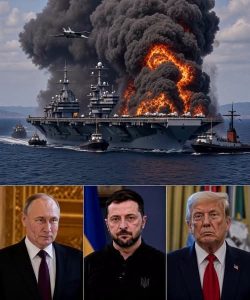
A dramatic image showing a burning aircraft carrier alongside photographs of Vladimir Putin, Volodymyr Zelenskyy, and Donald Trump is circulating with a sensational headline claiming that a Russian Su-57 pilot has destroyed a U.S. aircraft carrier carrying 700 tanks.
The claim is designed to look like an urgent breaking-news development, but available evidence does not establish that such an attack occurred. Searches for the exact headline lead primarily to sensational websites and social-media material, rather than confirmation from the U.S. Navy, Russian authorities, or major international news organizations. One website publishing the same claim explicitly labels the story fictional, while another says there is no credible evidence confirming the alleged attack. (hallofstars9)
That distinction is especially important because a direct Russian attack that destroyed a U.S. aircraft carrier would represent an extraordinarily serious military event.
The Viral Headline
The headline claims that a Russian Su-57 pilot “destroys” a U.S. aircraft carrier and adds the dramatic detail that the ship was carrying 700 tanks.
The wording immediately creates a picture of a massive military confrontation: a Russian fifth-generation fighter approaching an American carrier, a huge explosion at sea, hundreds of armored vehicles supposedly destroyed, and potentially hundreds or thousands of personnel affected.
But the available evidence does not support presenting that scenario as a confirmed event.
The exact headline has appeared repeatedly online, sometimes with phrases such as “13 minutes ago” or “30 minutes ago.” Similar versions have been published in July, August and September 2026. That repetition can make a claim appear independently confirmed when the different posts may simply be copying or republishing the same unverified story. (hallofstars9)
The Su-57 Is Real — But That Doesn’t Prove the Attack
One reason the story can appear convincing is that the aircraft mentioned in it is real.
The Russian Su-57 is a modern fighter aircraft associated with Russia’s advanced military aviation program. Its real-world existence and capabilities, however, do not provide evidence that a particular pilot carried out the attack described in the viral post.
This is an important distinction when evaluating military stories online.
A real aircraft can be placed into a fictional scenario. A genuine photograph can be paired with an unrelated claim. Computer-generated imagery and video-game footage can also look remarkably realistic.
In fact, at least one widely circulated video carrying essentially the same headline identifies itself as ARMA 3 gameplay and a virtual military simulation, rather than authentic combat footage. (YouTube)
That means viewers should be particularly careful when videos accompanying the claim appear to show explosions or aircraft-carrier attacks.
What About the “700 Tanks”?
Perhaps the most obvious warning sign is the claim that an aircraft carrier was carrying 700 tanks.
U.S. Navy aircraft carriers are designed primarily as floating aviation bases. The Navy describes its carriers as platforms built to operate aircraft and conduct naval air operations. For example, the USS Carl Vinson normally carries more than 60 aircraft, while approximately 3,000 sailors make up the ship’s company and roughly 2,000 more personnel comprise its air wing. (AirPAC)
The Navy’s general description of its aircraft carriers similarly emphasizes aviation, air operations, maritime security, sea control and power projection. (U.S. Navy)
Tanks, by contrast, are normally transported using military logistics vessels and specialized cargo ships rather than being stored aboard an aircraft carrier in anything approaching the numbers claimed by the viral story.
That does not mean an aircraft carrier cannot transport ground equipment under unusual circumstances. It means the specific “700 tanks aboard an aircraft carrier” description should immediately prompt questions about the source and context.
What Would a Real Attack Look Like in the News?
If a U.S. nuclear-powered aircraft carrier had actually been destroyed by a Russian fighter, the event would be far beyond an ordinary military incident.
The United States operates some of the largest and most important warships in the world. The Navy describes Nimitz- and Gerald R. Ford-class carriers as the centerpiece of American naval forces. Ford-class carriers are approximately 1,100 feet long and can carry dozens of aircraft. (Naval History and Heritage Command)
A confirmed loss of one would therefore generate immediate attention from governments, defense ministries, military officials, satellite analysts and major international news organizations.
There would also be questions about the identity of the ship, its location, the circumstances of the incident, casualties, rescue operations, damage assessments and the response of the United States and its allies.
At present, the viral material does not provide that level of evidence.
The Image Is Not Confirmation
The photograph accompanying the headline is another important part of the story.
It depicts an aircraft carrier surrounded by enormous flames and thick black smoke. The scene is visually dramatic, but a dramatic image does not establish when, where or whether an event occurred.
The image should therefore be treated as an illustration accompanying the claim rather than independent proof of the alleged attack.
This is particularly important in the current information environment, where digitally generated or manipulated images can be made to resemble news photographs.
The presence of recognizable world leaders underneath the carrier image also adds emotional weight to the post, but photographs of Putin, Zelenskyy and Trump do not establish that they were involved in or responding to the alleged incident.
Similar Stories Have Circulated Before
The exact wording of this claim has appeared repeatedly online.
A September 15 article using the “BREAKING 30 minutes ago” formulation describes the story as a fictional scenario and says there was no reliable confirmation that a U.S. carrier had actually been destroyed. (News Today)
Other versions have similarly warned that the claim lacks credible evidence. One report examining the story specifically notes that material associated with it includes ARMA 3 simulation footage. (hallofstars9)
That pattern is significant.
A genuine breaking-news story normally develops through multiple independent sources. A rumor, on the other hand, can appear on dozens of websites while still originating from one piece of fabricated or simulated content.
Therefore, counting the number of websites repeating a claim is not the same as counting independent confirmations.
Why Military Hoaxes Spread So Quickly
Military stories are particularly effective at attracting attention because they involve danger, national security and powerful weapons.
A headline mentioning Russia, the United States, a stealth fighter and an aircraft carrier naturally creates curiosity.
Adding phrases such as “30 minutes ago,” “destroyed,” or “700 tanks” makes the story feel even more urgent.
That urgency can cause people to share a post before asking basic questions.
Where did the information originate?
Which carrier was supposedly attacked?
Where did the incident happen?
Who confirmed it?
Is there satellite imagery?
Are there independent photographs?
Has the U.S. Navy issued a statement?
Has Russia acknowledged the incident?
Does the accompanying video come from a real news organization, military source or simply a gaming channel?
Those questions are much more useful than simply looking at how many people have shared the post.
The U.S. Carrier’s Real Capabilities
Understanding real aircraft carriers also helps put the claim into perspective.
The U.S. Navy describes its carriers as highly capable mobile airfields that operate with carrier strike groups. The ships are supported by aircraft, escorts, sensors, weapons systems and command-and-control capabilities. (U.S. Navy)
For example, the Navy’s published information on Nimitz-class carriers lists approximately 3,200 ship’s-company personnel and about 2,480 air-wing personnel, along with more than 60 aircraft depending on the carrier and deployment configuration. (AirPAC)
This also explains why a carrier cannot simply be viewed as an isolated ship.
A carrier normally operates as part of a broader force. Its protection involves other ships, aircraft, sensors and defensive systems.
That does not make carriers invulnerable. No military platform is invulnerable.
But it does mean that claims of a single fighter suddenly destroying one require substantial evidence.
What We Know Right Now
Based on the information currently available, several facts can be separated from the viral claim.
The Su-57 is real.
U.S. aircraft carriers are real and operate globally.
The two countries possess sophisticated military forces.
Military simulations using the same headline exist online. (YouTube)
But there is no credible confirmation found for the specific claim that a Russian Su-57 pilot destroyed a U.S. aircraft carrier carrying 700 tanks.
The “700 tanks” detail is also inconsistent with the normal function of an aircraft carrier, which is primarily an aviation platform.
Why Verification Matters
False military reports can have consequences beyond ordinary internet misinformation.
A fabricated report of a Russian attack on a U.S. carrier could create unnecessary fear and encourage people to believe that a major international conflict has already begun.
That is why the safest approach is to wait for credible confirmation before treating dramatic military claims as fact.
The most responsible conclusion at this point is therefore straightforward:
The viral story claiming that a Russian Su-57 pilot destroyed a U.S. aircraft carrier carrying 700 tanks has not been established as real.
The accompanying image and circulating videos should not be treated as proof, particularly because related video material has been identified as military simulation gameplay. (YouTube)
The story may continue appearing on social-media pages and websites using increasingly urgent language. But repetition does not turn an unverified claim into a confirmed event.
For readers, the lesson is simple: when a headline claims that a major military confrontation happened “30 minutes ago,” pause before sharing. Look for the ship’s name, location, official statements and independent reporting.
In this case, those pieces of evidence are missing.
The dramatic image may capture attention, but the available evidence does not confirm the alleged attack.