2 Hours Ago! In 2 Minutes, a U.S. International Airport Was Completely Destroyed!!! — What the Viral Image Really Shows
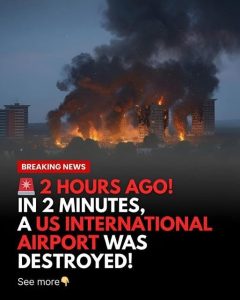
A dramatic image circulating online claims that a U.S. international airport was “completely destroyed” in just two minutes. The post uses urgent language — “2 HOURS AGO!” and “BREAKING NEWS” — and shows what appears to be a major urban area engulfed in flames and enormous clouds of black smoke.
The image is designed to look like footage from a catastrophic attack or disaster.
However, the available evidence does not establish that a U.S. international airport was destroyed in the event described by the post. In fact, searches for the exact wording lead to articles explaining that the underlying video is a fictional military-simulation scenario created with Arma 3, rather than footage of a real-world attack. (Vative Post)
That distinction is extremely important because the image and headline together can easily give viewers the impression that an actual airport has just been destroyed.
The Viral Claim
The headline reads:
“2 HOURS AGO! IN 2 MINUTES, A US INTERNATIONAL AIRPORT WAS DESTROYED!”
There is no airport name in the headline.
That is one of the first warning signs.
A genuine breaking-news report involving the destruction of a major U.S. airport would normally identify the airport, city, circumstances and authorities responding to the incident.
Instead, the viral post relies almost entirely on urgency and dramatic imagery.
The wording “2 hours ago” is also designed to make the viewer feel that they are receiving information before everyone else.
That kind of presentation can encourage people to share immediately rather than verify the information first.
The Image Looks Real — But That Doesn’t Make It Real
The photograph shows an enormous fire spreading through what appears to be a dense urban environment.
Several tall buildings are visible behind the flames, while a massive column of dark smoke rises into the sky.
At first glance, it could easily be mistaken for footage of a real attack.
But visual realism is not the same thing as documentary evidence.
Modern video games and military simulations can produce highly detailed environments, explosions, smoke effects, aircraft, vehicles and urban destruction. Arma 3, in particular, is known for allowing creators to construct elaborate military scenarios that can look surprisingly similar to real battlefield footage.
The websites carrying this particular claim acknowledge that the underlying material is a fictional simulation. One report describes it as an invented large-scale conflict created inside Arma 3 and specifically states that it does not represent actual events. (mstusanews.com)
The Arma 3 Connection
Arma 3 is a military simulation platform that allows users to create complex combat scenarios.
Creators can place soldiers, armored vehicles, aircraft and other military equipment into large environments and then produce cinematic sequences that resemble professional military footage.
That capability is relevant here because the video associated with the viral claim reportedly depicts a fictional conflict rather than an actual attack on a U.S. airport. (Vative Post)
The distinction can become blurred when clips are removed from their original context.
A viewer may encounter only a short sequence showing explosions and buildings burning. If the original title and disclaimer have been removed, the viewer may have no obvious indication that the footage comes from a game.
A social-media page can then add its own headline claiming that the footage shows a real attack.
Within minutes, the fictional scenario can begin circulating as supposed breaking news.
Why the “Two Minutes” Detail Matters
The claim that the airport was destroyed “in 2 minutes” adds another dramatic element.
It suggests an incredibly rapid and overwhelming attack.
But the post doesn’t explain what caused the destruction.
Was it an aircraft?
A missile?
A bomb?
A fire?
An industrial accident?
A natural disaster?
The absence of those basic details makes the headline impossible to evaluate on its own.
A legitimate emergency involving an international airport would normally produce information from airport authorities, local emergency services, police, fire departments, the Federal Aviation Administration or other government agencies.
None of those details appears in the viral headline.
What Real Airport Emergencies Look Like
Major airports are among the most closely monitored pieces of infrastructure in the United States.
They handle thousands of passengers, aircraft movements, employees and large quantities of equipment every day.
An event capable of completely destroying one would therefore have consequences far beyond the airport itself.
Flights would be diverted or canceled.
Emergency services would respond.
Local authorities would issue warnings.
Airlines would communicate with passengers.
The FAA and other agencies could become involved depending on the circumstances.
Major news organizations would also report the event independently.
For that reason, a claim of a completely destroyed U.S. international airport cannot reasonably be confirmed simply by looking at one dramatic image.
A Real Airport Disaster Can Still Look Different
There have, of course, been genuine aviation disasters and major airport emergencies.
For example, an Amazon Air cargo aircraft recently overran a runway at Miami International Airport, striking a vehicle and causing deaths and injuries. The National Transportation Safety Board has been investigating the crash and released information from the cockpit voice recorder concerning the final moments before the aircraft left the runway. (ABC News)
That real event demonstrates an important point.
Real disasters generate a trail of evidence.
Investigators release information.
Officials make statements.
Photographs from multiple locations emerge.
Witnesses are interviewed.
Emergency agencies become involved.
Airlines issue operational notices.
The information develops over time.
A viral post containing one dramatic image and an urgent headline is fundamentally different.
Why These Posts Use “Breaking News”
The words “BREAKING NEWS” have enormous psychological power.
They tell readers that something is happening right now and that they need to pay attention immediately.
The phrase “2 HOURS AGO” intensifies that feeling.
But the age of a social-media post does not prove the age of the event being shown.
A video created months or years earlier can be uploaded today.
A fictional video can be presented as real.
An old photograph can be given a new caption.
A computer-generated image can be described as eyewitness photography.
This is why the timestamp of the post itself should never be treated as confirmation of an event.
The Role of Military Simulations
Military simulations have become increasingly sophisticated.
Platforms such as Arma 3 allow users to reproduce modern battlefields with remarkable detail.
Aircraft can fly over cities.
Armored vehicles can move through streets.
Explosions can destroy buildings.
Smoke can fill the sky.
Large groups of soldiers can participate in coordinated scenarios.
When filmed from cinematic camera angles, the resulting material can resemble professional military footage.
The September 2026 reports associated with this specific headline describe exactly that kind of fictional scenario. One source explains that the video depicts an invented conflict and emphasizes that the scenario is not a representation of real-world events. (Vative Post)
Another report describes the material as an imaginative modern conflict involving tanks, helicopters, fighter aircraft and special-operations forces. (mstusanews.com)
Why the Distinction Is Important
This isn’t simply a question of whether a video is entertaining.
When fictional military footage is presented as real, it can create genuine confusion.
People may believe that a war has started when it has not.
They may believe that a city has been attacked.
They may believe that thousands of people are in danger.
They may share the information with relatives and friends.
The misinformation can then spread faster than the correction.
That is why identifying the source of dramatic footage is essential.
How to Check a Claim Like This
Before sharing a headline claiming that an American airport has been destroyed, look for several basic pieces of information.
First, identify the airport.
What is its name?
Where is it located?
Second, look for official confirmation.
Has the airport itself issued a statement?
Have local authorities confirmed an emergency?
Third, check major news organizations.
Is the same event being reported independently by multiple reputable outlets?
Fourth, examine the original video.
Does it contain a disclaimer?
Does it mention Arma 3, simulation, gameplay or fictional content?
Fifth, look for context.
Was the footage actually recorded at the location claimed by the post?
These simple steps can prevent many false stories from spreading.
The Bigger Problem With Viral Disaster Images
The internet rewards dramatic content.
A quiet airport operating normally is not particularly likely to become viral.
An airport surrounded by fire and smoke is different.
It immediately captures attention.
That is why sensational pages frequently combine frightening images with phrases such as “BREAKING,” “JUST NOW,” “2 HOURS AGO,” and “SEE MORE.”
The objective is often to make the reader click before thinking.
The headline in this case follows exactly that formula.
It does not identify the airport.
It does not identify the cause.
It does not name officials.
Instead, it presents a dramatic conclusion and leaves readers to fill in the missing details themselves.
What the Evidence Supports
Based on the available reporting, the viral claim should not be treated as confirmation that a U.S. international airport was destroyed.
The exact headline has been published by websites that describe the associated footage as a fictional Arma 3 military simulation. (Vative Post)
The photograph itself therefore should not be used as evidence that an actual U.S. airport was attacked.
This does not mean that real airport emergencies never happen. They do, and recent aviation incidents demonstrate how quickly authorities and investigators can provide verifiable information when something serious occurs. (ABC News)
Rather, it means that this particular viral claim requires evidence that the post does not provide.
Final Takeaway
The image is frightening, the headline is urgent, and the presentation strongly resembles breaking news.
But the evidence points in another direction.
The material associated with the claim comes from a fictional military-simulation scenario rather than confirmed footage of a U.S. international airport being destroyed.
There is currently no reliable evidence establishing the dramatic statement that “a U.S. international airport was completely destroyed in two minutes.”
So before sharing the image, remember one simple rule:
A realistic picture is not automatically a real event.
Check the location, identify the original source, look for official statements and compare the claim with independent reporting.
In an era when military simulations can look remarkably authentic, that few minutes of verification can make the difference between spreading genuine breaking news and spreading a fictional scenario as fact.