Straight, Happily Married Man Loves to Wear Heels and Skirts — And Says Style Has No Gender
For generations, fashion has been divided into neat categories: suits and trousers for men, dresses and skirts for women, and certain shoes considered appropriate depending on who is wearing them. But those boundaries have become increasingly flexible, and people are discovering that clothing can be a form of personal expression rather than a strict set of rules.
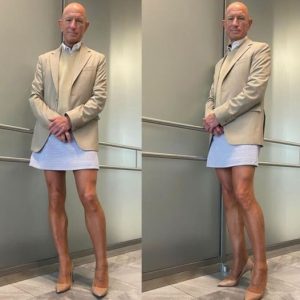
One striking example is the man pictured above, whose polished appearance combines traditionally masculine tailoring with a short skirt and high heels. The look is deliberate, confident and carefully styled, demonstrating how fashion can challenge assumptions without necessarily changing anything about a person’s identity.
For a straight man who is happily married, wearing skirts and heels can simply be something he enjoys.
Clothing Doesn’t Determine Who Someone Is
One of the most persistent assumptions surrounding men’s fashion is that a man who enjoys traditionally feminine clothing must have a particular sexual orientation or gender identity.
In reality, clothing cannot tell us someone’s sexuality.
A man can wear a skirt and still identify as straight. He can wear heels without wanting to be a woman. He can enjoy makeup, jewelry or traditionally feminine silhouettes while remaining completely comfortable with his identity.
The same principle applies in the opposite direction. A person’s clothing choices don’t automatically tell the world everything about their personality, relationships or private life.
Fashion is visual, but identity is much more complicated.
That distinction is particularly important when looking at photographs such as this one. The outfit immediately attracts attention because it combines a sharply tailored beige blazer with a short, light-colored skirt and pointed high heels. The result is unconventional, but it is also coordinated and sophisticated.
Rather than looking accidental, the styling appears intentional from head to toe.
Confidence Is Part of the Look
Perhaps the most noticeable feature of the photograph isn’t the skirt or the heels. It is the confidence of the person wearing them.
He stands upright, with his hands folded in front of him, presenting the outfit in a composed manner. There is no suggestion that he is attempting to hide what he is wearing. Instead, the outfit appears to be worn openly and confidently.
That attitude can make an enormous difference.
Clothing that might initially seem unusual becomes much less surprising when the wearer behaves as though it is completely normal. Confidence has always been an important part of fashion, whether someone is wearing a traditional suit, an extravagant evening gown or an experimental combination of garments.
The message is simple: if you feel comfortable in what you are wearing, that comfort often becomes part of the overall appearance.
Why Do Some Men Enjoy Wearing Heels?
High heels have a surprisingly complicated history.
Although heels are now strongly associated with women’s fashion in many parts of the world, they were not originally designed exclusively for women. Men in various historical periods wore heeled footwear for practical, social and fashionable reasons.
Over time, Western fashion developed increasingly rigid distinctions between men’s and women’s clothing. Certain garments became culturally associated with one gender, while others were associated with the other.
Those conventions are not universal, however.
Today, some men are rediscovering heels simply because they like the way they look or feel. A well-designed pair of heels can change posture, alter the silhouette of an outfit and create a more formal or dramatic appearance.
For someone who enjoys fashion, that can be reason enough.
There doesn’t have to be a deeper explanation.
The Appeal of the Skirt
The skirt in the photograph creates an especially interesting contrast with the blazer.
The blazer is traditionally associated with men’s formalwear. It has structured shoulders, tailored lines and a classic silhouette. Pairing it with a skirt creates a hybrid look that borrows elements from different areas of fashion.
This kind of mixing is increasingly visible in contemporary style.
Fashion designers have spent years experimenting with gender-neutral and gender-fluid clothing. Runways and fashion magazines regularly feature garments that don’t fit neatly into traditional categories.
But people don’t have to work in fashion to participate in that change.
Someone can simply decide that they like a particular garment and wear it.
For a married man, the decision may have nothing to do with rejecting masculinity. It can instead be about expanding the range of clothing available to him.
Marriage and Personal Style Can Coexist
Another interesting part of the story is the idea that a man’s unconventional clothing choices do not have to conflict with a happy marriage.
Relationships are built around far more than clothing.
A married couple may have different tastes in music, food, hobbies, entertainment and fashion. One partner may love dressing formally while the other prefers casual clothes. One may enjoy experimenting with their appearance while the other rarely changes their style.
Those differences don’t automatically create a problem.
In a healthy relationship, personal expression can exist alongside commitment to another person. Clothing is one of many areas where individuals may want the freedom to make their own choices.
For some couples, a partner’s unusual fashion preferences may even become an ordinary part of daily life.
What outsiders see as surprising can eventually become completely normal to the people involved.
Breaking the Stereotype
Images like this can also challenge the stereotype that masculinity has only one appearance.
The man in the photograph retains several traditionally masculine elements in his styling. His blazer is tailored and structured, while his posture is formal and composed.
At the same time, the skirt and heels deliberately break from conventional men’s fashion.
That combination makes the photograph interesting because it refuses to fit neatly into a single category.
Modern fashion increasingly recognizes that masculinity doesn’t have to look exactly the same on every person. Some men prefer jeans and sneakers. Others prefer three-piece suits. Some enjoy colorful clothing, jewelry or elaborate hairstyles. Others are comfortable experimenting with skirts and heels.
None of those choices alone provides a complete definition of the person wearing them.
The Importance of Personal Freedom
At the heart of the discussion is a straightforward idea: adults generally want to feel comfortable expressing themselves.
For some people, that means following traditional fashion conventions. For others, it means ignoring them.
There is no single reason someone might choose an unconventional outfit.
They might enjoy the aesthetic. They might appreciate the craftsmanship of particular shoes. They might like the feeling of wearing a skirt. They might find traditional fashion restrictive. Or they might simply think the outfit looks good.
Sometimes the simplest explanation really is the correct one: they like it.
The photograph illustrates that point particularly well. The outfit is not presented as a joke or costume. It looks carefully selected, with complementary colors and a deliberately polished appearance.
The heels complete the silhouette, while the blazer adds structure and formality.
Changing Attitudes Toward Men’s Fashion
Society’s ideas about men’s clothing have changed dramatically throughout history.
Garments once considered unusual for men eventually became commonplace. Colors, fabrics, hairstyles and accessories have repeatedly moved between cultural categories.
Even trousers, which are now considered a standard part of men’s wardrobes, have a history tied to changing social conventions.
Fashion therefore isn’t fixed.
What seems unconventional in one generation can become ordinary in another.
The growing popularity of gender-neutral clothing reflects this broader evolution. Many retailers now market garments without emphasizing whether they are intended exclusively for men or women, while designers increasingly experiment with silhouettes that can be worn by anyone.
That doesn’t mean everyone will suddenly want to wear skirts or heels. Most people will continue choosing clothing based on personal taste.
But it does mean there may be less pressure to follow traditional rules simply because they have existed for a long time.
More Than a Photograph
A photograph like this can easily become a conversation starter because it immediately challenges expectations.
The image presents a man dressed in a way that many viewers might traditionally associate with women’s fashion. Yet the calm, formal presentation makes the outfit feel less like a provocation and more like a personal style choice.
That distinction matters.
Rather than asking what someone’s clothing “means,” it can sometimes be more useful to recognize that clothing can mean different things to different people.
For one person, a skirt might represent fashion experimentation. For another, it could be comfort. For someone else, it might simply be an item they enjoy wearing.
The same garment can carry completely different meanings depending on the individual.
Ultimately, the story isn’t necessarily about heels or skirts at all. It is about the freedom to decide how one wants to present oneself.
A straight, happily married man can enjoy traditionally feminine clothing without those facts being contradictory. His relationship status and sexual orientation don’t dictate every aspect of his wardrobe.
And perhaps that’s the most interesting lesson from the photograph: personal style doesn’t always need an explanation.
Sometimes a person simply finds an outfit that makes them feel confident, puts it on, looks in the mirror and decides they like what they see.
That can be enough.