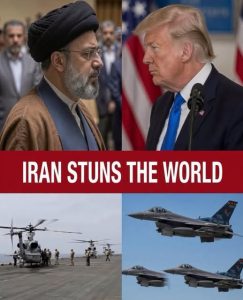
Just In: Iran Stuns the World and Announces Conditions for Renewed Talks With the United States
Iran has made a significant announcement as tensions with the United States continue to escalate across the Middle East.
According to statements from Iran’s senior security leadership reported on September 20, 2026, Tehran has communicated conditions to Washington for restarting negotiations aimed at ending the ongoing conflict. The message was reportedly transmitted through Qatar, which has been acting as a mediator between the two sides. (Al Jazeera)
The development is notable because it combines two seemingly different messages from Tehran: an openness to diplomacy and a warning that Iran is also preparing for continued military confrontation.
Iranian officials say they want an end to the fighting, but they have attached specific conditions to renewed negotiations.
Iran’s Three Publicly Identified Demands
Mohsen Rezaei, secretary of Iran’s Supreme National Security Council, told Al Jazeera that Tehran had sent Washington conditions for ending the war.
Of the seven conditions reportedly communicated to the United States, Iranian officials have publicly identified three major demands.
They are:
- An end to the war on all fronts.
- The release of frozen Iranian funds.
- An end to the U.S. naval blockade.
Rezaei said Qatar had delivered Iran’s conditions to Washington and that Tehran was waiting for a response from President Donald Trump. (Al Jazeera)
The seven-condition proposal has not been fully disclosed publicly, meaning that the three demands currently receiving attention may not represent the complete Iranian position.
That distinction is important.
Online headlines may describe the announcement as a complete peace proposal, but the available reporting indicates that only part of the seven conditions has been publicly revealed.
A Diplomatic Opening During a Dangerous Moment
The announcement comes at an especially tense point in the conflict.
The United States and Iran have continued exchanging threats, while fighting involving Iran-aligned groups has expanded the regional dimension of the crisis.
Reuters reported on September 20 that tensions had intensified, with Trump warning that Iran could face further economic pressure or attacks on its leadership, while Iranian military officials threatened retaliation against American forces and regional allies if Iran were attacked again. (Reuters)
At the same time, diplomatic channels have remained open.
Qatar and Pakistan have been involved in efforts to bring the United States and Iran back toward negotiations. Previous negotiations produced a memorandum of understanding, but that arrangement later expired after both sides accused each other of violations. (Gulf News)
The latest Iranian announcement therefore represents a continuation of diplomatic contacts rather than a confirmed peace agreement.
No final deal has been announced.
Iran’s Message Is More Complicated Than a Peace Announcement
Iran’s leadership has paired its diplomatic message with military warnings.
Rezaei said Tehran was prepared for what he described as a “decisive war” if Washington rejected Iran’s conditions. He also said Iranian military planning had shifted toward U.S. naval assets in the Gulf, Gulf of Oman and Arabian Sea. (Al Jazeera)
Those statements should not be interpreted as evidence that another major attack is definitely coming.
They represent the position expressed by an Iranian official.
The broader situation remains fluid, with military operations, diplomatic communications and economic pressure continuing simultaneously.
Al Jazeera described Tehran’s approach as a combination of diplomatic engagement and military preparation. (Al Jazeera)
The Strait of Hormuz Remains Central
One of the most important issues in the dispute is the Strait of Hormuz.
The narrow waterway is one of the world’s most strategically important energy routes, and developments there have consequences far beyond Iran and the United States.
Iranian officials have made reopening the waterway an issue connected to the wider conflict.
Rezaei said Iran had come close to announcing an agreement with Oman concerning the Strait of Hormuz before the proposal was shelved. He indicated that the agreement remained possible, although regional approval could be required before it is announced. (Gulf News)
Meanwhile, tensions around commercial shipping have continued.
The Associated Press reported that Iran claimed its Revolutionary Guard had struck the Togo-flagged oil tanker Trend in the Strait after alleging that it attempted unauthorized passage. The incident added to concerns about the security of international shipping in the area. (AP News)
What About Iran’s Nuclear Program?
Another major question concerns Iran’s nuclear policy.
Rezaei said Iran had not decided to withdraw from the Nuclear Non-Proliferation Treaty, despite Iranian arguments that recent attacks and international pressure could provide grounds for reconsidering its position. (Al Jazeera)
That means reports suggesting that Iran has already decided to leave the treaty would go beyond the available evidence.
Iran’s nuclear program has been one of the most sensitive issues in relations between Tehran and Western governments for years.
The latest statements suggest that Tehran is keeping its options open while maintaining that its nuclear doctrine has not changed.
At the same time, Rezaei warned that future U.S. pressure or international action could affect Iran’s calculations. (Al Jazeera)
Why the Announcement Matters
The announcement matters for several reasons.
First, it confirms that diplomatic communication between Iran and the United States has not completely disappeared despite the military confrontation.
Second, Iran has publicly put specific conditions on the table.
Third, Tehran is simultaneously signaling that it does not intend to negotiate from a position in which it believes it has surrendered its leverage.
That combination could make future negotiations complicated.
Washington would have to decide how to respond to Iran’s demands, while Tehran would have to determine whether it is prepared to modify its own position if negotiations resume.
Neither side has announced an agreement.
The Economic Consequences
The conflict has already had consequences beyond the battlefield.
Energy markets have been particularly sensitive to developments involving the Persian Gulf and Strait of Hormuz.
Al Jazeera reported that oil prices had moved above $100 per barrel amid the latest regional escalation. (Al Jazeera)
Any prolonged disruption to shipping through the region could therefore affect fuel prices, transportation costs and economies far outside the Middle East.
That is one reason governments around the world are watching the negotiations closely.
A diplomatic settlement could potentially reduce some of the pressure on energy markets, while further escalation could create additional uncertainty.
But the ultimate economic effect depends on developments that have not yet occurred.
Qatar’s Role
Qatar has become an important intermediary in the latest diplomatic effort.
Iran says Qatar transmitted its conditions to Washington.
Pakistan has also been involved in mediation efforts, with Pakistani officials continuing contacts with Tehran. (Gulf News)
The involvement of third-party governments is significant because direct communication between Washington and Tehran has been extremely difficult during the conflict.
Mediators can carry messages between the two sides without requiring an immediate direct negotiating relationship.
Whether those efforts produce formal talks remains uncertain.
A Major Announcement, But Not Yet a Peace Deal
The phrase “Iran stuns the world” makes for a dramatic headline, but the actual development is more precise.
Iran has not announced that the war is over.
It has not announced a final peace agreement with the United States.
Instead, Iranian officials say Tehran has communicated conditions for renewed negotiations and is waiting for a response from Washington. (Al Jazeera)
At the same time, Iranian officials are warning that their military is prepared for further confrontation if their conditions are rejected.
That makes the coming days potentially important for diplomacy, but it would be premature to describe the latest announcement as a completed breakthrough.
What Happens Next?
The next major development is likely to depend on Washington’s response.
If the United States responds positively to some or all of Iran’s conditions, mediators could attempt to restart formal negotiations.
If Washington rejects the proposal, the military and economic confrontation could continue.
Iran has made clear that it views the end of the conflict, release of frozen assets and termination of the naval blockade as key issues.
The United States, meanwhile, has its own demands and has continued to pressure Tehran.
For now, the two sides remain far apart on fundamental questions.
Yet the fact that messages are still being exchanged through Qatar and other intermediaries demonstrates that diplomacy has not completely disappeared.
The situation remains extremely fluid.
Iran is signaling readiness to negotiate while warning that it is also prepared for further conflict. The United States faces decisions about whether and how to respond. Qatar and Pakistan are attempting to keep diplomatic channels open, while the security of the Strait of Hormuz remains a central concern.
So, behind the dramatic headline is a more complicated reality: Iran has presented conditions for renewed talks, but no agreement has been reached.
The next response from Washington—and whether both sides can turn indirect communications into formal negotiations—will determine whether this latest announcement becomes the beginning of another diplomatic effort or simply another chapter in an increasingly dangerous confrontation. (Reuters)